/
Sensex jumps 1,718 to 81,028, Nifty tops 25,000 in seventh straight gain, but smallcaps fall as rally narrows
The Sensex rose 1,718 points to 81,028 on 6 November and the Nifty 494 to 25,030, a seventh straight gain, despite a rout on Wall Street. The rally has narrowed: the Midcap 100 ended flat and the Smallcap 100 fell over 0.8%. The Sensex has added about 7% in four sessions.
A
4 min
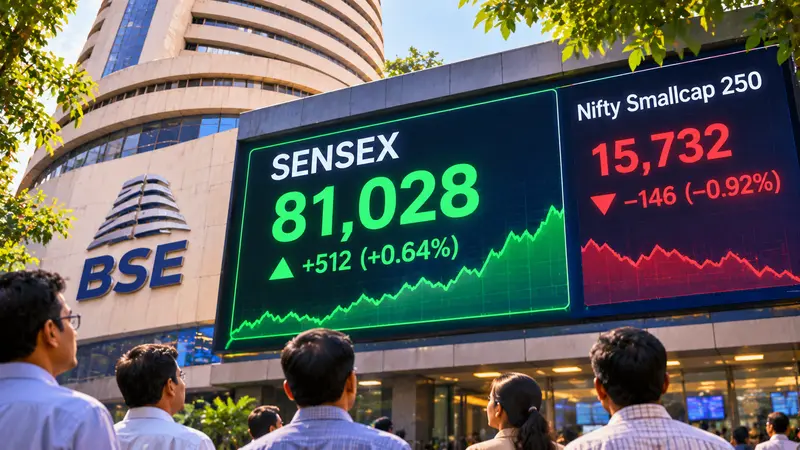
The Sensex jumped 1,718 points to close at 81,028 on Friday 6 November 2026, and the Nifty 50 climbed 494 points to settle at 25,030, a gain of about 2% for each and the seventh straight session of advances on the BSE and the National Stock Exchange. The official market report said the rise came despite weak global cues. It came one day after the Nasdaq Composite fell more than 5.5% in New York.
Below the headline indices the picture was very different. The NSE Midcap 100 ended almost flat with a negative bias, and the Smallcap 100 dropped over 0.8%. The market rose strongly, but only at the top.
The week in numbers
The scale of the run becomes clear when the sessions are placed side by side.
| Session | Sensex close | Points | Nifty close | Smallcap 100 |
|---|---|---|---|---|
| Tuesday 3 November | 76,917.85 | +1,225 | 23,810.85 | – |
| Wednesday 4 November | 77,301.40 | +384 | 23,960.60 | +2% |
| Thursday 5 November | 79,310 | +2,009 | 24,537 | almost +0.6% |
| Friday 6 November | 81,028 | +1,718 | 25,030 | over −0.8% |
The Sensex has added about 5,335 points in four sessions from Monday's close near 75,693, a rise of about 7%. The Nifty is up about 6.8% over the same period. These are unusually large moves for benchmark indices that hold India's biggest companies.
The last column is the one to look at. On Wednesday, smallcaps outpaced the Sensex. On Thursday, they lagged it. On Friday, they fell while the benchmark rose more than 2%. That sequence suggests money is concentrating in the largest shares and leaving smaller ones, which is often how a rally behaves late in a strong run. It may also simply reflect profit-taking in names that had already moved. The day's report does not say which.
Why it matters, and what is not known
The official report gives no explanation for the strength, and it does not list sectors or stock-level gainers and losers for Friday. Readers should be wary of confident accounts of the reason. Three facts can be set down.
First, the fall on Wall Street was concentrated in technology. The Nasdaq Composite fell more than 5.5%, the S&P 500 dropped 4.4% and the Dow Jones Industrial Average fell over 3.4%, on concerns that the Democratic victory in the midterm elections could bring tighter oversight of artificial intelligence and limits on data centre expansion. India's benchmarks have far less exposure to that theme than American ones, so the shock may not have carried across in the usual way.
Second, crude was far below its level earlier in the week. Brent traded near $96.71 a barrel on Thursday, after about $102 on Wednesday, even with a rebound. Cheaper oil is a direct support for a country that imports most of its crude.
Third, the rupee had gained for two sessions up to Thursday, closing at 94.47 to the dollar. Reserve Bank data released on Friday show foreign exchange reserves at $717.06 billion in the week ended 30 October, down $2.69 billion over the week, so the central bank's cushion remains large, though it slipped.
None of these proves a cause. The word "defying" in the official report is fair: a 2% rise on a day of weak global cues is unusual, and it deserves more caution than celebration.

The festival calendar may play a part too. Friday was Dhanteras, the start of the five-day Diwali period, when sentiment among domestic investors has often been firm. That is an observation about mood, not an official finding.
What to watch next
A seven-session run of this size invites a pause, and a down day would not by itself change the trend. Four things matter more.
The first is whether the rally widens or narrows further. If midcaps and smallcaps keep falling while the Nifty holds above 25,000, the move rests on a smaller number of shares and is more fragile.
The second is foreign flows. The exchanges publish provisional buying and selling by foreign portfolio investors after each session, and those figures will show whether overseas funds drove the week's gains or whether domestic money did.
The third is oil and West Asia. Iran says that it will not reopen the Strait of Hormuz until its demands are met, and hopes of easing there have helped this rally. A reversal would hit the same sectors that led it on Thursday.
The fourth is whether the American sell-off spreads. A one-day fall driven by technology can stay contained, but if it deepens it could reach Indian IT companies, which earn much of their revenue in the United States, and overall risk appetite. The US Federal Reserve held its target range at 3.75% to 4% on 28 October with two members wanting a rise, so there is little comfort from cheaper money there.
For a market that has moved this far this quickly, the sensible stance for a reader is to note the size of the move and not to assume it will continue.
This article is for information and is not investment advice.
Sources
About the Author
A
Amita Sahani
Staff Writer
Amita Sahani writes for Wirony. Every story under this byline is reviewed and approved by an editor before it is published, and corrections are made openly.
A
4 min
What did you think?