/
Cabinet approves Rs 2,814 crore for four lithium and nickel processing plants: how the subsidy works
The Union Cabinet on 4 November cleared a capital subsidy of 30%, capped at Rs 500 crore per lithium plant and Rs 900 crore per nickel plant, for two plants of each. India is largely import dependent for lithium and nickel. Bidders asking for the lowest support will win.
R
5 min
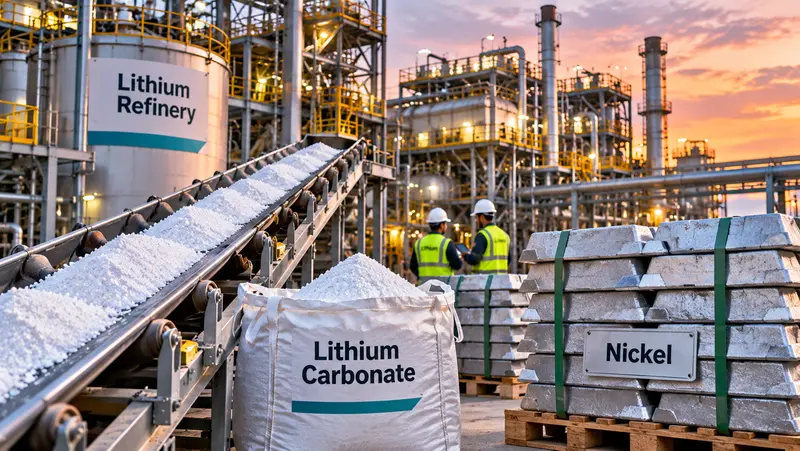
The Union Cabinet on 4 November 2026 approved a Capex Support Scheme to Promote Critical Mineral Processing with an outlay of Rs 2,814 crore, running from 2026-27 to 2030-31, the Press Information Bureau said. The scheme will pay a capital subsidy of 30% of eligible investment for four plants: two to process lithium, with a minimum capacity of 30 kilotonnes each, and two to process nickel, with a minimum capacity of 50 kilotonnes each.
The money is modest. The aim is not. The scheme targets the stage of the supply chain where India is weakest and where global control is most concentrated: turning ores and intermediate products into the high-purity compounds that go into batteries.
How the scheme works
The subsidy is capped at Rs 500 crore for each lithium beneficiary and Rs 900 crore for each nickel beneficiary. Together the four caps add up to Rs 2,800 crore, nearly the whole outlay. At a 30% rate, those caps correspond to eligible investment of about Rs 1,667 crore per lithium plant and Rs 3,000 crore per nickel plant, so the scheme can support at least about Rs 9,300 crore of plant spending at its limit, though actual projects may cost more or bid for less.
Selection has two stages. Applicants are first assessed for technical qualification, and only those who pass move to a financial bid. For each mineral, two beneficiaries are chosen on a least-cost basis, meaning the lowest capital support sought. The money is paid in three tranches linked to milestones. Cobalt is expected to be recovered as a by-product of nickel production.
The design has a clear logic. Reverse bidding means a company must offer to take less public money to win, and milestone payments mean the Treasury does not pay in advance for plants that are never finished.
Why it matters
The Cabinet's note is unusually direct about the risk. It says processing of critical minerals remains geographically concentrated in a few global locations, which exposes supply chains to geopolitical disruption, price volatility and potential supply restrictions, with implications for national security, economic sovereignty and decarbonisation targets. It adds that India remains substantially dependent on imports for refined intermediates and high-purity materials because domestic processing is at a nascent stage, and that commercial projects face high capital needs, limited technology and constrained access to raw materials.
The Ministry of Mines told the Lok Sabha in July that India is largely import dependent for lithium, cobalt, nickel and potash. A ministry presentation from January projects that by 2030 demand will grow about 6 to 8 times for lithium, 3 to 5 times for cobalt and 1.5 to 2 times for nickel, graphite and rare earths. These are the materials behind electric vehicles, grid batteries, electronics, defence and speciality steel, the sectors the scheme names.
The timing connects to another Cabinet decision the same day. The Rs 14,500 crore grid storage scheme asks battery projects to meet a 40% domestic content rule. Those batteries need lithium compounds. Processing capacity is a condition for meeting that kind of target with Indian material and not imported chemicals.
Where this fits in the larger plan
This is one piece of a broader effort. The National Critical Mineral Mission, approved in January 2025 with an outlay of Rs 34,300 crore over seven years, including about Rs 16,300 crore of central spending, covers exploration, overseas acquisition of assets, stockpiling, mineral processing parks and recycling. In September 2025 the Cabinet also approved a Rs 1,500 crore incentive scheme for recycling critical minerals from e-waste, battery scrap and end-of-life vehicles, targeting 270 kilotonnes of annual recycling capacity and 40 kilotonnes of mineral output. Budgets have added customs duty exemptions on lithium-ion battery scrap and cobalt waste, and in 2026-27 on capital goods for processing critical minerals.

The chain now has a recognisable shape: find or buy ore, recycle what can be recovered, process it at home, and create demand through storage and electric vehicle schemes. The processing link had been the missing one.
Three questions will decide whether the plants get built. The first is feedstock. A processing plant needs a steady supply of ore or intermediate material, and India's own lithium and nickel output is small. The note itself lists constrained access to raw materials among the obstacles. Bidders will have to show overseas supply arrangements, which brings back some of the geopolitical exposure the scheme is meant to reduce.
The second is technology. High-purity lithium and nickel compounds are hard to make at battery grade, and the note cites limited availability of suitable technologies. Partners with know-how may come from countries that are themselves competing for the same market.
The third is price. Mineral prices swing sharply, and a plant in India has to compete with established refiners at scale. A 30% subsidy lowers the capital cost, but it does not guarantee a margin once a plant is running.
Critics may say four plants in five years is a small step against a very large dependence. However, the scheme is better read as a first commercial test than a final answer. If the bids draw serious companies and the milestones are met, it will show that domestic refining can work, and it gives a template for other minerals. What to watch next are the guidelines, the technical criteria and the first bid round. This article is for information and is not investment advice.
Sources
About the Author
R
Reyaansh Agarawal
Staff Writer
Reyaansh Agarawal contributes to Wirony, covering stories that are carefully reviewed and approved by the editorial team before publication. Wirony is committed to maintaining tran…
R
5 min
What did you think?