/
DeepSeek reportedly plans 160,000 Huawei Ascend chips and V5 training on them; Arm slides on AI chip worries
DeepSeek plans at least 160,000 Huawei Ascend 950DT chips at a roughly 1 GW Inner Mongolia site and reportedly aims to start pre-training V5 on them from late 2026, say unconfirmed reports. Arm shares fell about 14% in two sessions to 2 November after Intel's weak outlook.
S
5 min
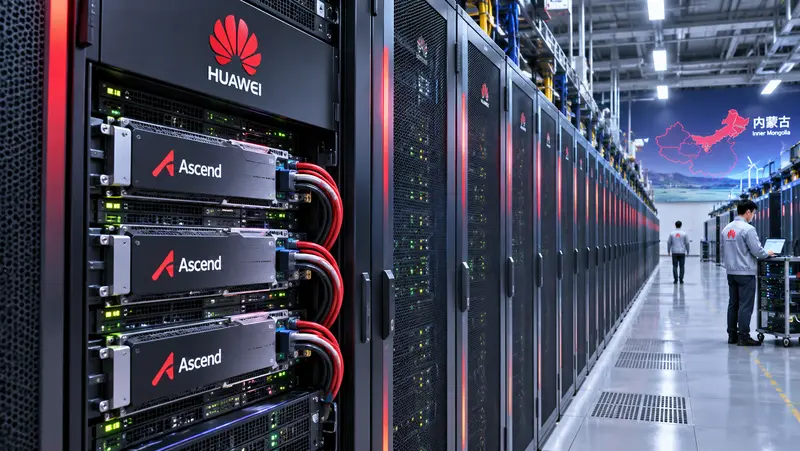
DeepSeek, the Chinese artificial intelligence lab, plans to deploy at least 160,000 Huawei Ascend 950DT accelerators at a data centre in Ulanqab, Inner Mongolia, and reportedly wants to begin pre-training its next model, V5, on the chips as early as the end of this year, according to reports. The plans have not been confirmed by DeepSeek, and the reports disagree about whether the chips are meant for training or for running models. Separately, shares of the British chip designer Arm have fallen about 14% in two sessions on worries about demand for AI chips, which shows how sensitive the sector is to every sign of change in the market.
What is reported
A report on 4 September said DeepSeek is building a data centre of roughly 1 gigawatt in Ulanqab, partly in its own infrastructure and partly leased from other operators, and wants at least part of the capacity operating by the end of 2027 or early 2028. That report said the chips would be used to run its models, which is known as inference, and that DeepSeek did not then plan to use them for training, even though Huawei designed and markets the chip for training. A later report, on 19 October, said DeepSeek plans to begin pre-training on the 950DT by the end of 2026, and that a full pre-training run may need more than 10,000 chips running for weeks. Most of the supply of Huawei's next chip, the Ascend 960DT, may go to DeepSeek from the first quarter of 2027, it said.
Ulanqab already hosts data centres for Alibaba, VNET Group and Kuaishou, and more than 90% of the area's computing capacity is reported to be devoted to AI. Huawei engineers have reportedly been embedded with DeepSeek's team to shape the chip around the lab's models, and Huawei is targeting a commercial release of the 950DT in the fourth quarter of 2026. DeepSeek's founder, Liang Wenfeng, reportedly told investors that four Ascend 950 chips are needed to match the capability of one Nvidia GB300, and that Huawei would start delivering training chips around the fourth quarter of 2026 or the first quarter of 2027.
The chip
Huawei's roadmap, announced in September 2025, has two Ascend 950 versions. The 950PR, aimed at the first stage of running models, was due in the first quarter of 2026, with 128 GB of memory at 1.6 TB/s, and a shipped card based on it was reported with 112 GB and 1.4 TB/s, below the roadmap. The 950DT, aimed at the decoding stage and at training, is due in the fourth quarter of 2026, with 144 GB of memory at 4.0 TB/s. The Ascend 960 is due in the fourth quarter of 2027 with 288 GB and roughly twice the compute. Huawei has claimed that the 950-generation card has 2.8 times the low-precision compute of Nvidia's H20, which is a vendor claim and not an independent benchmark, and one third-party estimate puts Nvidia's B300 at about seven times the raw compute of one Ascend 950.
DeepSeek has open-sourced software for the chips, including libraries it says reached more than 95% of the Ascend 950's peak performance in tests, and announced with Huawei a 'supernode' linking 128 Ascend 950 chips. Reports in February to April said Huawei chips were used for part of the training of its V4 model, which Huawei said, but DeepSeek reportedly struggled to train on earlier Ascend chips because of stability and performance problems.
Why it matters
The move follows US export controls on advanced AI chips bound for China. A December 2024 rule restricts exports of advanced high-bandwidth memory to China, so the Korean memory makers cannot sell it to Huawei, which is co-designing its own memory with its logic chips to keep supply in-house. Nvidia's chief executive Jensen Huang has said that its share of China's advanced AI market has fallen from about 95% to effectively zero. A large lab committing to Huawei's chips for volume would be a sign that the Chinese AI stack can run without Nvidia, at least for part of its work.
The risks are timing and supply. The plan relies on Huawei delivering the 950DT in the fourth quarter, which overlaps with the late-2026 start for V5 pre-training, so any slip in Huawei's production could delay the model. Analysts also note that reports say DeepSeek still relies on Nvidia for the largest frontier training runs.
Arm shares fell 9.97% on 30 October to about $205.97, after Intel forecast fourth-quarter revenue of $15 billion to $16 billion, below analysts' expectations, and set off a broad sell-off in chip stocks. They fell a further 4.46% on Monday to $196.79, which is about 14% down over two sessions. Arm is about to launch its first in-house chip, which it calls the AGI CPU, and has said that customer demand for it exceeded $2 billion across fiscal 2027 and 2028, while the manufacturing capacity it has secured would support a $1 billion opportunity over those years, a gap that investors are watching. One analysis links the month's weakness to higher interest rates raising doubts about the AI build-out, and to pressure on the cloud provider CoreWeave spreading to related stocks. Arm is reportedly due to report earnings this week.
S
5 min
What did you think?