/
Lost 1,900-year-old Roman arch traced near Split in more than 1,000 stone blocks
Archaeologists say over a thousand limestone blocks at Dicmo, near Split in Croatia, belong to a lost Roman triumphal arch from the reign of Trajan. Many had been reused in houses and walls, and a retired architect spent nearly 50 years collecting worked stones.
P
4 min
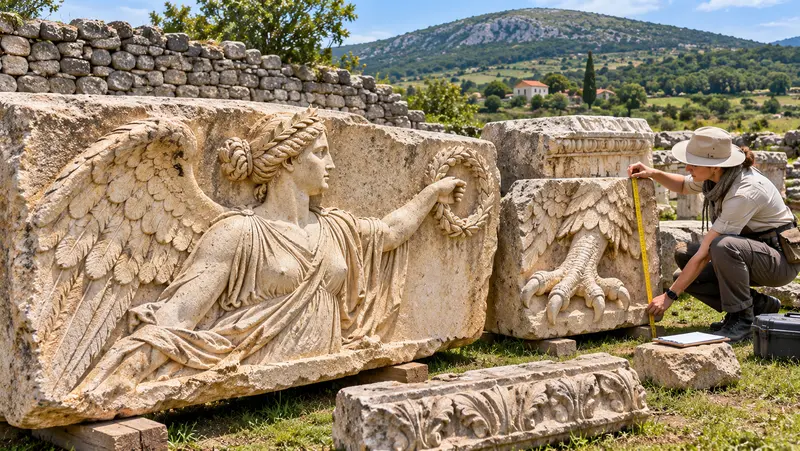
Archaeologists in Croatia say they have identified the remains of a monumental Roman triumphal arch at Dicmo, a place near the Adriatic city of Split. More than a thousand worked limestone blocks have been documented, and the researchers date the monument to the reign of the emperor Trajan, almost 1,900 years ago. The identification was reported on 28 November 2026.
The blocks were not buried in one neat heap. Many lay scattered across private land or had been built into houses, barns and boundary walls over the centuries. Božo Kokan, a retired architect from Dicmo, spent nearly 50 years collecting carved stones found on his family's property, keeping together pieces that might otherwise have been broken up or lost.
In 2024 a study by Nikola Cesarik, Dražen Maršić and Kokan examined more than a thousand fragments and proposed that they belonged to a lost Roman monument. A team led by Maršić, an archaeologist at the University of Zadar, has continued the work, and excavations during 2026 brought further sculpted pieces to light.
Why an arch and not a temple
| Clue | What it suggests |
|---|---|
| Curved architectural elements | The span of an archway |
| Reliefs of Victoria | A monument celebrating victory |
| Eagle wing and talon | Imperial and military symbolism |
| Eros figures and decorated pilasters | Rich ornamental design |
| Large inscription fragments | A public dedication |
Taken together, the curved elements, the sculpture and the inscription led the team to conclude that the structure was a triumphal arch. The original position of many pieces has still to be worked out.
The decisive clue is in the lettering. Surviving fragments carry imperial titles, among them Germanicus, which formed part of Trajan's official style. Trajan ruled from AD 98 to 117, a period in which the empire reached its greatest extent.
Inscriptions are valuable to archaeologists because Roman emperors collected titles in a known order. A single word can narrow a date to one reign, and combinations of titles can sometimes narrow it further to a few years. Here the evidence points to Trajan, although fragments leave room for refinement.
Ancient Dicmo, known as Decimin, stood where routes met between Salona, the capital of the Roman province of Dalmatia, and the settlement of Aequum inland. An arch at such a point would have been seen by officials, soldiers and traders travelling between the coast and the interior.
About 100 metres away is another Roman building, with finds that include pottery, roof tiles and a coin of the emperor Diocletian. They indicate activity in the late third or early fourth century, long after Trajan, and show that the area stayed in use.
What remains unknown
| Question | Status |
|---|---|
| Who built it and exactly when | Reign of Trajan proposed |
| Why it stood at this spot | Unresolved |
| What it looked like complete | Under study |
| Whether it marked a campaign | Not established |
One possibility raised is a connection with Trajan's wars against the Dacians, north of the Danube. The evidence is not strong enough to establish it. Arches in the Roman world honoured military success, but also emperors, public works, boundaries and the generosity of local communities, so a victory carving on its own does not identify a particular war.
Reassembling an arch from reused blocks is a puzzle with missing pieces. Researchers record each stone's shape, decoration, tool marks and fittings, then test which faces could have joined. Three-dimensional scanning allows fragments to be matched digitally without moving heavy blocks repeatedly. Even a partial reconstruction can reveal the height and width of the opening and where the inscription sat.
What a triumphal arch was for
Roman arches were free-standing gateways, usually built over a road, with one or three openings and a top storey that carried an inscription and often statues. The text named the person honoured and the body that paid for the work. Carvings repeated a familiar language: winged Victory, eagles, captured arms and young Eros figures holding garlands. Travellers did not need to read Latin to understand that power and success were being celebrated.
Because they stood beside busy routes, arches were exposed to later builders looking for ready-cut stone. Once a monument began to fall, its blocks were valuable: squared, strong and free for the taking. Reuse of this kind destroys the structure but can protect individual carvings, which survive inside walls until someone recognises them.
Standing Roman arches survive in only some places, and each newly identified one adds to the picture of how the empire advertised its power far from Rome. This case also shows the value of local knowledge: a resident's decades of care preserved evidence that specialists could later study. Further excavation and analysis may explain why the arch was raised at this crossroads. Croatia's Ministry of Culture and Media is the national authority for cultural heritage.
About the Author
P
Prateek Rawat
Staff Writer
Prateek Rawat is a contributor to Wirony. All articles published under this byline undergo editorial review and approval before publication, with any necessary corrections handled…
P
4 min
What did you think?