/
Canada's top court largely upholds Quebec's ban on religious symbols at work
The Supreme Court of Canada on 27 November largely upheld Quebec's Bill 21, leaving in place its ban on some public workers wearing hijabs, turbans or kippahs. The court struck down the law's face-covering ban for members of the National Assembly.
S
4 min
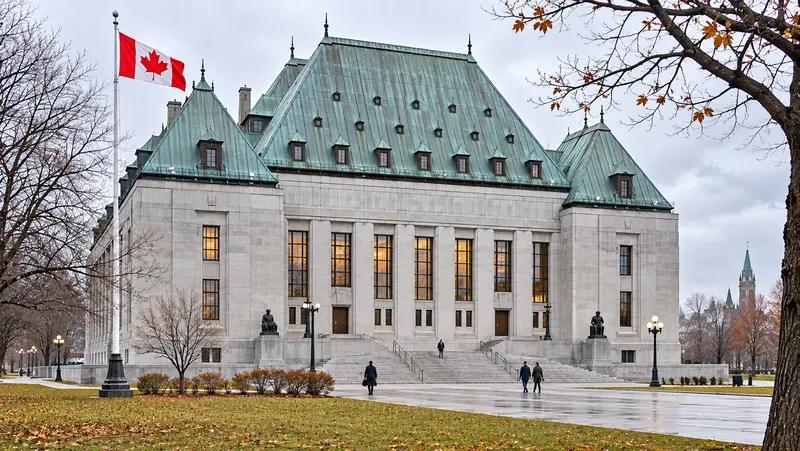
The Supreme Court of Canada on Friday, 27 November 2026, largely upheld Quebec's secularism law, known as Bill 21, which bars certain public workers from wearing religious symbols such as hijabs, turbans and kippahs while on the job. The ban stays in force. The court did, however, strike down one part of the law, which required members of Quebec's National Assembly to have their faces uncovered.
Passed in June 2019, the Act respecting the laicity of the State applies to people in specified public roles, including teachers and police officers. Teachers already in their posts on 27 March 2019 were allowed to keep wearing symbols so long as they stayed in the same job with the same employer. Quebec invoked the notwithstanding clause when it passed the law, shielding it from challenges under several rights in the Canadian Charter of Rights and Freedoms, and renewed that protection in 2024.
How the court divided
Seven justices heard the case over four days in March, with a record 51 intervening parties, six provincial attorneys general among them. The decision runs to more than 500 pages and splits in different ways on different questions, so there is no single vote count for the ruling.
| Question | Outcome |
|---|---|
| Ban on religious symbols | Remains in force |
| Pre-emptive use of the notwithstanding clause | Valid |
| Quebec's power to pass the law | Upheld unanimously |
| Face-covering ban for National Assembly members | Struck down unanimously |
| English-language school boards and minority language rights | No infringement, 5-2 |
| Gender equality clause, section 28 | Interpretive only, 4-3 |
| Power to declare a law inconsistent despite the override | Exists, 4-3 |
Section 33 of the Charter, the notwithstanding clause, lets a legislature declare that a law operates despite certain rights, including freedom of religion and equality. Such a declaration lasts up to five years and can be renewed. Challengers argued that a government should have to justify using it, or should not be able to invoke it before any court had ruled. The reasons written by Chief Justice Richard Wagner rejected that: the validity of an override declaration does not depend on a pressing objective or a prior judicial decision, and "It is not open to the courts to place additional limits."
The override cannot touch every right. Section 3, which protects the right to vote and to stand for and sit in the legislature, lies outside its reach. All the justices found that requiring elected members to uncover their faces was an unjustified infringement of that right to play a meaningful role in the democratic process. The Quebec Superior Court and Court of Appeal had reached the same conclusion on this point.
Schools, equality and declarations
The trial court had held that the law could not apply to English-language school boards because of minority language education rights under section 23. The Court of Appeal removed that exception, and the Supreme Court agreed by five to two that those rights are not infringed.
On section 28, which guarantees Charter rights equally to men and women, a majority held that it guides interpretation. Justices Martin, Karakatsanis and O'Bonsawin would have treated it as a source of rights in its own right. A four-to-three majority also held that courts may declare a law inconsistent with rights even when the override is in place, although only three justices would have made such a declaration about Bill 21, so none was issued.
Muslim women are the group most affected. Justices Karakatsanis and O'Bonsawin, dissenting in part, wrote that the burdens "fall most heavily on Muslim women." Some women have removed their headscarves at work to keep their jobs. The law's wording also covers turbans worn by Sikh men and kippahs worn by Jewish men in the listed roles. Quebec has since extended similar restrictions to school support staff and volunteers through Bill 94 and to daycare staff through Bill 9, again using the override.
Reactions
Quebec Premier Paul St-Pierre Plamondon welcomed the ruling as a win for the province's distinct model of secularism, while saying it should also be read as a setback for the notwithstanding clause. Prime Minister Mark Carney said colleagues were studying it carefully, and federal Justice Minister Sean Fraser said the government was reviewing the decision, its intervention having focused on the override. Alberta Premier Danielle Smith called it "a win for provincial rights". Manitoba Premier Wab Kinew called it a bittersweet day.
The National Council of Canadian Muslims called it "a dark day in our constitutional democracy". The Canadian Civil Liberties Association described the law's effect as discrimination and said that was why it took on the case.
The ruling confirms that provinces may use the override in advance, without first losing in court, which affects how other governments may legislate. The separate finding that courts can still say whether a protected law is inconsistent with rights leaves a route for judicial comment, even where the law continues to operate. Because override declarations expire after five years unless renewed, the debate returns to legislatures and voters at regular intervals. The full reasons are published by the Supreme Court of Canada.
About the Author
S
Subhash Gupta
Desk Editor
Subhash Gupta is a writer at Wirony, contributing articles that are reviewed and verified by the editorial team before publication. The publication prioritises accuracy, editorial…
S
4 min
What did you think?