/
Dense fog advisories issued; Howrah–Delhi trains run up to 14 hours late
Dense fog triggered advisories in parts of Canada and the US on Monday, cutting visibility to near zero in places. In India, fog slowed trains on the Howrah–Delhi route, with some delays running 10 to 14 hours. Forecasters in Britain also warned of possible freezing fog later this week.
R
5 min
Dense fog disrupted travel and triggered advisories across parts of North America and northern India on Monday, with near-zero visibility reported in some areas and rail and road movement slowed as the season’s first widespread fog episodes took hold.
In southern Saskatchewan, Environment Canada warned drivers early Monday about fog that was cutting visibility to near zero across portions of the region. The advisory urged extra caution on roads where the fog can thicken quickly, leaving little time to react.
A similar message went out in the inland US Northwest, where a Dense Fog Advisory covered the Monday morning commute. Forecasters described a quiet start to the week overall, with daytime temperatures expected in the upper 40s to low 50s, but flagged the fog as the immediate hazard for drivers.
Advisories spread across regions
In Colorado, the Denver metro area woke to fog on Monday as a Dense Fog Advisory extended east into northern parts of the state through 8 a.m. The fog arrived as a broader, more active weather pattern moved across the state: widespread rain and mountain snow were expected in the high country, with flooding concerns lingering in the southwest after multiple inches fell over the past 24 hours.
Forecasters said the Denver area would see on-and-off rain through the day with temperatures around 50 degrees, while the eastern plains could turn breezy with gusts up to 40 mph during the afternoon. Rain chances were expected to linger into the evening and early Tuesday morning, with a few snowflakes possible in some foothill locations and along the Palmer Divide as temperatures dropped.
In Britain, forecasters warned that freezing fog could descend later this week, with the Met Office expected to consider further warnings if conditions develop. Freezing fog is especially problematic because droplets can remain liquid while suspended in air, then freeze on contact with surfaces, creating a thin glaze that is hard to spot until tyres or shoes lose grip.
India rail traffic hit
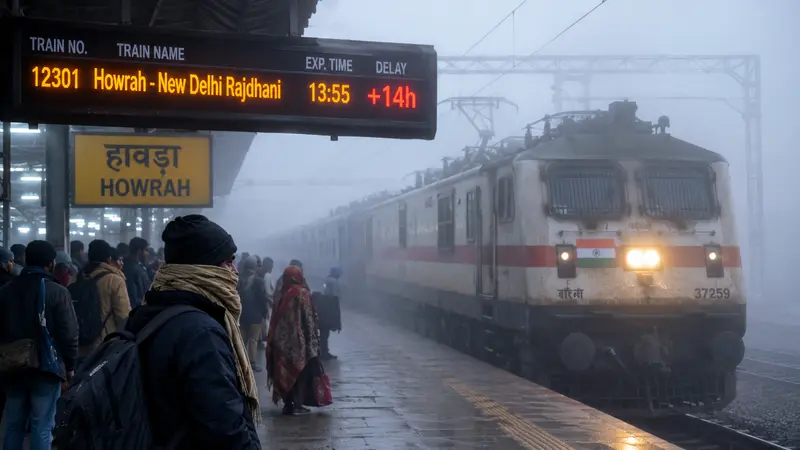
In India, fog slowed trains on the Howrah–Delhi rail route as colder weather began to set in. At Pt Deen Dayal Upadhyaya (Pandit Deen Dayal Upadhyaya) Junction in Chandauli district, services in both directions ran hours late on Monday, with delays stretching from 10 to 14 hours for some trains.
Passengers faced long waits on platforms as arrival times slipped through the day, disrupting onward connections and travel plans. One special fare service, the Haridwar–Malda Town Special, was scheduled to reach the junction at 11:10 am, but display boards later showed an expected arrival at 9 pm.
The disruption underlined how quickly fog can ripple through a busy rail corridor. Reduced visibility forces drivers to cut speed, and once a few trains fall behind schedule, the knock-on effects can persist for hours as traffic is resequenced and platforms fill.
Why fog forms, and why it matters
Fog is a visible aerosol made up of tiny water droplets or ice crystals suspended at or near the Earth’s surface. Meteorologists classify it as fog when it reduces horizontal visibility to less than 1 kilometre; when visibility stays at 1 kilometre or more, it is generally described as mist. Haze can look similar at a distance, but is typically driven by dry particles such as dust or smoke rather than condensed water.
The basic recipe is simple: the air cools to, or very near, its dew point so that relative humidity approaches 100%. Water vapour then condenses onto microscopic particles in the air, known as condensation nuclei, forming the droplet cloud that drivers experience as a grey wall across a highway or runway.
How the cooling happens determines the type of fog. Radiation fog is common on clear, calm nights when the ground loses heat quickly and cools the air just above it. Valley fog forms when colder, denser air drains into low-lying areas and becomes trapped beneath a warmer layer. Advection fog develops when warm, moist air moves over a cooler surface, while steam or evaporation fog can appear when cold air passes over warmer water.
These distinctions matter because they help forecasters judge how long fog will last and where it will thicken. Radiation fog, for example, often dissipates after sunrise as sunlight warms the ground and mixes drier air downward. Advection fog can persist longer when the cooling surface remains in place.
For the public, the main risk is straightforward: low visibility compresses reaction time. That is why dense fog advisories focus on driving behaviour, urging slower speeds, greater following distances and attention to sudden changes when a clear stretch of road drops into a dense patch.
Aviation and rail operations are also vulnerable. Flights can be delayed or cancelled when visibility drops below operating minima, and train services slow when drivers cannot safely maintain normal speeds. Monday’s rail delays at Pt Deen Dayal Upadhyaya Junction offered an early-season reminder of how quickly fog can derail timetables on a major route.
What comes next will depend on local conditions. In Colorado, forecasters expected rain to clear on Tuesday with more sunshine and slightly warmer temperatures, a shift that can help scour out fog by mixing the lower atmosphere. In Britain, attention turns to whether temperatures fall low enough for freezing fog later this week. In the northern plains of North America and along India’s fog-prone corridors, commuters are likely to see more advisories as nights lengthen and cooling near the ground becomes easier.
R
5 min
What did you think?