/
Maha Navami 2026 date confusion: why some observe it on Oct 19 and others on Oct 20
Maha Navami 2026 may be observed on 19 October or 20 October, depending on which panchang and tithi rule a family or temple follows. The day honours Maa Siddhidatri and includes Shodashopachar puja, Kanya Pujan, Ayudha Puja in some regions, and Durga Havan during Navami tithi.
R
4 min
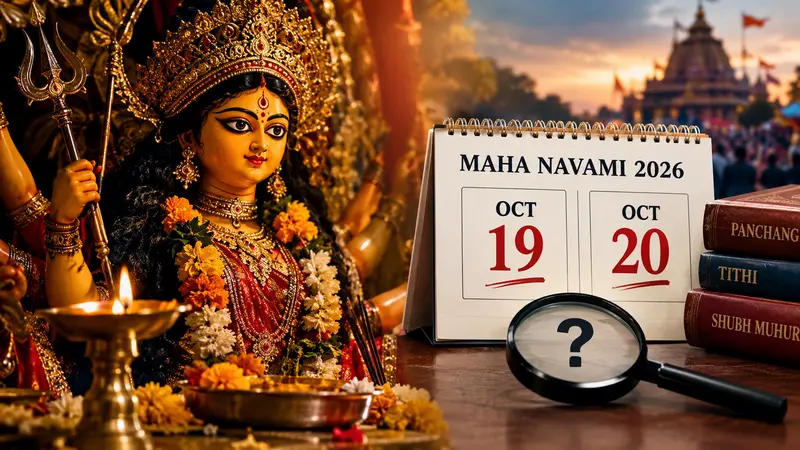
Confusion over whether Maha Navami in 2026 falls on 19 October or 20 October has sharpened on Monday morning as households and temples look to finish Sharad Navratri rituals and, in many traditions, the main Durga Puja observances.
The short answer is that both dates can be correct, depending on which calendar a family or temple follows and how it applies the lunar day, or tithi, to a civil date. In 2026, Navami can be observed on 19 October 2026 in many Navratri calendars, while some Durga Puja traditions may place Maha Navami rites on 20 October because of where the Navami tithi falls across the two dates.
The underlying reason is simple but easy to miss in practice: a tithi is not a fixed 24-hour day. It begins and ends at specific times that do not always match midnight-to-midnight on the Gregorian calendar. Regional panchang methods and long-standing temple customs then decide which civil date “carries” the festival.
Why the date differs
Maha Navami is the ninth day of Navratri and is tied to the worship of Maa Siddhidatri, the ninth form of Navadurga. Many devotees mark it as the culmination of the nine-day vrat and a turning point before Vijayadashami.
At the same time, the day is also linked to the final phase of the mythic battle between Goddess Durga and the demon Mahishasura, with Durga remembered as Mahishasuramardini, the slayer of Mahishasura. That association is why, in Durga Puja calendars, the day often carries a distinct set of rites, including offerings and homa.
In 2026, the mismatch arises because the Navami tithi overlaps two civil dates. Some communities observe the day on the date on which the tithi is present at sunrise; others use different decision rules rooted in their panchang and temple practice. The result is a split: for many, Navratri Day 9 is marked on 19 October, while others keep Maha Navami on 20 October.
Because the choice is calendar-driven, families are generally advised to follow their customary panchang and the timings used by their local temple or priest for that year.
Puja vidhi and key rituals
Maha Navami worship typically begins with preparation of the space. Homes are cleaned, the altar is readied, and an idol or image of Maa Siddhidatri or Goddess Durga is placed and decorated. Red cloth, fresh flowers and garlands are commonly used.
The puja itself is often performed as a Shodashopachar Puja, the 16-step form of worship. Offerings usually include kumkum, sindoor, akshat (rice grains), red flowers, seasonal fruits and sweets. Many households keep the bhog simple and traditional, with preparations such as halwa-poori offered to the देवी as prasad.
Mantra jaap is another central element. Devotees chant mantras dedicated to Maa Siddhidatri, seeking wisdom, inner steadiness and fulfillment. In many homes, the chanting is paired with aarti and the reading or listening of Navratri katha.
For many families, the day also includes Kanya Pujan, sometimes performed on Navami and sometimes as part of an Ashtami-Navami transition depending on local practice. Young girls are worshipped as manifestations of the divine feminine energy, and in several traditions a young boy is included as Bhairav. The ritual typically involves washing the feet, offering food, and giving small gifts or dakshina.
In parts of southern and western India, Ayudha Puja or Astra Puja is observed around this phase of Navratri. Tools, machinery, books and musical instruments are cleaned and placed before the deity for blessings. The act is devotional, but it also serves as a yearly reset: people treat their instruments of work and learning with care and gratitude.
Homa muhurat and what to follow next
A key feature of Maha Navami is the Durga Havan, also called Durga homa. The ritual is performed with a consecrated fire, into which offerings such as ghee, sesame seeds and selected herbs are made while mantras are chanted. Devotees regard it as a purifying rite and an expression of thanks to the Mother Goddess.
The timing for the havan is generally kept when the Navami tithi is active. Many households and temples prefer the morning hours or the Aparahna kaal window, aligning the fire ritual with the portion of the day considered suitable for such offerings.
Because tithi start and end times vary by location and calculation method, the exact muhurat can differ from city to city and between panchangs. Devotees who are observing Maha Navami on 19 October should check the Navami tithi window used by their priest or temple for today’s local timing; those observing it on 20 October should do the same for Tuesday.
For many, the next step after Navami is Vijayadashami, when Durga’s victory is celebrated and, in several traditions, idols are immersed. In homes keeping the Navratri fast, Navami is also when people prepare to conclude the vrat, with the closing rituals tied to their family’s custom.
In practical terms, the date question in 2026 is less about being “right” or “wrong” and more about consistency. Follow the panchang and tradition you have always followed, match the tithi-based timing for puja and homa, and coordinate with your local temple schedule if you plan to join community worship.
R
4 min
What did you think?