/
‘Happy Dussehra wishes’ trend on Oct 20 as Vijayadashami greetings flood WhatsApp
Searches for “happy dussehra wishes” rose Tuesday as Vijayadashami was observed across much of India on 20 October 2026. With eastern India marking the day on 21 October, greetings in Hindi, English and regional languages are being shared across both dates.
R
4 min
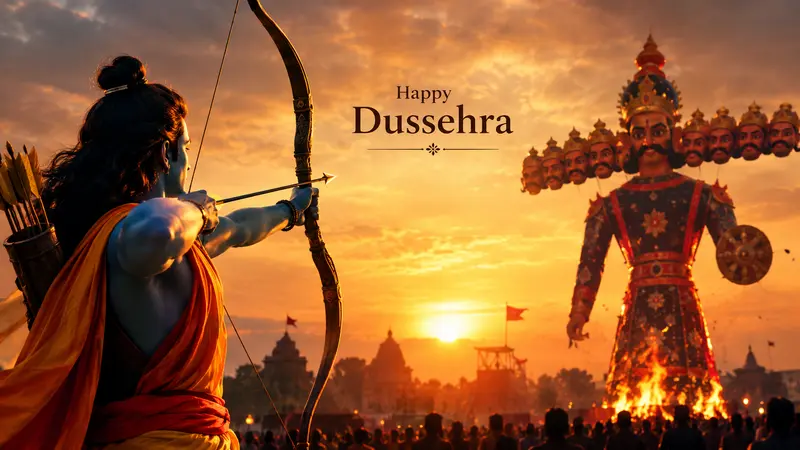
With Vijayadashami falling on 20 October 2026 across much of north, west and central India, “happy dussehra wishes” and “happy vijayadashami wishes” surged in searches on Tuesday morning as people looked for ready-to-send greetings, WhatsApp statuses and short messages for family, friends and colleagues.
The spike comes as the festival marks the close of Navratri for many households, and as offices reopen after the holiday stretch in some cities. For many, the first order of business on Dussehra morning is not a ritual or a visit, but a quick message to relatives, work groups and school circles.
In the past hour, multiple fresh wish guides in Hindi, English and regional languages have been published and widely shared, reflecting a familiar pattern: as soon as the festival date arrives, the demand for short, copy-and-send lines rises sharply.
Why the greeting rush peaks today
Dussehra, also called Vijayadashami, is widely observed as a celebration of the victory of good over evil. In much of India, the day is linked to Lord Rama’s victory over Ravana. In parts of eastern India, the festival is centred on Goddess Durga’s triumph over Mahishasura and is tied to local Durga Puja traditions.
That regional difference matters this year because the main day of observance is not uniform. While many states are marking Dussehra on 20 October, reports note that 21 October 2026 is being observed as Vijayadashami in West Bengal, Odisha and parts of eastern India, based on local tradition and the timing of the tithi.
The split calendar has also widened the window for greetings. People in cities with mixed workplaces and migrant communities often send messages across both dates, especially to colleagues or friends whose families follow a different observance.
What people are sending
The most-shared greetings this morning follow a few clear themes: victory of truth over falsehood, courage in difficult times, and wishes for peace and prosperity. Hindi message collections circulating on Tuesday stress moral resolve and personal strength, drawing directly from the festival’s core idea of “good defeating evil.”
One widely circulated Hindi wish frames the day as a personal reset, urging recipients to let go of negativity and move forward with hope. Another set of messages leans on the idea that Lord Rama’s victory teaches patience and faith when facing life’s challenges.
English-language wish packs being shared in office groups tend to be shorter and more formal, aimed at colleagues and clients. They often avoid religious references while keeping the central motif of righteousness winning over darkness. Family-oriented wishes, by contrast, are more devotional, asking for divine grace, peace and prosperity at home.
Regional-language greetings are also in heavy circulation. Marathi Dussehra messages, for instance, commonly reference the tradition of exchanging Apta leaves as “gold,” with lines built around “sonं घ्या, सोन्यासारखं राहा” (take gold, live like gold). Such messages blend the festival’s moral theme with local custom, making them especially popular on WhatsApp.
Alongside text, image-based greetings and short statuses are being shared for Instagram stories and Facebook posts, with many people looking for a single line that fits neatly over a festive photo.
A festival message shaped by platforms
The way Dussehra wishes are written has increasingly been shaped by how they are used. Short lines work better for messaging apps. Slightly longer notes are saved for family chats. A different tone is used for work groups, where people often want to be warm without being overly familiar.
That has led to a kind of informal etiquette around “Dussehra wishes”:
A message to elders is typically more respectful and devotional. A note to friends is upbeat and casual. For colleagues, many prefer a neutral wish that focuses on positivity and success.
Even within the same household, the choice can vary by audience. People who send a religious greeting to family may send a secular, motivational line to a manager. The same festival, in other words, travels through multiple registers as it moves across contact lists.
The timing of these messages is also changing. Instead of being sent after evening celebrations, many are now delivered early in the day, in part because phones and office chats are checked before commutes and meetings. For those in eastern India observing Vijayadashami on 21 October, Tuesday has become an advance-sharing day, while Wednesday is expected to bring a second wave.
For readers searching for wording, the broad trend is clear: messages that are specific, personal and short are being forwarded the most. A greeting that mentions “health” and “peace” is common for family groups; a line that mentions “success” and “new beginnings” is favoured for professional circles.
With the festival being observed across two dates in different regions this year, the greeting cycle is likely to stretch into Wednesday as well, especially in workplaces and friend groups spread across states.
R
4 min
What did you think?