/
DAC clears about Rs 2.12 lakh crore of proposals for Army, Navy and IAF; 82% to come from Indian industry
The Defence Acquisition Council, chaired by Rajnath Singh, granted Acceptance of Necessity on Monday to capital proposals worth about Rs 2.12 lakh crore, covering drones, counter-drone systems, helicopters, air defence and guns. About 82% of the value is to come from Indian industry.
P
4 min
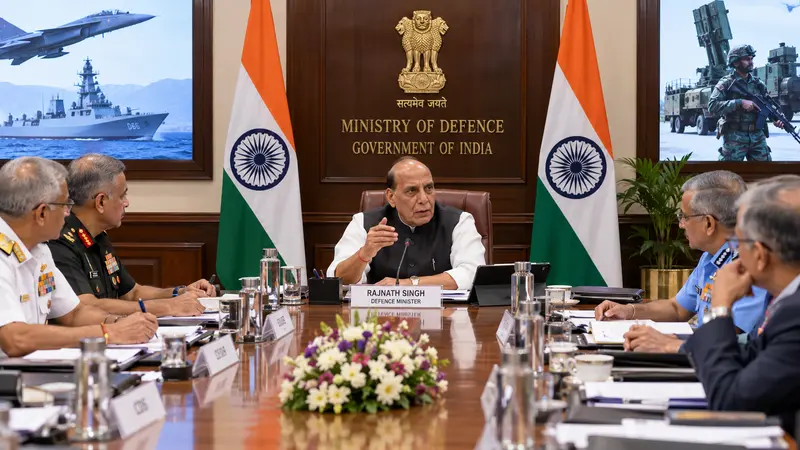
The Defence Acquisition Council, chaired by Defence Minister Rajnath Singh, has cleared capital acquisition proposals worth about Rs 2.12 lakh crore for the Army, the Navy and the Air Force. The council met on Monday, 26 October, and gave what is known as Acceptance of Necessity to the proposals. The Ministry of Defence says that about 82 per cent of the value of the approved procurement will come from Indian industry.
What an Acceptance of Necessity is
Acceptance of Necessity, or AoN, is the first formal approval in India's defence procurement process. It is an in-principle administrative approval, and it says that the need for the equipment has been accepted. It is not a contract and does not fix a price or a supplier. After an AoN, the services issue requests for proposals, vendors respond, the equipment is tested in trials, the price is negotiated and the Cabinet Committee on Security clears larger contracts. The whole process often takes years, so the figure of Rs 2.12 lakh crore is a measure of intent and not of money about to be spent.
What is in the package
The ministry's release lists the equipment by service.
- Army: High Mobility Vehicles, a Self-Propelled Tracked Gun System, a Gun Shot Response System, Light Multi Role Helicopters, a Very Short Range Air Defence System, a platform-based counter-drone system, a long-range unmanned aerial system, a surveillance drone, an integrated surveillance and strike system and a long-range kamikaze drone system.
- Navy: an Active Offboard Decoy System, which is meant to strengthen defence against anti-ship missiles, along with other major naval platforms that the reports do not name.
- Air Force: helicopters, among them Special Utility Helicopters for air transport, air defence systems, weapons and a mobile X-band Doppler weather radar system, which gives local weather surveillance in forward areas.
The list shows where the services see their needs. Drones and counter-drone systems appear in several forms, which reflects the way that recent conflicts have been fought, and air defence and surveillance feature on the list for all three services.

The ministry says that about 82 per cent of the approved procurement by value will come from Indian industry, in line with its policy of self-reliance in defence. The statement is about what the proposals are meant to deliver and not about what has been signed. The real share will be known only when contracts are placed, and it can change if a foreign vendor is chosen for a particular item or if Indian firms rely on imported parts. Defence analysts have long pointed out that the label 'Indian' can cover a wide range of local content.
The council has cleared large packages before. A meeting on 27 March 2026 gave approval to proposals worth about Rs 2.38 lakh crore, and another approved proposals worth Rs 52,000 crore to improve combat readiness. The latest package is of the same order of size, which means that the cumulative value of the AoNs is very large. A number of those approved earlier are still at the stage of trials and negotiations, and the ministry has said that it wants to shorten the time between approval and contract.
The first thing to watch is how quickly the requests for proposals are issued, since that decides whether the equipment can arrive within the period the services have asked for. The second is how many of the items are for Indian firms that already have a product and how many will need to be developed, which affects the delivery time. The third is the budget, because large contracts add to the capital outlay of the defence budget over several years.
For the industry, the package is a signal of demand in drones, counter-drone systems and air defence, areas in which private companies and start-ups have been investing. For the services, it is a list of what they hope to get in the next decade, and the proof will come with the signing of contracts.
The reports are based on a release from the Ministry of Defence and do not give figures for each item, the number of units or the names of vendors, so the details of the programme will become clearer as individual proposals move forward.
P
4 min
What did you think?