/
Supreme Court orders separate warning labels on food high in sugar, salt and fat
On 26 November the Supreme Court told the food regulator FSSAI to require a separate front-of-pack hexagon for each of high total sugar, high salt and high saturated fat, with a picture and words. FSSAI must redo the thresholds and report on draft rules after ten weeks.
A
4 min
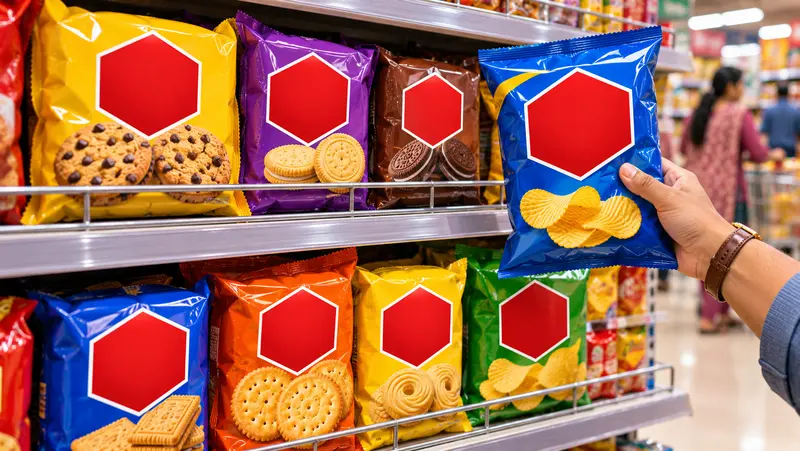
The Supreme Court on Thursday, 26 November 2026, directed the Food Safety and Standards Authority of India (FSSAI) to require clear warnings on the front of packaged foods that are high in sugar, salt or saturated fat. Each of the three must have its own hexagon, with a picture and words such as "high sugar", so that one packet could carry up to three. A bench of Justices J.B. Pardiwala and K. Vinod Chandran gave the ruling on Constitution Day. The regulator must report on its draft rules after ten weeks.
The judgment settles both which nutrients trigger a warning and how the warning must look. FSSAI has to treat total sugars and saturated fat, along with salt, as the nutrients of concern. Its earlier approach looked at added sugar and added fat. The regulator must also revisit and set the threshold for each nutrient afresh, and may not simply adopt the table in the 2024 Dietary Guidelines for Indians that it had proposed, because that table was calculated on added sugar and added fat.
The court said the thresholds must be based on evidence and "neither too low nor too high". If they are too low, nearly every product carries a warning and shoppers stop noticing. If they are too high, products that can harm health escape a label.
How the label must look
| Requirement | Direction |
|---|---|
| Shape | A separate hexagon for each nutrient |
| Content | A standard picture of the nutrient and the words high fat, high sugar or high salt |
| Size | Not less than about 4 to 5 per cent of the front panel, unless there are clear reasons otherwise |
| Lettering | Prominent, conspicuous and easy to read when buying and using the product |
The court rejected the idea of a single combined hexagon for a product that is high in more than one nutrient. A separate mark tells a shopper which nutrient is in excess, which matters to people who need to limit one of them in particular, such as salt for high blood pressure or sugar for diabetes.
The petition was filed as a public interest case by the 3S and Our Health Society. FSSAI had proposed red hexagons in an affidavit of 28 August, which would apply only when a product was high in two or more of added saturated fat, added sugar and salt. The petitioner called that trigger scientifically unjustified. FSSAI later moved to a system in which a warning applies when any one nutrient crosses its limit, and proposed a voluntary period of 365 days and about four months to finalise the draft regulations. The court had earlier questioned the regulator's approach and criticised it over the risk of bowing to corporate pressure. Judgment was reserved on 28 September.
The Union government must make sure the Food Safety and Standards (Labelling and Display) Regulations of 2020 are strictly enforced. The new regulations must come into force without delay, and FSSAI must anticipate obstacles and keep to the court's timeline. The government must also build practical nutrition literacy into school teaching through workshops and activities. The judgment does not say whether the proposed 365-day voluntary period has been accepted.
Why front-of-pack labels matter
Most Indian packets already list nutrients in a table on the back, but the figures are small and hard to compare while shopping. A front warning gives the answer at a glance. Several countries use warning marks for sugar, salt and fat, and health experts argue that they help shoppers choose and push manufacturers to reduce the amounts to avoid a mark. India has a rising burden of diabetes, obesity and heart disease, and packaged foods and drinks are a growing part of diets in towns and villages alike.
Shoppers will not see the new marks immediately, because FSSAI has to write the thresholds and the regulations first. Food companies will have to check their recipes against the new limits and redesign packets, and some may change recipes to stay below the thresholds. Producers of biscuits, snacks, instant foods, sauces and soft drinks are likely to be most affected. Industry bodies can be expected to comment on the draft when it is published.
Reading a packet meanwhile
Until the marks appear, shoppers can look at the nutrition table, which states energy, sugar, fat and sodium per 100 grams or per serving, and at the ingredient list, where ingredients are given in order of quantity. Sodium multiplied by about 2.5 gives the amount of salt. Anyone with diabetes, high blood pressure or another condition should follow the advice of a doctor or dietitian. This report is for information only and is not medical advice.
The matter will be listed after ten weeks, when FSSAI must file an affidavit on the progress of the draft regulations, which would fall in early February 2027. Once the rules are notified, the directions on thresholds and label design will apply. The Supreme Court publishes the judgment on its website, and FSSAI publishes draft regulations for public comment.
About the Author
A
Amita Sahani
Staff Writer
Amita Sahani writes for Wirony. Every story under this byline is reviewed and approved by an editor before it is published, and corrections are made openly.
A
4 min
What did you think?