/
India gives 1 crore HPV vaccine doses to 14-year-old girls in under nine months
India has given more than 1 crore HPV vaccine doses to 14-year-old girls in under nine months, covering about 87% of the 1.2 crore girls targeted. Six states reached 100%. The campaign, launched in February 2026, uses a free single dose. PM Modi welcomed the milestone and WHO congratulated India.
R
4 min
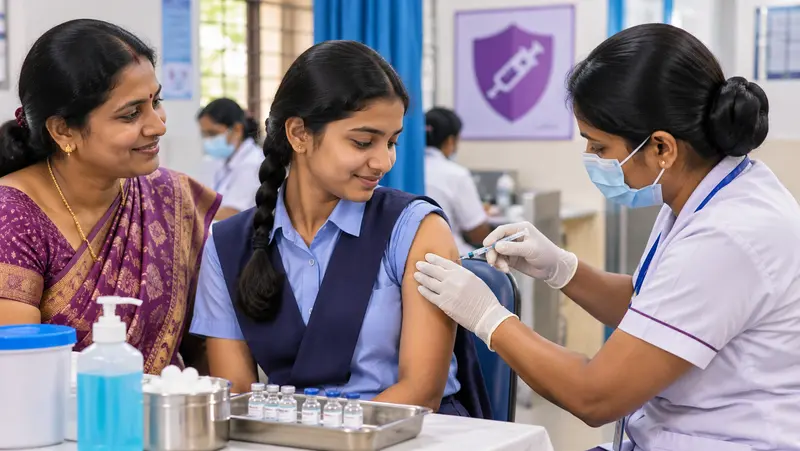
India has given more than one crore, or 10 million, doses of the vaccine against the human papillomavirus (HPV) in less than nine months under its National HPV Vaccination Campaign, the Union health ministry has said. The campaign, launched by Prime Minister Narendra Modi in February 2026, offers a free single dose to girls aged 14 at government health facilities. Prime Minister Modi welcomed the milestone on 23 November, and the World Health Organization's South-East Asia Region congratulated India.
The ministry says about 87 per cent of the annual target group, about 1.2 crore girls, has been vaccinated. The target is based on the 2021 population estimates of the Registrar General of India. The vaccine is voluntary, and parents' consent is needed. It is given as a single dose at government health facilities by trained medical officers, with arrangements for rare adverse events available round the clock. The U-WIN digital platform is used to book slots, track doses in real time and issue certificates.
Six states have vaccinated 100 per cent of their target group: Gujarat, Uttar Pradesh, Andhra Pradesh, Mizoram, Madhya Pradesh and Bihar. Uttar Pradesh gave the most doses, more than 29 lakh, Bihar more than 13 lakh and Gujarat nearly 8 lakh. Other states are close behind, though the reports give different figures. One says Assam, Telangana and Karnataka are above 93 per cent, and another gives Assam over 96 per cent, Telangana over 95 per cent and Karnataka above 90 per cent. One report says 12 states have crossed 80 per cent.
| Item | Detail |
|---|---|
| Doses given | More than 1 crore (10 million) |
| Period | Under nine months from February 2026 |
| Target group | 14-year-old girls, about 1.2 crore a year |
| Coverage | About 87% |
| Schedule | Single dose, free, voluntary |
| States at 100% | Gujarat, Uttar Pradesh, Andhra Pradesh, Mizoram, Madhya Pradesh, Bihar |
| Platform | U-WIN, for booking, tracking and certificates |
What leaders said
Union Health Minister J P Nadda congratulated all states and said that the progress reflects a collective commitment. He said that through government facilities and the U-WIN platform India is moving closer to a future free from cervical cancer, and he reiterated the government's commitment to extending HPV vaccination to every eligible girl. Prime Minister Modi welcomed the achievement as an important step towards protecting adolescent girls against cervical cancer and said that every dose contributes to their health. Vice-President C P Radhakrishnan also commended the milestone.
HPV is the cause of nearly all cases of cervical cancer, and cervical cancer is among the most common cancers in Indian women. Vaccinating girls before they are exposed to the virus is the most effective way to prevent it, and the vaccine protects against the types that cause most cases. The ministry cites global experience of more than 800 million doses and nearly two decades of research in support of the vaccine's safety.
One explainer says the campaign uses a vaccine that protects against four types of the virus and includes India's own quadrivalent vaccine, but the ministry reports read do not name the vaccine or its maker. The same explainer gives India's burden as over 1.2 lakh cases and nearly 80,000 deaths a year, without citing a source, so those figures are not confirmed here.
Why single dose and why age 14
The World Health Organization's immunisation advisers said in 2022 that a single dose of an HPV vaccine can be used, which makes a national programme cheaper and easier to run. The vaccine works best when it is given before a girl is exposed to the virus, and the WHO recommends vaccinating girls between the ages of 9 and 14, so the campaign's target of 14-year-olds is at the top of that range.
The WHO's South-East Asia Region congratulated India on giving 10 million doses. The WHO has a global strategy to eliminate cervical cancer as a public health problem, which sets targets for vaccinating girls, screening women and treating disease, and a vaccinated cohort of this size counts towards the first of them.
What is still to do
Vaccination covers only one age group each year, so the campaign has to run for many years before its effect on cancer cases is visible, because the disease takes years to develop. The ministry says it will work with states and communities to close the remaining gaps and reach all eligible girls, and the six states at 100 per cent will be a test of whether the same coverage can be kept up in the second year of the campaign. Screening of adult women, which the vaccine does not replace, remains important.
This report is for information only and is not medical advice. Parents who have questions about the vaccine should ask a doctor or their nearest government health centre.
The Ministry of Health and Family Welfare, the Press Information Bureau and the WHO are the official sources for the figures and statements quoted here.
About the Author
R
Reyaansh Agarawal
Staff Writer
Reyaansh Agarawal contributes to Wirony, covering stories that are carefully reviewed and approved by the editorial team before publication. Wirony is committed to maintaining tran…
R
4 min
What did you think?