/
SEBI lets NRIs complete KYC digitally from abroad from 3 December: who qualifies and what you will need
A SEBI circular of 4 November removes the need to be physically in India for digital KYC, for NRIs, OCIs and foreign nationals in FATF-compliant countries. It takes effect on 3 December 2026. An overseas address is accepted, video checks get strict safeguards, and existing records stay valid.
R
5 min
The Securities and Exchange Board of India has removed the rule that a client must be physically in India to complete digital KYC, for Non-Resident Indians, Overseas Citizens of India and foreign nationals living in countries that comply with Financial Action Task Force standards. The circular, dated 4 November 2026 and numbered HO/38/30/12(3)2026-MIRSD-POD2/I/25175/2026, takes effect 30 days later, on 3 December 2026. It applies to all SEBI-registered intermediaries, stock exchanges, clearing corporations and depositories.
SEBI said the older rule "in effect restricts a client outside India" from submitting documents and completing the process digitally. The change follows a consultation paper and press release of 14 August.
What changes
The KYC Master Circular of 2023 required intermediaries to ensure the client's physical location was in India during digital KYC. That left an NRI in Dubai or Toronto with paper forms, attested copies and couriers, or a trip home. Four main changes now apply:
- A client located in a FATF-compliant country can submit KYC information and documents digitally, and the intermediary may accept them.
- KYC Registration Agencies will tag each attribute of a record as "validated" if it has been checked against an official or source database. All records become portable, so they can be shared with another intermediary whether or not every attribute is validated.
- An intermediary may rely on KYC done by another SEBI-registered intermediary, using the KRA record, or by an entity regulated by the RBI, IRDAI, PFRDA or the IFSC Authority, using the central KYC registry. The intermediary keeps ultimate responsibility.
- An authorised official of the intermediary must be present during Video In Person Verification, and the process is subject to concurrent audit.
The same process applies to re-KYC for clients in FATF-compliant countries, and SEBI's December 2025 relaxation on geo-tagging for NRI re-KYC is superseded.
What you will need
The circular sets out each element of the process.
| Item | Requirement |
|---|---|
| PAN | Collected and verified against the Income Tax database; the original or a copy need not be insisted on |
| Passport | Copy required, plus the OCI card where applicable |
| KYC form | Physical, scanned with electronic signature, or digital with electronic signature |
| Specimen signature | Wet signature, or a cropped image under electronic signature, with a wet signature shown during video verification |
| Proof of identity and address | One officially valid document; the current address must be an overseas address |
| Mobile and email | Indian or international mobile; verified by OTP or another method |
| Language | Documents in English, or translated and attested by a certifying authority |
Where the original document is not shown to the intermediary, clients have four options: an equivalent e-document through DigiLocker, an e-document issued by the issuing authority through a verifiable mechanism, Aadhaar e-KYC by OTP, biometric or face authentication, or a copy attested by a certifying authority. Certifying authorities include a notary public, an authorised official of an overseas branch of a scheduled commercial bank registered in India, branches of overseas banks with which Indian banks have relationships, a court magistrate or judge, and the Indian embassy or consulate general in the country of residence. Foreign nationals whose documents show no address may use a document from a foreign government department or a letter from a foreign embassy or mission in India.
The safeguards, and why it matters
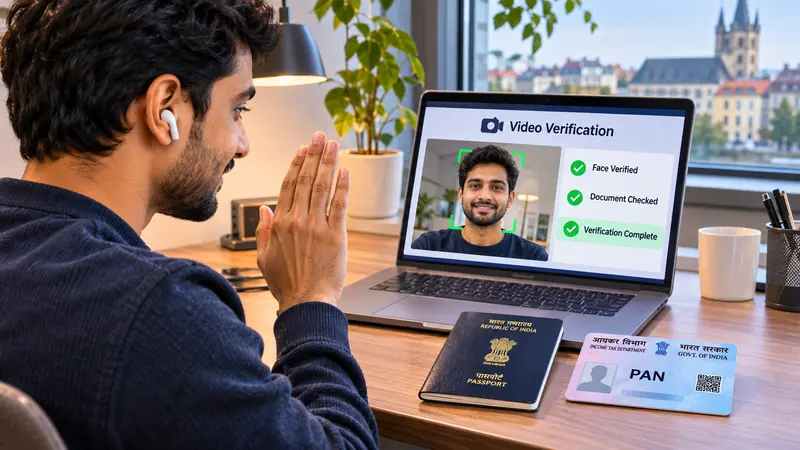
Moving KYC abroad increases the risk of impersonation, and the video rules are SEBI's answer. The Video In Person Verification must record client consent in an auditable way, use random prompts to show that the session is not pre-recorded, keep an uninterrupted recording with live GPS co-ordinates and time stamps, block VPNs, proxies and spoofed IP addresses, and check face liveness. The client's IP address must come from India or a FATF-compliant country and match the country stated in the KYC form and document. The liveness check must not exclude people with special needs. Data must be encrypted end to end, and the intermediary must upload the KYC details to the KRA within three working days of completing the process.

What this means in practice is less paperwork and less travel for the many Indians abroad who want to open a trading or demat account or update old records. It also reduces duplicate KYC, since records can be reused between intermediaries and even across financial regulators through the central registry. For intermediaries, the burden shifts: they must build the video infrastructure, follow SEBI's cyber security framework and remain responsible for a client they may never meet.
Several limits are worth reading carefully. Clients in countries that do not comply with FATF standards stay on the existing process; the circular points to FATF's own published details for which countries those are. KYC already completed before the circular takes effect remains governed by the old provisions, so nobody needs to redo a valid record because of this rule. An individual foreign national seeking registration as a Foreign Portfolio Investor follows the separate FPI master circular. The rules on what a non-resident may buy, and on repatriation and tax, are not touched by this circular.
A sensible way to prepare is to check whether your PAN and passport details match, confirm that your current overseas address appears on an officially valid document, and ask your broker or depository participant when its digital route for overseas clients will go live, since the circular lets intermediaries accept digital submissions and does not force them to offer it on day one. The full circular is on SEBI's website under Legal and Circulars.
This article is for information and is not investment advice.
Sources
About the Author
R
Reyaansh Agarawal
Staff Writer
Reyaansh Agarawal contributes to Wirony, covering stories that are carefully reviewed and approved by the editorial team before publication. Wirony is committed to maintaining tran…
R
5 min
What did you think?