/
NVS-03 could bring NavIC back to four satellites, the minimum for positioning, after months below the line
ISRO launched NVS-03 on 30 October. In July the government told Parliament that NavIC had only three working satellites and could not offer standalone positioning, which needs four. Once in its slot at 111.75° East, NVS-03 could restore that. NVS-04 and NVS-05 are still to come.
S
5 min
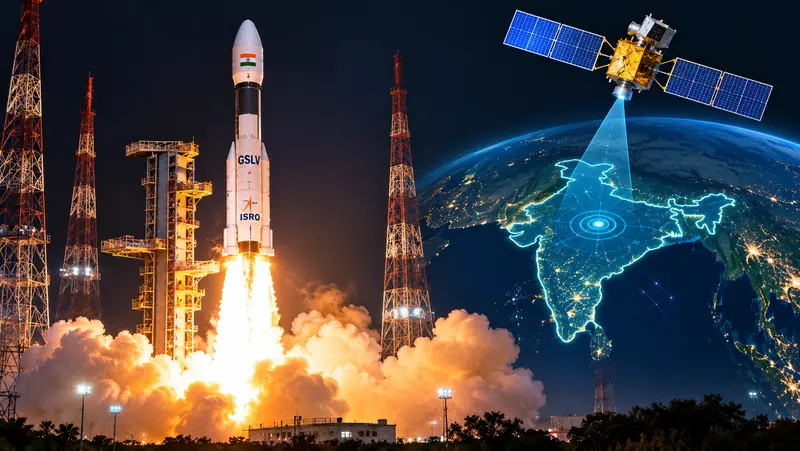
The Indian Space Research Organisation launched the navigation satellite NVS-03 on 30 October 2026 at 23:51 hours from Sriharikota, on the 20th flight of the GSLV. The launch was a success, and the first orbit manoeuvre was completed the next day. The full significance of the mission lies in a written reply to Parliament three months earlier: NavIC, India's regional navigation system, had fallen below the number of satellites it needs to tell anyone where they are.
On 29 July the Department of Space told the Lok Sabha that NavIC had three satellites providing services, IRNSS-1B, IRNSS-1I and NVS-01, and that "minimum four operational satellites are required in orbit" for basic positioning. So the constellation could not provide a standalone positioning service, although its timing service worked. NVS-03 is the satellite that can bring the count back to four.
How NavIC got here
NavIC was designed with seven satellites, three in geostationary orbit and four in inclined geosynchronous orbit, covering India and a region about 1,500 km beyond its borders. Its first-generation satellites carried atomic clocks that have been the system's main weakness. A parliamentary standing committee reported that some satellites could not provide navigation and timing services because their onboard atomic clocks malfunctioned, and ISRO said the procured atomic clock on IRNSS-1F stopped working on 13 March 2026, when that satellite completed its ten-year mission life.
The replacement series has had a hard start. NVS-01 reached orbit in May 2023. NVS-02, launched on 29 January 2025, did not reach its intended slot because the oxidiser valves did not open for orbit raising. That loss delayed the build-up just as old satellites were ageing out. A March 2026 reply said eleven satellites had been launched and eight were functional, but only three were broadcasting navigation signals, with five usable for one-way messaging. By late July the working navigation count remained three.
The government told Parliament that this creates no vulnerability for users, because NavIC is used in a multi-constellation environment for most purposes, and that the armed forces use multiple navigation systems including NavIC. That is a reassurance with a limit: the value of an independent system is that it can be relied on alone when others are denied, and in July it could not provide positioning on its own.
What NVS-03 adds
NVS-03 weighs about 2,250 kg and carries payloads in the L1, L5 and S bands. The L1 signal matters most for ordinary users. It is the band used by most consumer navigation chips, and including it alongside the legacy L5 and S signals makes it easier for phones and other devices to receive NavIC. The satellite carries an indigenous atomic clock alongside procured clocks. ISRO's chairman said it was the third indigenous clock in orbit, with two already working, which is significant given the history of clock failures.
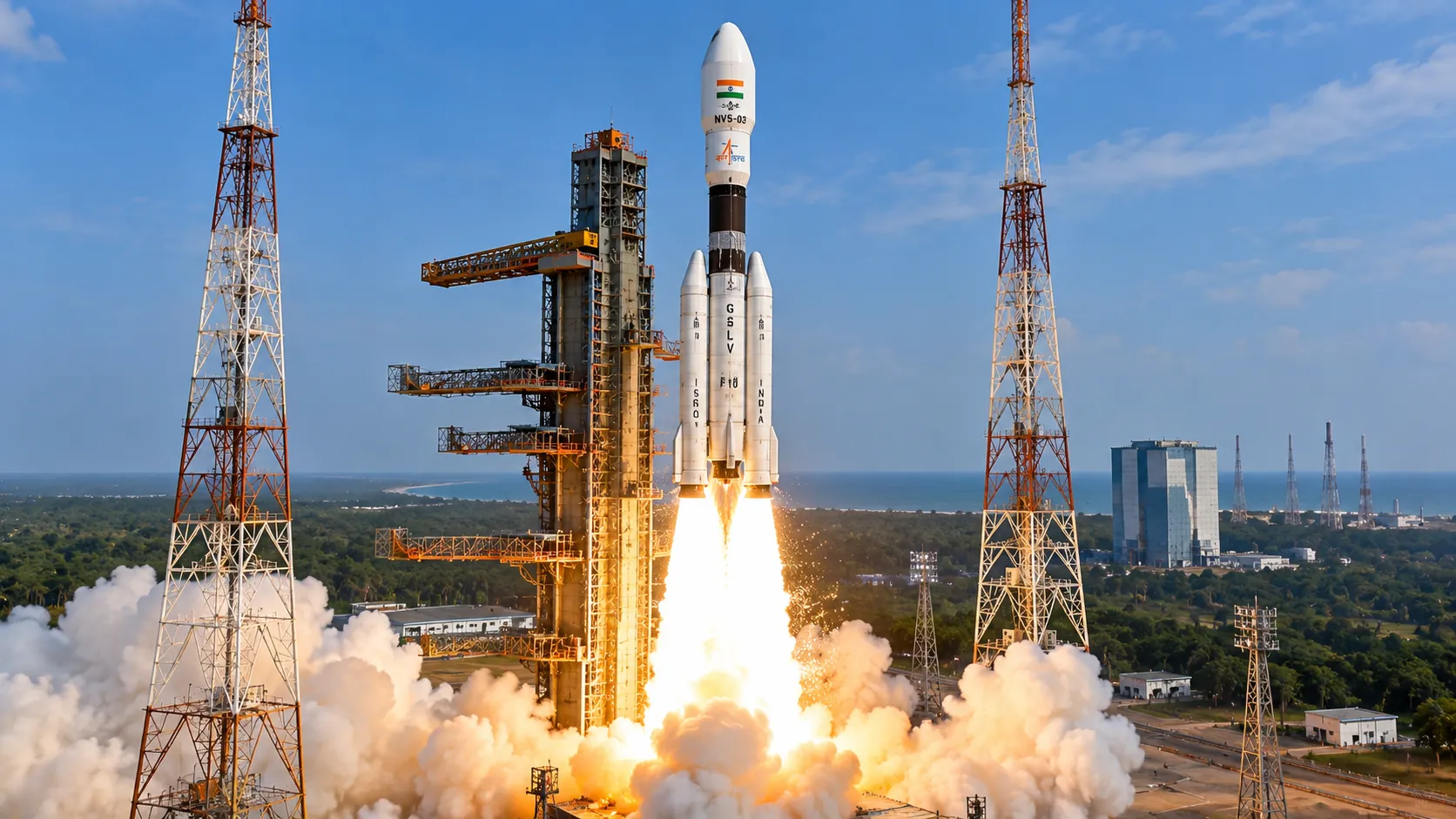
NVS-01, launched in 2023, carries a rubidium clock built by the Space Applications Centre in Ahmedabad and has a designed life of 12 years, so the new series is meant to carry the system well into the next decade. ISRO will use NVS-03's liquid apogee motor in further manoeuvres to raise it from a geosynchronous transfer orbit, with a low point near Earth and a high point of about 35,786 km, to its slot at 111.75° East. The GSLV-F18 stood about 50 metres tall, weighed about 420 tonnes at lift-off and used India's own cryogenic upper stage. The launch also set a record: the 56-day gap since the previous GSLV flight is the shortest the rocket has achieved.
Why it matters
Satellite navigation is an invisible utility. Transport, shipping, aviation, disaster management, precision agriculture, power grids and telecom networks all rely on positioning and timing. India's interest in its own system goes back to the idea that a country should not depend on a foreign-controlled signal in a crisis. NavIC offers two services: an open Standard Positioning Service for civilians and an encrypted Restricted Service for strategic users.
A working constellation of four is a minimum, not a finish line. Four satellites allow a receiver to calculate a basic position, but with no margin if one fails, and with weaker geometry than a full seven. Official accounts of the launch say signals from four satellites can serve several purposes, but that the full constellation must be completed before navigation services are integrated with mobile systems for public use.
Three steps remain, and none is guaranteed. First, NVS-03 must complete its orbit raising, the stage at which NVS-02 failed. Second, it must be tested and commissioned. Launch success is not the same as an operating service, and the government has not given a date for service. Third, NVS-04 and NVS-05, described as in an advanced stage of realisation, must follow, with no launch dates in the official material read for this article. PIB's backgrounder says those satellites are in the pipeline.
Critics might say that a system launched more than a decade ago should not be at this point, and the record in Parliament supports the concern. However, the problems on the record are specific: atomic clocks and a valve failure. Indigenous clocks and a faster launch rhythm are the two things that could change the outcome.
The next official marker to watch is a statement from ISRO that NVS-03 has reached 111.75° East and that its signals are in service. Until then, NavIC's status remains what the government told Parliament in July.
Sources
About the Author
S
Subhash Gupta
Desk Editor
Subhash Gupta is a writer at Wirony, contributing articles that are reviewed and verified by the editorial team before publication. The publication prioritises accuracy, editorial…
S
5 min
What did you think?