/
Onion prices jump again in India as supply tightens during festive season
Onion prices have risen again in India during the festive season, with reports citing supply shortages and weak monsoon conditions. One report put the year-on-year rise at 108%, alongside higher September retail inflation. Ukraine also saw a 12% weekly jump in wholesale onion prices.
R
4 min
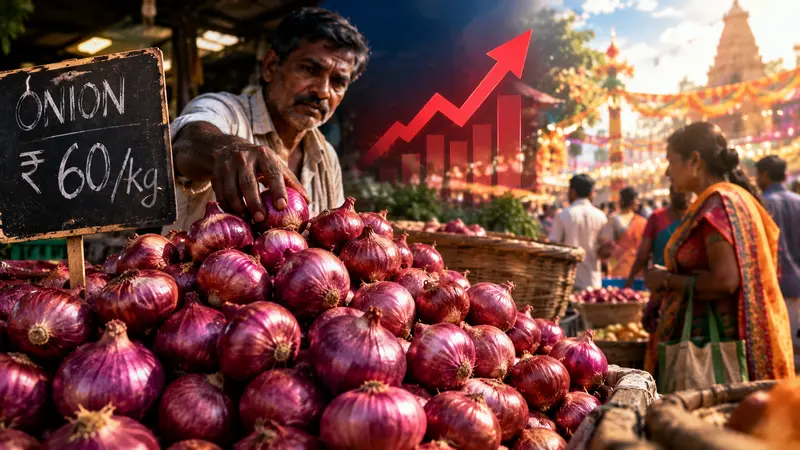
Onion prices have jumped again in parts of India in the middle of the festive season, adding to pressure on household budgets already strained by costlier sugar and edible oils.
Reports published on Friday said the surge has been sharp enough to disrupt routine kitchen spending, especially for lower- and middle-income families. The same reports pointed to a mix of supply and weather factors behind the rise, after months of uneven availability.
One account of the latest spike said onion prices were up 108% year-on-year. It linked the jump to a mismatch between output and market supply, arguing that a weak monsoon this year and acreage cutbacks after farmers received low prices in recent seasons have reduced arrivals.
The knock-on effect has shown up in inflation readings as well. Retail inflation rose to 5.54% in September, while food inflation also moved higher, according to the same report, which added that the impact varied by location.
Supply worries meet festival demand
The timing matters. Onions sit at the centre of everyday Indian cooking, and demand typically firms up as households and eateries prepare for heavier festival-season consumption.
The reasons being discussed are familiar to anyone who has watched the onion cycle: when farmgate returns are poor for a stretch, growers scale back, and the next season’s supply tightens. This year’s weather has compounded the problem, with a weaker monsoon cited as a factor in lower production and uneven arrivals.
That squeeze is being felt alongside increases in other essentials. Reports on Friday described sugar and edible oils as moving up at the same time, creating a broader grocery-bill shock rather than a single-item spike.
India’s sensitivity to onion prices is not just cultural. The bulb is a cornerstone ingredient across regional cuisines, prized for the way its flavour changes with heat, from sharp and pungent when raw to sweet and mellow when slowly cooked.
The latest move is not confined to India. In Ukraine, wholesale onion prices rose by an average of 12% over the past week, with farmers selling onions for 10 to 16 hryvnias per kilogram, reports said on Friday.

The Ukraine data points to a wider pattern of volatility in a basic crop that is stored, traded and shipped across borders, but still heavily influenced by local harvest timing and storage conditions. Even when onions are available, prices can swing quickly when the market senses a near-term gap between supply and demand.
Why onions swing so much
Onions, also known as bulb onions or common onions, are the most widely cultivated species in the genus Allium. Their close relatives include garlic, scallion, leek and chives. The shallot is a botanical variety of onion that was treated as a separate species until 2011.
The same chemistry that makes onions a kitchen staple can also make them a headache at the cutting board. When the bulb’s cells are damaged, it releases sulfur-based gases, including syn-propanethial-S-oxide, which irritate the eyes and trigger tears. Cooks often try to blunt the effect by chilling the bulb before slicing or rinsing it under cold water.
From a nutrition standpoint, onions are low in calories and supply vitamin C, B vitamins such as folate and B6, and potassium. They contain more than 17 types of flavonoids, including quercetin and anthocyanins, and also provide prebiotic fibres like inulin that support beneficial gut microbes. Organic sulfur compounds in onions have been linked with helping manage cholesterol and blood pressure.
On the farm, onions are grown as biennials but are typically treated as annual crops. They do best in loose, well-drained soil with organic matter and need consistent moisture as bulbs swell. Harvest usually begins once the tops naturally flop over. After lifting, bulbs are cured in a warm, dry, well-ventilated space for two to three weeks so they develop a papery outer skin suited for storage.
For consumers, the immediate question is what happens next. The material available on Friday did not include any official price-control announcements, import decisions or specific market interventions. What it does show is a renewed bout of price stress arriving at a politically and economically sensitive moment, when household food bills are already under strain from other staples.
If the supply imbalance persists, the festive bump in demand could keep retail prices firm in the near term. If arrivals improve, onions can fall as quickly as they rise.
R
4 min
What did you think?