/
Modi opens RBI data centre and cyber institute in Bhubaneswar, warns of 'cyber terrorists' targeting banks
Prime Minister Narendra Modi inaugurated the Reserve Bank of India's Rs 169 crore data centre and Cybersecurity Training Institute in Bhubaneswar. He said modern wars also target economies and that the banking system must be protected from cyber terrorists.
S
4 min
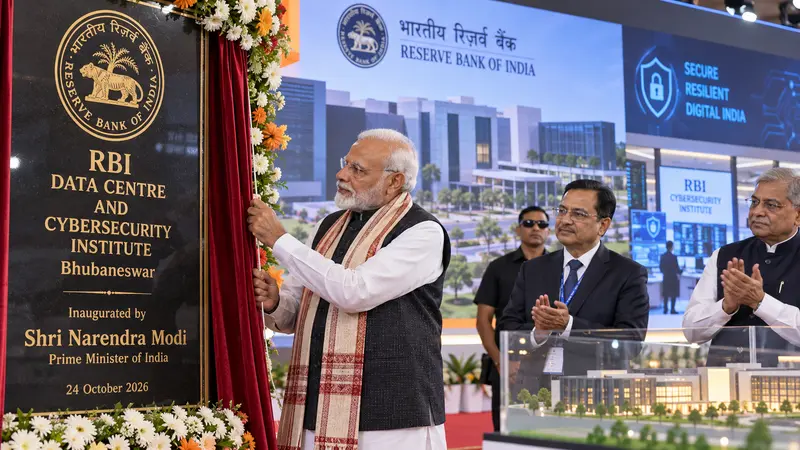
Prime Minister Narendra Modi inaugurated the Reserve Bank of India's new data centre and Cybersecurity Training Institute in Bhubaneswar on Sunday, 25 October, and used the occasion to say that India's banking system has to be protected from what he called cyber terrorists. The two facilities together cost Rs 169 crore. He travelled to the Odisha capital in the afternoon after a morning in Varanasi.
What the prime minister said
Modi said that modern wars are not fought only by conventional forces and that economies are also attacked. If a country is to be weakened, he said, its economy can be targeted, and a cyberattack on banks is one way of doing that. Protecting the banking system from cybercriminals and cyber terrorists, he said, is as important as building the country's economic strength.
He added that old systems, old methods of training and obsolete tools cannot meet the threats of today, and that the country needs modern infrastructure and skilled people. The new institute is meant to train staff for the sector in dealing with such threats, and the data centre is the technology base for the RBI's own systems.
Modi described India's banking sector as being among the most efficient in the world, with round-the-clock access. He said that small entrepreneurs, artisans, street vendors and workers in the unorganised sector had been brought into formal banking for the first time. He compared this with the period of Congress governments, when, he said, loans were largely limited to a few wealthy people, and he credited policies since 2014 with giving debit and credit cards to ordinary people. The past decade, he said, had been about the expansion of banking access, and the coming decade would be about efficiency and reliability. These claims are the prime minister's own statements and are political in tone.
He also spoke of the state's future, saying that Odisha would develop sectors from mining to microchips and open up opportunities for its youth.
Why the timing matters
Coverage of the speech linked it to a recent data exposure at the State Bank of India. The bank said on 21 October that a preliminary review of about 3.75 lakh records found on the dark web had identified 3,897 customer records that contained personal information. The figures come from a single report on the speech and are not included in the main account of the event.
Whether or not that case was in the prime minister's mind, the threat is real and growing. Banks and payment systems are a favourite target of criminals because the reward is cash, and they are also a possible target in conflicts between states. The more of everyday life that runs through UPI, mobile apps and online banking, the more costly an outage or a breach becomes. Fraud that works through phone calls and fake links is a daily problem as well, and police forces in several cities have been arresting cyber fraud gangs and freezing the money in their accounts.
The Reserve Bank already requires banks to follow cybersecurity frameworks and to report incidents to it, and it supervises how they protect their systems. A central institute for training gives the regulator a way of raising the skills of staff in the institutions it oversees.
A data centre of the central bank holds the systems that run its own operations and those on which banks depend, so its security and resilience have a bearing on the whole system. A cybersecurity training institute typically runs courses and simulated attacks, so that staff learn to spot a breach and respond to it before they face a real one. A training institute is a slower investment but may be more important in the long run. The shortage of trained cybersecurity staff is one of the main problems for banks, particularly the smaller ones such as cooperative and regional rural banks, which cannot compete for talent with large private lenders. A central institute can train staff from the whole sector and set a common standard.
The test will be what the institute teaches and to whom. If it reaches the smaller banks that are the easiest targets, it will raise the level of the whole system. If it trains mainly the central bank's own staff, its effect will be narrower.
S
4 min
What did you think?