/
L&T Q2 profit rises 33% to Rs 5,202 crore, revenue up 16%; order intake up 28% to Rs 1.48 lakh crore
Larsen & Toubro's consolidated net profit rose 33% to Rs 5,202 crore in the September quarter, with revenue up 16% to Rs 78,750 crore. Order intake rose 28% to Rs 1,47,665 crore, 63% of it international, taking the order book to Rs 8.54 lakh crore. EBITDA margin fell to 8.6%.
S
4 min
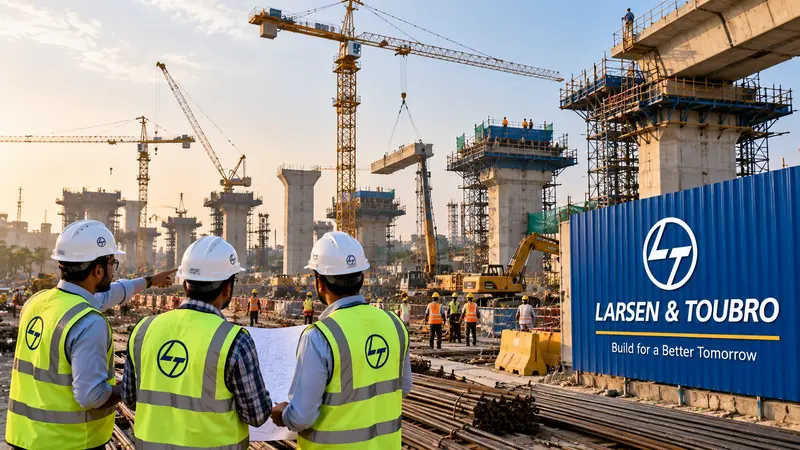
Larsen & Toubro reported a 33 per cent rise in consolidated net profit to Rs 5,202 crore for the September quarter of 2026-27, up from Rs 3,926 crore a year earlier, and a 28 per cent rise in order intake to Rs 1,47,665 crore. Revenue from operations rose 16 per cent to Rs 78,750 crore from Rs 67,984 crore. The results were announced after the market closed on Tuesday, 27 October, so the reaction of the shares will show only on the next trading day.
The headline numbers
| Measure | Q2 FY27 | Change from a year earlier |
|---|---|---|
| Net profit | Rs 5,202 crore | Up 33% |
| Revenue | Rs 78,750 crore | Up 16% |
| EBITDA | Rs 6,845 crore | Up 1% |
| EBITDA margin | 8.6% | Down from 10.01% |
| Order intake | Rs 1,47,665 crore | Up 28% |
| Order book | Rs 8,53,514 crore | Up 15% from March 2026 |
International business was important on every line. It contributed Rs 45,870 crore of the revenue, or 58 per cent of the total, and Rs 92,375 crore of the order intake, or 63 per cent. International orders make up 54 per cent of the order book.
The numbers show a gap that is worth looking at. Net profit rose by a third and revenue by about a sixth, but operating profit before interest, depreciation and tax, which is known as EBITDA, rose by only 1 per cent to Rs 6,845 crore, and the margin fell from 10.01 per cent to 8.6 per cent. The reports do not break down what made up the difference between the operating figure and the net profit, which can include other income, a lower tax charge or the share of profits from associates. One report says that the profit beat the estimate of analysts by about 17 per cent, but the margin is the number that analysts will focus on.
Margins at large engineering and construction companies move with the mix of projects. Contracts in the early stage of work often carry lower margins, and international projects in the Gulf may have a different profile from those at home. The company has not given a formal outlook in the reports.
Orders and the order book
The order intake was driven by wins in hydrocarbons, both offshore and onshore, as well as in the CarbonLite Solutions business, public spaces and airports, and power transmission and distribution. In the first half of the year, order inflow was Rs 2,55,678 crore, up 22 per cent, and 60 per cent of it was from outside India. The drivers named for the half-year include offshore hydrocarbons, offshore wind, minerals and metals, and residential and commercial buildings.

One report noted that new orders in the infrastructure and utilities segment fell 13 per cent, which is a reminder that the strength in orders comes mainly from the Middle East and from energy projects, not from domestic infrastructure.
The order book of Rs 8.54 lakh crore is the largest in the company's history, according to its chairman and managing director, S.N. Subrahmanyan. He said that the company had delivered a strong quarter in an ever-changing geopolitical landscape, and that the order book gives multi-year visibility of revenue.
For the six months to September, net profit rose 24 per cent to Rs 9,325 crore from Rs 7,543 crore, and revenue rose 11 per cent to Rs 1,46,692 crore from Rs 1,31,662 crore. International revenue was Rs 80,263 crore, or 55 per cent of the total.
L&T closed at Rs 3,665.10 on the National Stock Exchange on Tuesday, down 0.4 per cent, before the results were released, and its market value was about Rs 5.04 lakh crore. On Wednesday, investors will look at two things: whether the profit beat and the record order intake outweigh the fall in the margin, and whether the dependence on the Gulf for new business is seen as a risk when the region is tense. Oil prices at a six-month high and attacks on Saudi Arabia are part of the setting, and projects in the region can be affected by delays and by changes in spending plans.
For the wider economy, the figures show that private and government spending on large projects in India continues, but that the largest growth in orders is coming from abroad.
S
4 min
What did you think?