/
India-EU free trade agreement likely to be signed on 16 December in Brussels
India and the EU are likely to sign their free trade agreement on 16 December during Prime Minister Narendra Modi's visit to Brussels, an official said. EU Ambassador Jean-Eric Paquet says it will enter into force next year. It gives 93% of Indian exports duty-free access.
S
4 min
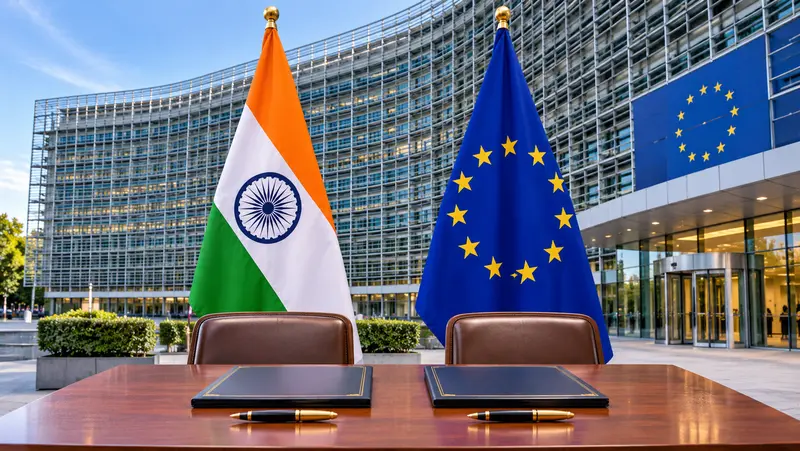
India and the European Union are likely to sign their free trade agreement on 16 December, an official said on Sunday, 22 November 2026. The EU's Ambassador to India, Jean-Eric Paquet, said the agreement will be signed during Prime Minister Narendra Modi's visit to Brussels in December and will come into force next year. Negotiations on the deal were concluded on 27 January this year.
The European Commission has sent proposals to the Council of the EU seeking authorisation to sign and conclude the agreement, together with the final legal text and the schedules of tariff cuts. Signing is the step that comes after the 27 member states approve, and it is followed by ratification. The European Parliament's consent is normally needed before an EU trade agreement can enter into force, and on the Indian side the government approves trade agreements without a parliamentary vote.
The pact has been called the "mother of all deals". Under it, 93 per cent of Indian exports will get duty-free access to the EU market. Imports of European luxury cars and wines will become cheaper in India.
Why it is big
The agreement creates a market of about two billion people. India is the world's fourth-largest economy and the EU the second-largest economic bloc, and together they account for about a quarter of global GDP and roughly a third of international trade, about $11 trillion of a global total of about $33 trillion.
The EU is India's largest trading partner for goods among trading blocs. India is the EU's ninth-largest partner for goods and its sixth-largest for services.
| Item | Detail |
|---|---|
| Likely signing date | 16 December 2026, Brussels |
| Talks concluded | 27 January 2026 |
| Entry into force | Next year, according to the EU ambassador |
| Duty-free access for Indian exports | 93% |
| Combined market | About 2 billion people |
Indian exporters of goods such as textiles, clothing, leather, gems and jewellery, and engineering products have long sought lower EU tariffs, and the share of exports entering duty-free is the main gain on the Indian side. For European firms, the gains are in a large, fast-growing market for cars, wines and spirits, machinery and services. The specific tariff lines in the final schedules have not been published in the material available, so the effect on each product cannot yet be given.
The material read for this article does not describe how the deal treats the EU's carbon border adjustment mechanism, services or investment, which were among the hardest subjects in the talks. Those details will be in the legal text once it is released.
What remains before it takes effect
Three steps remain. The Council must authorise the signature, the two sides must sign, which is expected on 16 December, and the agreement must then be ratified. The ambassador's statement that it will enter into force next year suggests both sides expect ratification to move quickly. The timing could still slip if member states raise objections at the Council stage.
The talks themselves have a long history: they began in 2007, stalled in 2013 and were relaunched in 2022, and the conclusion in January ended more than a decade of on-and-off negotiation.
The EU agreement would be the largest of a series of trade deals that India has struck in recent years. India has agreements in force or signed with the United Arab Emirates, Australia, the European Free Trade Association of Switzerland, Norway, Iceland and Liechtenstein, and the United Kingdom. The EU deal is the biggest by far, because the EU is India's largest trading partner among blocs. Signing it would also mark a shift for India, which for years was wary of deep trade agreements with rich economies.
For the EU, the agreement is part of an effort to spread its trade beyond the United States and China. It has signed or concluded agreements with several other large economies in recent years. An agreement with India gives European firms access to one of the fastest-growing large markets in the world, at a time when India is growing at about 7 per cent a year.
The steps on the EU side
On the European side, the Council of the EU, which represents the 27 governments, has to authorise the signature. After signing, the European Parliament votes on whether to consent to the agreement. Parts of a trade agreement that fall within the EU's exclusive powers can then be applied, and the rest depends on the member states. The ambassador's timeline suggests that both sides expect these steps to be completed in 2027.
For Indian buyers, the most visible change will be in the price of imported European cars and wines, once tariffs fall under the schedule. For workers, the gains depend on how quickly exporters in labour-intensive industries can expand. The Ministry of Commerce and Industry and the European Commission are the sources for the final text and tariff schedules, and for the date of entry into force.
About the Author
S
Subhash Gupta
Desk Editor
Subhash Gupta is a writer at Wirony, contributing articles that are reviewed and verified by the editorial team before publication. The publication prioritises accuracy, editorial…
S
4 min
What did you think?