/
Australia's unemployment rate jumps to 4.9%, highest since the pandemic, as 43,500 jobs go
Australia's unemployment rate rose to 4.9% in October from 4.7%, the highest of the post-COVID era, the ABS said on 19 November. Employment fell 43,500, mostly part-time. Economists say the data closes the door on an RBA rise in December.
A
4 min
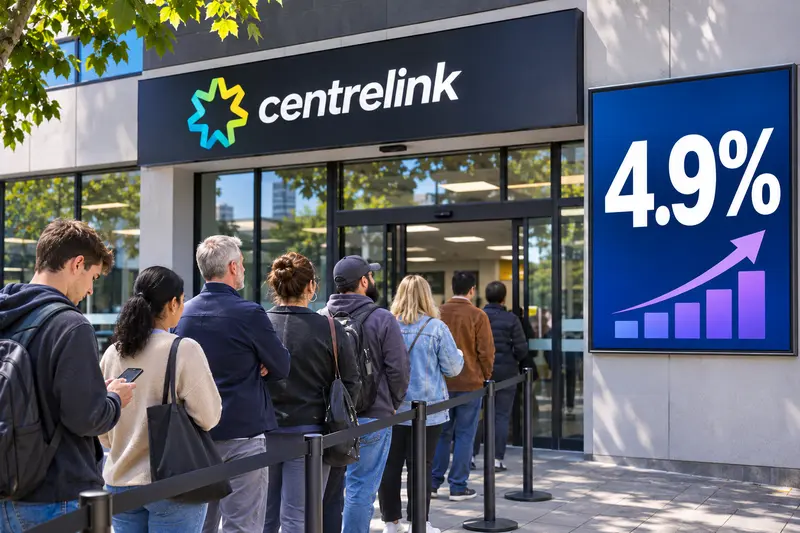
Australia's unemployment rate rose to 4.9 per cent in October 2026 from 4.7 per cent in September, the highest rate of the post-pandemic period, according to figures from the Australian Bureau of Statistics (ABS) released on Thursday, 19 November. Employment fell by 43,500 people, and the Moody's analysis cited in reports says part-time jobs accounted for almost all of the fall. The figures are seasonally adjusted.
Economists said the data had surprised them and that it makes a further interest rate rise by the Reserve Bank of Australia (RBA) unlikely before the new year.
The labour force, which is the number of people working or looking for work, shrank by 30,400. The share of the working-age population in a job, known as the employment-to-population ratio, fell to 63.6 per cent from 63.9 per cent. Youth unemployment, for people aged 15 to 24, rose to 11.3 per cent from 11.1 per cent. The ABS's trend measure, which smooths out the month-to-month swings, put unemployment at 4.8 per cent in October after the September figure was revised up from 4.6 per cent to 4.7 per cent.
| Measure | October | September |
|---|---|---|
| Unemployment rate (seasonally adjusted) | 4.9% | 4.7% |
| Trend unemployment rate | 4.8% | 4.7% (revised from 4.6%) |
| Change in employment | -43,500 | – |
| Change in the labour force | -30,400 | – |
| Employment-to-population ratio | 63.6% | 63.9% |
| Youth unemployment (15 to 24) | 11.3% | 11.1% |
What the RBA expects
The RBA lifted its cash rate for the fifth time this year in early November. It expects unemployment to keep rising over the next two years and to reach 5.1 per cent by the end of 2028. Moody's said the labour market is now within sight of the RBA's peak, about two years earlier than the central bank forecast.
Governor Michele Bullock has said that rising unemployment is needed to "take enough heat out of the labour market" and so ease inflation. October's figures show that cooling is under way. David Bassanese of BetaShares said the data "cements the case for the RBA to remain on hold" at its December meeting, and Moody's said it "closes the door" on a rise in December. Economists expect rates to be held until at least February, and the debate has moved to how long the cash rate stays at its peak.
A single month of labour force data from a sample survey can move for reasons that are not about the economy. Mr Bassanese noted that the weakness could be statistical noise, including from changes to the way the labour force survey is run. He also warned that consecutive large falls in employment could mean the economy is already in recession. The trend figure of 4.8 per cent, which moves more slowly than the headline, is a better guide to the direction.
Readers who want the exact figures should look at the ABS release, and at the RBA's statement after its December meeting.
How the headline rate is measured
The unemployment rate is the share of people in the labour force who are out of work and looking for jobs. It can rise either when more people lose jobs or when more people start looking, and it can fall when people stop looking, which is why the ABS also publishes the employment-to-population ratio and the trend series. In October the rate rose even though the labour force shrank, because employment fell by more than the number of people who left the labour force.
The ABS survey covers a sample of households, and its monthly figures carry a margin of error, so one reading is best taken together with the trend. Both the seasonally adjusted figure of 4.9 per cent and the trend figure of 4.8 per cent are higher than in September, which is the reason economists see a real softening and not only a one-month jump.
Part-time work accounted for almost all of the fall in employment, according to Moody's. That matters for who is affected: part-time jobs are common among students, older workers and people with caring duties, so the fall does not necessarily mean a large number of full-time redundancies. The ABS release breaks the figures down by state and by age, and those breakdowns are the best place to see which groups were hit hardest.
What it means for households and for India
For Australian households, higher unemployment and a pause in rate rises point in different directions. Fewer jobs mean less security, particularly for young people, whose unemployment rate is above 11 per cent. A pause in rate rises would ease pressure on people with mortgages, who have faced five increases this year.
For readers in India, Australia is a major destination for students and skilled workers, and a weaker labour market can affect part-time work for students and the hiring of migrants. The data does not change visa rules, and the effect on any one person will depend on their field and state.
This article is for information only and is not investment or financial advice.
About the Author
A
Amita Sahani
Staff Writer
Amita Sahani writes for Wirony. Every story under this byline is reviewed and approved by an editor before it is published, and corrections are made openly.
A
4 min
What did you think?