/
SEBI chief Pandey on FPI reforms: five-day onboarding, longer KYC cycles from 1 December
SEBI chairman Tuhin Kanta Pandey said on 20 November that FPI onboarding can take as little as five business days, that KYC review cycles lengthen from 1 December, and that a consultation paper will soon remove other constraints. NRIs can now complete KYC without visiting India.
S
4 min
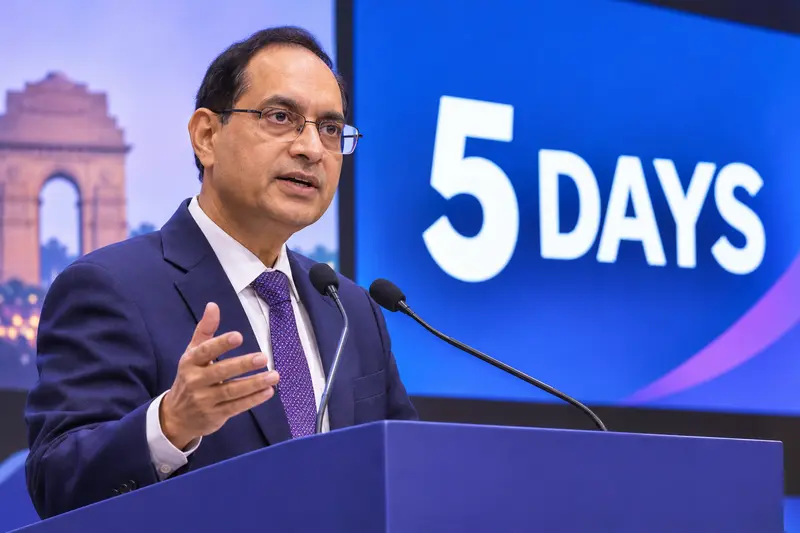
The Securities and Exchange Board of India (SEBI) plans to simplify the rules for foreign portfolio investors (FPIs) and cut registration time to as little as five business days, chairman Tuhin Kanta Pandey said on Friday, 20 November 2026. Speaking at the CII-DFS Financing Summit 2026, he said a consultation paper would follow "very soon" to remove constraints that other countries do not impose. This article is a summary of what was said, and the regulator has not yet published a circular for the new measures.
The five-day target
Pandey said the regulator is working to reduce the time taken to onboard an FPI to as little as five business days. Some foreign investors registered under the Swagat FPI framework have already completed onboarding within that period, he said. Around 740 FPIs have registered under the Swagat framework, which accounts for about 17 per cent of total FPI assets under custody.
The five-day figure is a target and not a rule that applies to every applicant. The measures SEBI has already introduced, as listed by Pandey, include digitising FPI onboarding, accepting digitally signed powers of attorney, and enabling net settlement to reduce funding costs. SEBI worked with the Reserve Bank of India on the digitisation, and a joint SEBI-RBI working group on a "Common Application Form" is expected to begin work soon.
Pandey said that from 1 December the KYC review cycles for applicable FPIs will be extended from one and three years to two and eight years respectively. In practice, FPIs that are classed as eligible will have to refresh their KYC documents less often. The circular text should be checked before an investor relies on these figures.
For non-resident Indians, overseas citizens of India and foreign nationals, he said eligible investors can now complete KYC and re-KYC without visiting India. SEBI has removed the requirement for NRIs to travel to India, and the process uses a video-based facility with guidelines already issued.
| Measure | What was said on 20 November |
|---|---|
| FPI onboarding time | Target of as little as five business days |
| Swagat FPI framework | About 740 FPIs, 17% of FPI assets under custody |
| KYC review cycles | From 1 December, one and three years extended to two and eight years |
| NRI, OCI, foreign national KYC | Can be completed without visiting India |
| Consultation paper on FPI constraints | Promised "very soon", not yet released |
Why SEBI is doing this
India's market has seen heavy foreign selling in the past two years, and November has been the opposite. Brokers' data on Friday showed FPIs putting a record $12.21 billion into Indian equities in the month so far, after more than $60 billion of outflows between September 2024 and October 2026. Pandey said that companies raised an average of around Rs 10 trillion a year through equity and debt markets over the past decade, and about Rs 9 trillion in the first seven months of FY27. India's equity market capitalisation has crossed $5 trillion, and the country has more than 15 crore unique investors.
He described SEBI's approach as "optimum regulation", with rules proportionate to risk, and said the next phase of reforms would focus on simplifying access to capital and attracting long-term investment.
At a media interaction, Pandey also covered points that are not about FPIs. SEBI is exploring whether to build its own artificial intelligence model as part of digital public infrastructure, and Pandey said the proposal is at an initial stage and is being examined by a committee, flagging the risk of hallucinations and the need for safeguards. SEBI is working on a market-making framework to improve liquidity in corporate bonds, and listed companies no longer need to list all of their previously issued unlisted bonds, though new issues must still be listed.
A framework to protect investors in pre-IPO shares is under preparation, and a consultation paper on SME IPOs, including possible changes to lot sizes, is already out for feedback. Pandey declined to comment on proposals about securities transaction tax and long-term capital gains tax, and said SEBI has no role in determining the price of gold or silver.
What is still open
The consultation paper on FPI constraints is the part that matters most for foreign funds, because it would show which rules SEBI regards as unique to India. It has no date, and Pandey did not say which constraints would be removed. The consultation paper is the one to watch, and until SEBI publishes it, nothing about its contents can be taken as settled.
Foreign investors will want to see the circular on the 1 December KYC change, since it will define which FPIs are "eligible" for the longer cycle. The five-day timeline, for its part, will be tested by how many investors outside the Swagat framework can meet it.
This article is for information only and is not investment or financial advice.
About the Author
S
Subhash Gupta
Desk Editor
Subhash Gupta is a writer at Wirony, contributing articles that are reviewed and verified by the editorial team before publication. The publication prioritises accuracy, editorial…
S
4 min
What did you think?