/
Fed minutes: almost all officials expect more rate hikes, AI demand an inflation risk
Minutes of the Fed's October meeting show a 10-2 vote to hold rates at 3.75% to 4%, with two dissenters wanting a quarter-point rise. Almost all officials expect more increases, markets price a December hike, and Governor Waller says a half-point rise should be considered.
A
4 min
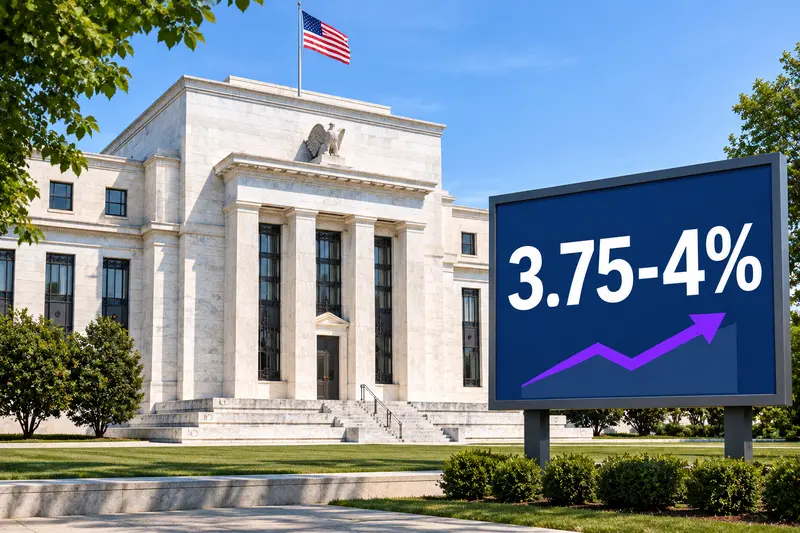
The minutes of the US Federal Reserve's October meeting, released on Wednesday, 18 November 2026, show that almost all officials expect interest rates to go higher. They also show that officials see demand linked to artificial intelligence as "a material source of inflation risk". Markets now fully price a quarter-point rise at the next meeting, on 8 and 9 December.
The Federal Open Market Committee voted 10 to 2 to keep the overnight borrowing rate in a range of 3.75 per cent to 4 per cent. The two dissenters, Governor Lisa Cook and Cleveland Fed President Beth Hammack, wanted a quarter-point increase. The minutes say "almost all participants" judged that further increases "would likely be appropriate" on their baseline outlooks, and that "some" policymakers favoured a quarter-point rise in October. Officials were confident that more increases would be needed but chose to wait for more information.
What do the minutes say about December?
A couple of participants said a larger increase might be needed in December. Governor Christopher Waller told CNBC the committee should consider a half-point rise and that the Fed may need to "shock" markets, and he is the only central banker publicly holding that view. St Louis Fed President Alberto Musalem expects as much as a full percentage point of increases by spring 2027. According to CME FedWatch, traders fully price a quarter-point rise on 8 and 9 December, give low odds to a half-point move and see a solid likelihood of two more rises in 2027.
| Item | What the minutes and markets show |
|---|---|
| October decision | Hold at 3.75% to 4%, by 10 votes to 2 |
| Dissenters | Lisa Cook and Beth Hammack, both for a quarter-point rise |
| Next meeting | 8 and 9 December; a quarter-point rise fully priced |
| Larger move | Waller says a half-point rise should be considered |
| Further path | Two more rises in 2027 priced; Musalem sees up to a full point by spring |
AI was central to the discussion. Officials saw demand tied to the technology as a source of inflation risk. They also saw it as a possible source of financial instability. Staff warned that off-balance-sheet leasing and circular financing among AI firms could amplify losses if returns are lower than expected, and most participants said that AI-related debt had grown quickly through complex and opaque structures. A few said that exposures were concentrated in a small number of firms.
What is the inflation picture?
October consumer prices rose 0.4 per cent overall and 0.3 per cent in the core measure, both 0.1 percentage point above expectations. Officials still expect inflation to fall sharply in 2027 and beyond as current shocks fade, but they worry that the effects of the Iran war and of President Trump's tariffs could become entrenched.
The "minutes" are the Fed's detailed record of what officials said at a meeting, published about three weeks after it. The "federal funds rate" range of 3.75 per cent to 4 per cent is the interest rate banks charge each other overnight, and it sets the base for most other borrowing costs in the United States. "Circular financing" means that companies invest in or lend to their own customers, who then use the money to buy the investors' products, so that the same money moves around in a loop and can make demand look larger than it is.
The CME FedWatch tool turns the prices of futures contracts into odds for each Fed decision. When it shows a move as "fully priced", traders have already built the expected rise into their bets, which means that a quarter-point rise in December would be no surprise, and that a decision to hold would move markets.
What would a half-point rise mean?
The Fed normally moves rates in steps of a quarter of a percentage point, so a half-point rise would be twice the usual step. Mr Waller's idea of using it to "shock" markets reflects a view that a bigger move would help to break the habit of expecting high inflation. Only he has said so publicly, and the minutes say that a couple of other participants thought a larger rise might be needed.
After the minutes, reports said gold fell to a low for 2025 and oil prices fell. Higher US interest rates tend to strengthen the dollar and weigh on dollar-priced metals, which is what the Indian market saw on 18 November, when metal stocks fell as a firmer dollar and rate expectations hit prices. For India, higher US rates can also pull money away from emerging markets and put pressure on the rupee. Those effects depend on how the Fed acts in December and are not certain.
What would change the picture is a softer inflation reading before 8 December, or a sign that AI-related financial stress is spreading. Readers should check the Fed's own statement and projections after the December meeting.
This article is for information only and is not investment or financial advice.
About the Author
A
Amita Sahani
Staff Writer
Amita Sahani writes for Wirony. Every story under this byline is reviewed and approved by an editor before it is published, and corrections are made openly.
A
4 min
What did you think?