/
SEBI sets minimum margins of 6%, 8% and 10% for commodity derivatives from 1 December
SEBI's circular of 17 November sets minimum initial margins of 6%, 8% and 10% for low, medium and high volatility commodity derivatives, with margin periods of risk of 2, 2 and 3 days. The same rules apply to farm and non-farm commodities from 1 December 2026 for one year.
R
4 min
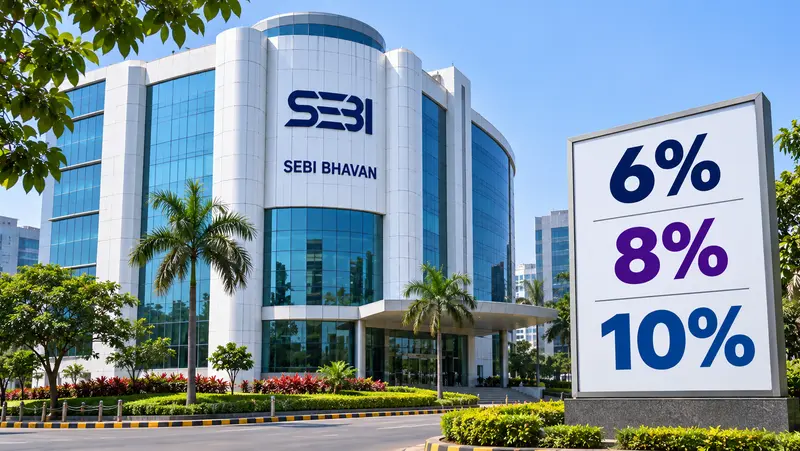
The Securities and Exchange Board of India (SEBI) has revised the minimum margins that traders must put up for commodity derivatives, and the new rules take effect on 1 December 2026. A circular issued on Tuesday, 17 November sets a minimum initial margin of 6 per cent, 8 per cent or 10 per cent, depending on how volatile the commodity is, and a minimum margin period of risk (MPOR) of two or three days. The same rules apply to farm and non-farm commodity derivatives.
The framework applies for one year from the date of the circular. SEBI's Board can extend it through a separate circular. The circular says it shall come into force from 1 December 2026.
SEBI groups commodity derivatives into three bands by volatility and gives each a floor for the initial margin and for the MPOR. The initial margin is the money a trader has to deposit before taking a position. The MPOR is the number of days of price movement that the margin is meant to cover while a defaulting trader's position is closed out. A longer MPOR means a larger cushion for the clearing corporation.
| Volatility band | Minimum initial margin | Minimum MPOR |
|---|---|---|
| Low | 6% | 2 days |
| Medium | 8% | 2 days |
| High | 10% | 3 days |
These are minimums. Exchanges and clearing corporations can ask for more when they judge that a contract is riskier, as they do now through additional and extreme-loss margins. The circular does not name the contracts that fall into each band, and it does not say how a commodity is assigned to a band. That job is left to the market infrastructure institutions, which is the name SEBI uses for exchanges, clearing corporations and depositories.
Why SEBI made the change
SEBI says it acted after representations from market participants, recommendations of a working group that was reviewing the rules for agricultural commodity derivatives, and the advice of its Risk Management Review Committee. Business Line reported the move as a cut in trading margins, while the circular itself speaks of revised minimum margins. The circular does not publish the earlier margin levels, so the size of any reduction cannot be checked from it. Traders should compare the new minimums with the rates their own exchange currently charges.
The circular treats farm and non-farm contracts alike. Under one table, the volatility band, not the type of commodity, is what sets the floor, so a volatile metal and a volatile crop face the same minimum.

The following is an illustration, not a figure from the circular. A trader who takes a commodity futures position worth Rs 10 lakh needs at least Rs 60,000 as initial margin if the contract is in the low volatility band, Rs 80,000 if it is in the medium band and Rs 1 lakh if it is in the high band. Exchanges often ask for more than the minimum, so the amount actually blocked can be higher. The MPOR works behind the scenes: it sets how many days of price moves the clearing corporation must be able to absorb if the trader defaults, which is why the high band has three days and not two.
Who is affected
The rules apply to the exchanges that list commodity derivatives, their clearing corporations, the brokers who pass margin calls to clients and the traders and hedgers who use the contracts. Farmers' producer organisations, processors and traders who hedge crop prices in agricultural contracts are covered in the same way as speculators, since the circular does not separate them.
SEBI has told exchanges and clearing corporations to set up systems to apply the framework, to amend their bye-laws, rules and regulations where needed, to inform market participants including investors, and to post the circular on their websites. Brokers will pass the change to clients through updated margin statements, so the first practical effect will be on the margin figure shown when a client places an order after 1 December.
What traders should check
A trader holding a commodity position through 1 December should check the new margin requirement with the broker before the date, because a lower or higher rate changes how much money is blocked. Traders who use leverage should keep a buffer above the minimum, since exchanges can raise the rate at short notice when prices swing. Anyone who is unsure which band a contract falls into should look at the notices from the exchange where it trades, since the bands are not listed in SEBI's circular.
The one-year term also matters. If SEBI does not extend the framework, the rules lapse on the anniversary, and the market would return to whatever the regulator decides then. Readers who want the exact wording should read the circular on SEBI's website and the notices of the exchanges.
This article is for information only and is not investment or financial advice.
About the Author
R
Reyaansh Agarawal
Staff Writer
Reyaansh Agarawal contributes to Wirony, covering stories that are carefully reviewed and approved by the editorial team before publication. Wirony is committed to maintaining tran…
R
4 min
What did you think?