/
GST reforms from 1 November: automatic refunds, easier registration for small online sellers, fewer notices
Process reforms approved by the GST Council on 8 October start in phases from 1 November. They cover automatic refunds, simpler registration for small online sellers and a minimum of Rs 10,000 for show-cause notices. No tax rates change.
S
4 min
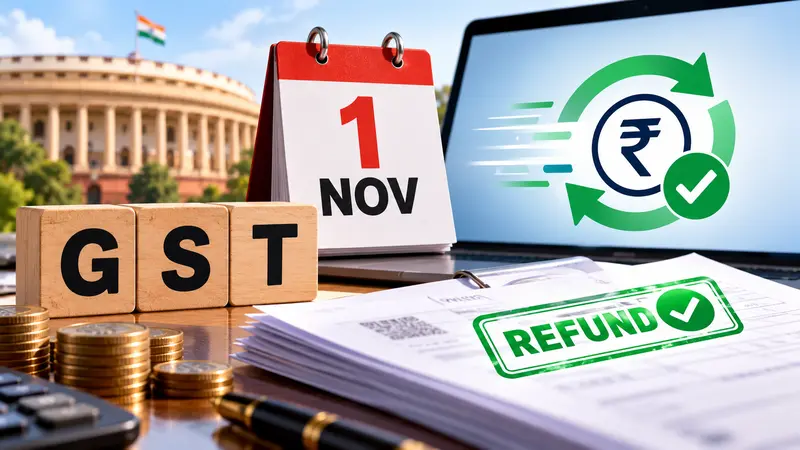
A set of GST process reforms approved by the GST Council on 8 October is due to start in phases from 1 November, with notifications and circulars expected as soon as Friday. The changes make refunds faster and automatic, simplify registration for small online sellers and cut down on notices. They do not touch tax rates, which the Council usually decides once a year for the next financial year.
Officials say the changes that can be made by administrative order will begin on 1 November, and those that need an amendment to the GST law are slated for 1 April 2027. The details below are as officials described them before the notifications, and the final text may differ.
Small sellers on e-commerce platforms
The change with the widest reach is for small suppliers who sell through e-commerce platforms in several states without having a physical presence in each. About 9.5 lakh such sellers are expected to benefit. To qualify, a seller must pass on input tax credit of no more than Rs 2.5 lakh a month.
Such a seller will be able to declare a platform's warehouse in a state as the principal place of business there. A genuine physical presence is needed in only one state, where physical verification and Aadhaar authentication will be done. In the other states, registration will follow with the platform's consent, without a tax officer's involvement. Delivery services by unregistered riders through e-commerce platforms attract GST at 5 per cent.
Refunds of excess balances in the electronic cash ledger will be sanctioned automatically, without an officer's intervention. The time limit for issuing an acknowledgement or a deficiency memo falls from 15 days to 10. For refunds on zero-rated supplies and inverted duty structures, 90 per cent of the claimed amount will be provisionally sanctioned automatically once the system has assessed the risk.
An inverted duty structure is one where the tax paid on inputs is higher than the tax collected on output, which builds up unused credit. The refund is widened to cover input services from 1 November 2026, and capital goods such as plant and machinery from 1 April 2027, with refunds on those spread over 60 months. Sectors expected to benefit include FMCG, pharmaceuticals and food processing.

Registration, notices and penalties
The registration form, GST REG-01, will have drop-down lists for prescribed documents, and the portal will get clearer navigation and tooltips, to cut rejections and repeated queries. A circular will list the documents required. The government says 61 per cent of taxpayers already get automatic registration within three working days.
A minimum threshold of Rs 10,000 will apply to show-cause notices, to reduce the compliance burden and litigation. The Council's package also proposes changes aimed at separating tax disputes from crime: the arrest powers of GST officers would be removed, the threshold for prosecution would rise from Rs 1 crore to Rs 5 crore, and the maximum general penalty would fall from Rs 25,000 to Rs 10,000. For cases without fraud, a 5 per cent penalty would apply and the Rs 10,000 minimum penalty would be dropped.
| Reform | When | What changes |
|---|---|---|
| Small e-commerce sellers | 1 Nov 2026 | One state's verification, other states by platform consent |
| Cash-ledger refunds | 1 Nov 2026 | Automatic, no officer needed |
| Refund acknowledgement | 1 Nov 2026 | 15 days cut to 10 days |
| Show-cause notices | 1 Nov 2026 | Minimum Rs 10,000 |
| Inverted duty on input services | 1 Nov 2026 | Refund widened |
| Inverted duty on capital goods | 1 Apr 2027 | Refund over 60 months |
| Return forms | 1 Apr 2027 | Draft open for comment 1 to 30 Nov |
Goods vehicles, returns and what is not decided
Only tax officers of the supplier's state or the recipient's state would be allowed to stop goods vehicles, not those of a state the goods merely pass through, and interception would need specific intelligence and approval from an officer at joint commissioner level. A faceless assessment system for central GST taxpayers registered in several states is planned for 2027-28, after a public consultation before the Budget. The government also plans to revamp the return forms to reduce mismatches between sales reported and tax paid, with draft forms open for comment on the MyGov portal from 1 to 30 November.
An optional annual return for businesses with turnover up to Rs 5 crore that supply directly to consumers has been approved in principle, with the final decision left to a later meeting. Finance Minister Nirmala Sitharaman has said most rate and process issues have been dealt with, though further reform is possible. Traders and tax practitioners should wait for the circulars, since the arrest, prosecution and penalty changes need the law to be amended.
S
4 min
What did you think?