/
CSR spending hit Rs 40,794 crore in FY25, but poorest states got Rs 94 a person against Rs 455 in least needy
A Sattva Consulting and India Data Insights analysis says CSR spending reached Rs 40,794 crore in FY25, but the five highest-poverty states got about Rs 94 per person against Rs 455 in the five lowest-need states. Maharashtra gets 19 times Bihar's per-person funding.
A
4 min
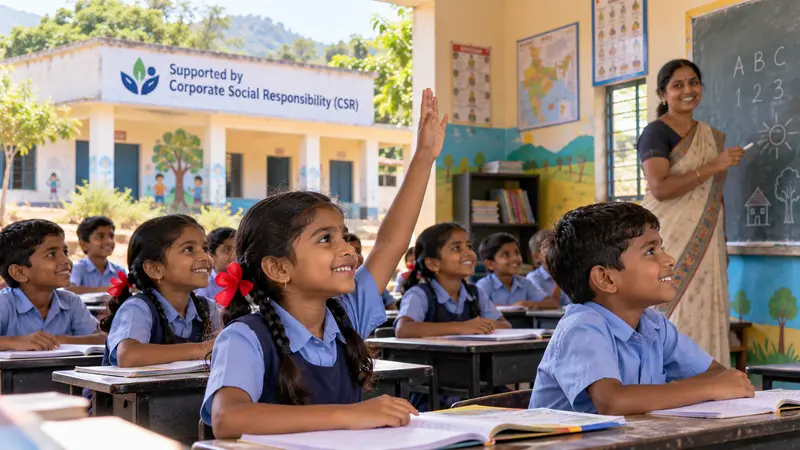
India's corporate social responsibility spending reached Rs 40,794 crore in the financial year 2024-25, but it did not go where the need is greatest. An analysis by Sattva Consulting and India Data Insights finds that the five states with the highest levels of multidimensional poverty received about Rs 94 per person in CSR funding, while the five states with the lowest need received about Rs 455 per person. The report was published on Monday, 26 October, and it is the work of one consulting firm and one data group and not of an official body.
The size of the gap
Total CSR spending has grown at a compound rate of about 15 per cent a year over the past decade, and about Rs 2.6 lakh crore has been spent since 2014. Education, healthcare, livelihoods and skilling, the environment and rural development together account for more than 80 per cent of the money.
The largest recipients are Maharashtra, Gujarat, Karnataka, Tamil Nadu and Delhi, the states where many large companies have their offices and plants. The report points to the case of Bihar. Its poverty index is nearly five times that of Maharashtra, yet Maharashtra receives roughly 19 times as much CSR funding per person. Between FY22 and FY25, Maharashtra gained Rs 3,381.9 crore in additional funding, while Bihar gained Rs 292.5 crore. Himachal Pradesh, Jharkhand, Odisha and Madhya Pradesh are among the other states that get little.
| Group | CSR funding per person |
|---|---|
| Five highest-poverty states | About Rs 94 |
| Five lowest-need states | About Rs 455 |
The coverage does not name the states in each group, so the exact composition of the two sets cannot be checked from the reports.
Why the money goes where it does
The reasons are simple. Under the Companies Act, companies that meet certain thresholds of profit, turnover or net worth must spend 2 per cent of their average net profit on social projects, and the law gives preference to the local area in which the company operates. A company with a factory in Gujarat or an office in Bengaluru will therefore tend to spend in the area around it. The companies that earn the most profit are headquartered in a few states, and a good deal of their giving stays close.
Projects are also easier to run where there is infrastructure, such as roads, partner organisations and banks. A company has to be able to monitor and report on its projects, and in remote or poor districts that takes more effort. This produces a pattern in which the places with the fewest services receive the least private funding.
The report says that funding for high-need states and districts is rising, but that the rise is still small compared with the development challenges. It offers a suggestion that is modest in size: redirecting an extra 5 per cent of the CSR funding of FY25 to high-need districts would roughly triple what those districts now receive. That is possible without any change of law, if companies and their foundations choose to fund projects further afield, and it would still leave most of the money where it is.
For companies, the finding is a reminder that the geography of their spending is a choice and that the law does not require them to restrict it to the neighbourhood of their plants. Many companies already fund projects in aspirational districts, and the data suggest that more could.
For state governments, the report is an argument to build the kind of ecosystem that attracts such funding: reliable local partners, clear processes and good data on needs. For civil society organisations in poorer states, it is a case for being visible to funders who are looking for places to give.
The report has limits. It relies on public disclosures by companies, which vary in quality, and the poverty measure used is one among several. The figures are for a single year, and the funding patterns of a few large companies can move them a long way. The report is also the work of a consultancy that serves the sector, so its recommendations are not neutral. Even so, the direction of the finding fits what many practitioners say: the money is large, it is growing, and it is concentrated in the states that need it least.
A
4 min
What did you think?