/
Cabinet clears 3% DA, DR hike to 63% for central staff and pensioners from July 1
The Union Cabinet approved a 3% hike in DA and DR on October 28, raising the rate from 60% to 63% from July 1, 2026. The move covers about 48.54 lakh employees and 68.71 lakh pensioners, with an annual cost of Rs 10,016.10 crore.
R
3 min
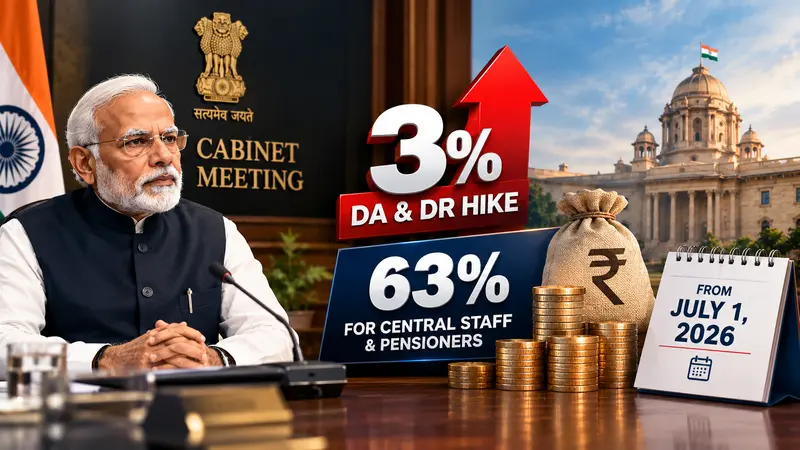
The Union Cabinet on Wednesday approved a 3% increase in Dearness Allowance (DA) for central government employees and Dearness Relief (DR) for pensioners, raising the rate from 60% to 63% of basic pay or pension.
The revised rate will apply retrospectively from July 1, 2026, meaning employees and pensioners are expected to receive arrears for the period since then.
Information and Broadcasting Minister Ashwini Vaishnaw announced the decision after the Cabinet meeting. In a statement contained in the Cabinet note, the government said the additional instalment is meant “to compensate against price rise”.
The move covers about 48.54 lakh central government employees and 68.71 lakh pensioners, taking the total beneficiary count to more than 1.16 crore people.
What the Cabinet decided
Dearness Allowance is a cost-of-living adjustment paid as a percentage of basic salary to government and public sector employees. Dearness Relief is the parallel payment for pensioners. Both are designed to protect take-home income when consumer prices rise.
The Cabinet’s decision lifts the DA and DR rate by three percentage points. For many households, the impact will be felt through the arrears component first, since the higher rate is effective from July.
The government has put the combined annual impact on the exchequer at Rs 10,016.10 crore.
| Item | Earlier rate (%) | New rate (%) | Effective from | Estimated annual cost (Rs crore) |
|---|---|---|---|---|
| DA/DR for central staff and pensioners | 60 | 63 | July 1, 2026 | 10,016.10 |
Data last updated: 28 October 2026, 4:13 PM IST
The Cabinet note described the increase as part of the accepted approach for adjusting DA and DR to reflect inflation.
DA is calculated as a fixed percentage of basic pay, and DR as a percentage of pension. For central government employees, the computation is linked to the All-India Consumer Price Index for Industrial Workers (AICPI-IW), following the approach recommended by Pay Commission frameworks.
Revisions are typically made twice a year, with the two standard effective dates being January 1 and July 1. The latest Cabinet decision follows that pattern by applying the higher rate from July 1.
For employees, the increase affects the DA component that is added to basic pay for salary calculation. For pensioners, the DR component is applied to pension. While the government has not detailed payment timelines in the material available today, retrospective implementation usually results in arrears for the months between the effective date and the date the new rate is paid.
DA is fully taxable as part of salary income under the Income Tax Act. That matters for workers whose taxable income may rise with the higher allowance, even as the aim of the payment is to offset cost pressures.
State-level pressure on pending dues
The central decision comes as some states face legal scrutiny over delayed DA and DR payments to their own employees and pensioners.
On October 27, the Punjab and Haryana High Court criticised the Punjab government for what it called a “defiant attitude” in complying with earlier directions on pending DA and DR instalments. The court directed the state’s Chief Secretary to appear in person on November 3 and to file a personal affidavit by October 30, subject to payment of costs of Rs 1 lakh.
Justice Harsh Bunger, hearing a contempt petition, said the circumstances could not be “countenanced in law” while dealing with allegations that the state had not released pending instalments at rates applicable to members of the All India Services serving in Punjab.
The contrast is sharp: while the Centre has cleared a fresh instalment for its workforce and retirees with a defined effective date, the Punjab matter highlights how DA and DR can also become a compliance and cash-flow issue when payments are held back.
For central government employees and pensioners, the immediate next step will be implementation through official orders that translate the new percentage into revised payouts and arrears. For Punjab, the next dates are already on the court calendar, with the affidavit deadline on October 30 and the personal appearance fixed for November 3.
R
3 min
What did you think?