/
8th Pay Commission: is 18 months of salary coming at once? Arrears, DA merger status and report timeline
A viral claim says central employees may get 18 months of salary at once under the 8th Pay Commission. It is an estimate of arrears, not a lump sum. The commission has 18 months from November 2025, the government has said no DA merger is under consideration, and no recommendations are out.
A
4 min
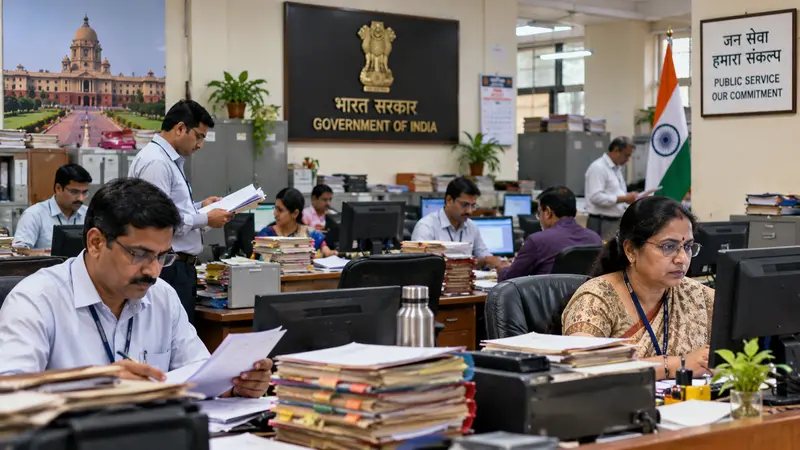
A claim that central government employees may receive 18 months of salary at once under the 8th Pay Commission has been trending in Telugu searches. The claim is a misreading. The 18 months is the time the commission has to submit its report, and any payment would be arrears, meaning the difference between old and new pay for the months before the new scale starts. No recommendations have been published, and no merger of dearness allowance with basic pay has been approved.
Where the commission stands
The 8th Pay Commission was constituted by a government resolution dated 3 November 2025. It is chaired by former Supreme Court judge Ranjana Prakash Desai. Professor Pulak Ghosh of IIM Bangalore is the part-time member and Petroleum Secretary Pankaj Jain is the member secretary. The Union Cabinet approved its terms of reference on 28 October 2025.
It covers about 50 lakh central government employees, including defence personnel, and 69 lakh pensioners, and its recommendations may affect the pay of state government staff too. It has 18 months to submit its final report, which runs to about May 2027, and it will submit interim reports as they are finalised. It is now in its consultation phase.
What the commission will weigh
The terms of reference tell the commission to consider pay, allowances and service conditions, the emolument structures and benefits in central public sector undertakings and the private sector, the country's economic conditions and the need for fiscal prudence, the resources needed for developmental expenditure and welfare measures, the unfunded cost of non-contributory pension schemes, and the likely impact on state government finances.
Where the 18-month figure comes from
The recommendations are likely to take effect from 1 January 2026. The minister said the specific date will be decided after the interim report, but that it should be 1 January 2026. If the report arrives around mid-2027 and the new scales apply from January 2026, the arrears period would run for about 18 months. One explainer site calculates the arrears as 18 months of the difference between new and old salary. That is a projection built on assumptions, not an official figure.
The amount would depend on the final recommendations, the fitment factor and whether any merger is accepted. It would be the gap between the old and new pay for each month, and not 18 full months of salary.
The current dearness allowance rate is 60% of basic pay, effective 1 January 2026. On 1 December 2025, Minister of State for Finance Pankaj Chaudhary told the Lok Sabha, in reply to Unstarred Question No. 212, that no proposal to merge the existing dearness allowance with basic pay was under consideration. One report says there has been no official reversal as of October 2026. The commission's verified social media account flagged as fake a viral claim of a 50% DA merger from 1 January 2026.

The commission held another round of meetings with employee organisations in Mumbai on 22 and 23 October 2026. Earlier meetings were held in Delhi, Ladakh, Kolkata, Bengaluru and other states and union territories. In most sessions, employee representatives called for changes to the fitment factor, dearness allowance, dearness relief and basic pay structures.
- Some unions want DA merged with basic salary when inflation reaches a set level.
- The Federation of National Postal Organisations wants the merger once DA exceeds 25%.
- Bharat Pensioners Samaj wants pensioners' DA and DR reviewed every three months instead of twice a year, and DR merged into basic pension after a threshold.
- One suggestion asks for a detailed review of how the All-India Consumer Price Index for Industrial Workers is calculated.
- The National Council (JCM) has proposed a fitment factor of 3.83.
Unions argue that a merger gives more lasting relief, since basic pay is the base for benefits such as house rent allowance, gratuity and leave encashment, though the formulas vary.
The 5th Pay Commission recommended converting DA into dearness pay when the price index base rises by 50%. The 6th Pay Commission rejected merging DA with basic salary at any stage and kept the twice-yearly review. The 7th Pay Commission kept the existing method of calculating DA and recommended no major changes.
The commission will now decide on these demands. The reports found do not report any decision or any specific fitment factor from the commission. Until it publishes its recommendations and the government accepts them, any figure for arrears or a new salary is an estimate.
A
4 min
What did you think?