/
TRAI caps IP port charges at Rs 42.3 lakh a year for a 10 Gbps port from 2027
TRAI released two regulations on 3 and 9 November. Annual IP-port charges are capped at Rs 5.6 lakh per 1 Gbps port and Rs 42.3 lakh per 10 Gbps port, and new interconnection must be IP-based, with existing E1/TDM links to migrate within three years. Both take effect on 1 January 2027.
P
4 min
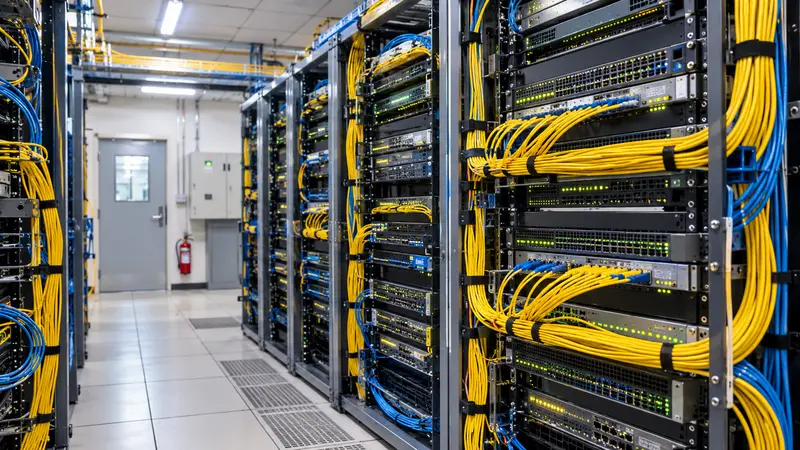
The Telecom Regulatory Authority of India has capped the annual charge for an IP interconnection port at Rs 5.6 lakh for a 1 Gbps port and Rs 42.3 lakh for a 10 Gbps port, in regulations released on 9 November 2026 that take effect on 1 January 2027. A second set of amendments, released on 3 November, makes IP-based interconnection the rule for all new links and gives operators three years to move existing E1/TDM links to IP. Together they replace a framework built for older circuit-switched technology, with port charges that were last revised in 2012.
The port charge is the amount an operator that seeks to connect pays the operator that provides the connection, for terminating links at its point of interconnection. Calls and data between networks pass through those points, so the charge sets part of the cost of connecting one network to another.
What the two regulations do
The Telecommunication Interconnection (Third Amendment) Regulations, 2026, issued on 3 November, change how and where networks meet. TRAI's press release lists these main points:
- Interconnection providers and seekers can agree on locations at the level of a licensed service area, which moves traffic from the older charging-area level to the service-area level. Existing traffic at the older points is to be migrated within three years, in phases.
- All new interconnections established after the rules take effect must be IP-based. All existing points that work on E1/TDM must move to IP within three years, in phases.
- For IP-based points, maximum call-handling capacity is set by concurrent session-handling capability and link bandwidth.
- There is now a procedure for surrendering a point of interconnection voluntarily, for example when traffic falls or services are withdrawn from an area. Earlier the rules covered only disconnection, a step taken for reasons attributable to the other operator.
- The validity of bank guarantees, and the interval for reassessing them, goes from six months to twelve, with a revised method for setting the ceiling.
- Interest on late payment of interconnection charges is mutually agreed, subject to a ceiling of the State Bank of India's one-year marginal cost of funds-based lending rate plus two percentage points.
- Operators must report on the shift of traffic to service-area points and on the migration to IP.
- A graded framework of financial disincentives applies to contraventions.
The port-charge ceilings: Rs 5.6 lakh and Rs 42.3 lakh a year
The Telecommunication Interconnection (Port Charges) (Third Amendment) Regulations, 2026, issued on 9 November, add a framework for IP ports alongside the one for E1/TDM ports. The definition of a port now covers both the legacy E1 port, at 2.048 Mbps, and IP ports, with bandwidth stated in Mbps or Gbps.
| Port type | Annual ceiling |
|---|---|
| 1 Gbps IP port | Rs 5.6 lakh |
| 10 Gbps IP port | Rs 42.3 lakh |
| E1 port | Charges prescribed earlier continue |
The ceilings are not fixed prices. Providers and seekers may agree to charge less, and may agree on port capacities other than 1 Gbps and 10 Gbps, with charges worked out in the open by the same method as the two ceilings. The charges apply uniformly across fixed-line, mobile, national long-distance and international long-distance services.
A simple calculation shows how the schedule treats bigger ports. The 10 Gbps ceiling is 7.55 times the 1 Gbps ceiling, which works out to Rs 4.23 lakh per Gbps against Rs 5.6 lakh, about 24% less per unit of capacity. That figure is derived from the two ceilings and is not stated by TRAI.
The regulator says the existing rules were based on legacy E1/TDM technologies and the charges in them were last revised in 2012. It reviewed them in a process that began with a pre-consultation paper on 3 April 2025, followed by a consultation paper on 10 November 2025. Written comments closed on 15 December 2025 and counter-comments on 29 December. Seventeen stakeholders submitted comments, nine submitted counter-comments, and an open house discussion was held on 28 January 2026.
What changes for operators and callers
For operators the two regulations change the economics and the engineering at once. Moving from E1/TDM links to IP ports means new equipment and new interconnection agreements within three years, and the ceilings set the most that an operator can charge another for each IP port. The bank-guarantee change, from six to twelve months, reduces how often guarantees must be renewed and reassessed. The voluntary surrender procedure lets an operator give up a point it no longer needs without having to treat it as a dispute.
For ordinary callers the effects are indirect. TRAI says the shift to IP improves bandwidth efficiency, call quality and end-to-end call performance, and that moving traffic to service-area points would simplify routing and use scarce numbering resources more efficiently. Interconnection charges are paid between operators, not billed to customers, so any effect on retail prices depends on how operators pass costs on.
The regulations take effect on 1 January 2027. TRAI says the full text and explanatory memorandum are on its website. Questions on the Third Amendment may go to its Advisor for Networks, Spectrum and Licensing.
Sources
- TRAI releases The Telecommunication Interconnection (Port Charges) (Third Amendment) Regulations, 2026, Press Release No. 157/2026 (Telecom Regulatory Authority2026-11-09
- TRAI released the Telecommunication Interconnection (Third Amendment) Regulations, 2026, Press Release No. 148/2026 (Telecom Regulatory Authority of India)2026-11-03
About the Author
P
Prateek Rawat
Staff Writer
Prateek Rawat is a contributor to Wirony. All articles published under this byline undergo editorial review and approval before publication, with any necessary corrections handled…
P
4 min
What did you think?