/
NCERT adds a 20-hour computational thinking and AI module for Classes 9 to 12, with deepfake lessons
NCERT has released a 20-hour introductory module on computational thinking and artificial intelligence for Classes 9 to 12, developed with IIT Madras and IIT Jodhpur. It is activity-based, needs no prior knowledge, and covers deepfakes, data privacy, misinformation and fairness.
R
4 min
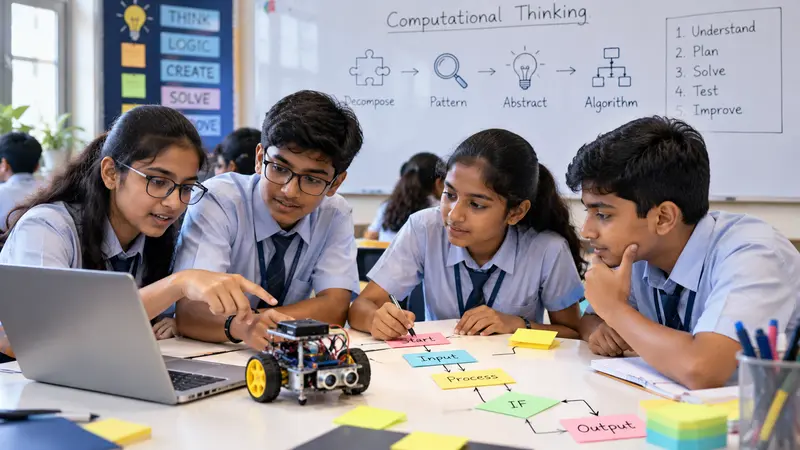
The National Council of Educational Research and Training has introduced a 20-hour introductory module on computational thinking and artificial intelligence for students of Classes 9 to 12. The module was developed in consultation with IIT Madras and IIT Jodhpur. It assumes no prior knowledge of the subject and is designed to be taught through activities and not through coding.
What the module covers
The module takes students through everyday uses of artificial intelligence and how machines learn from examples. It also covers digital safety and the ethical use of personal data, and these parts are likely to matter most to teenagers who use apps every day. The topics include:
- how to detect deepfakes, which are fake images, audio or video made to look real;
- data privacy and what happens to the information that people share online;
- misinformation and how it spreads;
- fairness, and the ways in which a system that learns from data can treat groups of people unfairly;
- how to check information that a computer system produces instead of accepting it as it stands.
The aim, according to the description of the module, is to help students understand how these systems work, recognise their limits, and become confident and responsible users who judge the output for themselves. It also stresses that human judgment, creativity and ethics stay at the centre of learning.
The module relies on discussion, practical exercises, experiments and reflection. Teachers can run the activities with or without digital devices, which is meant to make the module usable in schools with limited equipment. That point is important in a country where the access of schools to computers and internet connections varies a great deal.
One blog describes the module as five units and a 108-page textbook that can be downloaded free of charge from the NCERT website. That description comes from an unofficial source, and the structure should be checked against the NCERT document itself. The reports also do not give a start date or a rollout timeline beyond saying that students will study the module, and they do not say whether teachers will be trained to deliver it.
Why the module matters
School education already has some space for the subject. The National Education Policy of 2020 promotes computational thinking and coding from the middle years, and CBSE offers artificial intelligence as an elective skill subject in secondary classes. What is new about the NCERT module is that it is short, is meant for every student and puts safety and judgment ahead of programming.
Students of this age are already using tools that write essays, answer questions and produce pictures, and many of them cannot tell when the answers are wrong. Deepfakes and fake videos have been used for fraud and harassment, and several cases have involved schoolchildren. A short school course that teaches students to ask where a picture came from, how a claim can be checked and what data a service collects about them addresses real problems.
The choice of a computational thinking approach is also notable. Computational thinking is the habit of breaking a problem into steps, finding patterns and designing a solution that a machine or a person can follow. It does not require advanced mathematics, and it can be taught through puzzles and games. By placing the course in the senior classes, NCERT is aiming at students who are close to choosing subjects and careers.
What families can do at home
Parents can support the module without any technical knowledge. They can ask children where a picture or a video came from before it is shared, look at who posted it and whether other sources show the same thing, and talk about which apps are collecting their information. Those habits are the same ones that the module aims to teach, and they work as well at the dinner table as in a classroom.
The first question is how the module will fit into a timetable that is already full, since 20 hours has to come from somewhere. The second is who will teach it. A teacher who has never used the tools in question will find it hard to lead a discussion on how to detect a deepfake. The third is how it will be assessed, and whether it will be a part of the examination or an activity with no marks. Schools and state boards will decide those points, and the module will have an effect only to the extent that they find the time for it.
R
4 min
What did you think?