/
Maharashtra sets up three-tier committees to run its AI Policy 2026 and approve incentives and subsidies
Maharashtra has set up three committees to run its AI Policy 2026: a steering committee under the chief secretary, an executive committee that approves incentives and subsidies, and a technical committee that checks proposals. The policy targets over Rs 10,000 crore of investment and 1.5 lakh jobs.
A
4 min
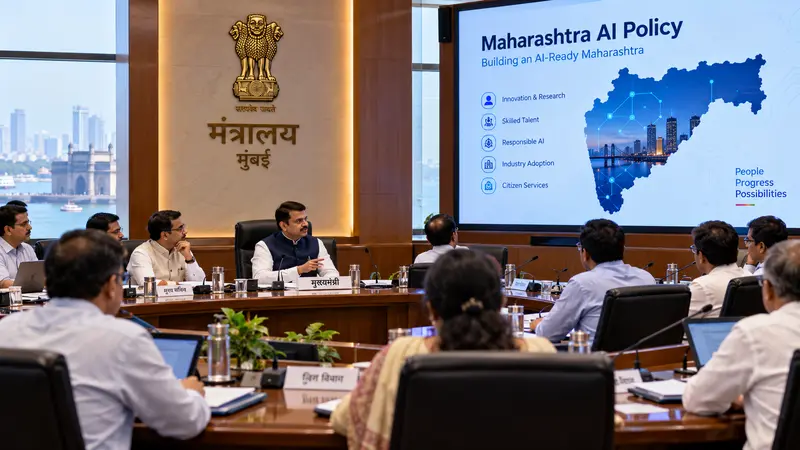
The Maharashtra government has set up three committees to oversee its Artificial Intelligence Policy 2026 and to approve the incentives and subsidies it offers. A Government Resolution was issued on Wednesday, 28 October. The committees run from strategy at the top to a technical check of each proposal, and an online portal is to support the process.
The three committees
| Committee | Chair | What it does |
|---|---|---|
| State Level Steering Committee | The Chief Secretary | Gives strategic direction and oversees how the policy is carried out; meets at least once every six months |
| Executive Committee | The Secretary of the Electronics, Information Technology and Artificial Intelligence Department | Approves proposals for incentives and subsidies, coordinates AI projects that involve several departments, helps to build partnerships with AI companies and research institutions, and reviews progress every quarter |
| Technical Committee | Not specified in the reports | Checks proposals for technical compliance and eligibility, recommends suitable cases to the Executive Committee, and monitors approved projects |
The Steering Committee includes senior officials from the departments of finance, industries, planning, higher and technical education, revenue, energy, and skills and employment. The reports do not name the members of the Executive Committee or the Technical Committee.
How a proposal would move
As the resolution describes the roles, a company that applies for support would first have its proposal examined by the Technical Committee, which checks whether it meets the technical requirements and is eligible. The cases that pass would be recommended to the Executive Committee, which decides whether to approve the incentive or subsidy. After approval, the Technical Committee monitors the project. The Steering Committee sits above this process and sets the direction. An online portal is to help to implement the policy, though the reports give no name, launch date or features for it.
The policy itself
The cabinet approved the policy earlier this year, and it was announced on 6 May. The reports describe incentives that include a capital subsidy of up to 20 per cent of the fixed capital investment, a 100 per cent remission of stamp duty, and an electricity tariff incentive of Rs 2 per unit for 10 years. The policy aims to attract more than Rs 10,000 crore of investment and to create more than 1.5 lakh jobs by 2031.
The latest resolution does not set out incentive amounts or new targets. It deals only with who decides.
According to an earlier report on the policy, the state plans to make at least 2,000 graphics processors available for AI applications, with a shared computing model for government departments, and to create datasets in Marathi, regional dialects and tribal languages through a State AI Data Exchange. It will be carried out through a dedicated Maharashtra AI Mission, aligned with the Centre's India AI Mission, and government departments will have to carry out an AI readiness audit every year.
The policy provides for six centres of excellence, in healthcare, agriculture, education, urban development, the Marathi language and finance, five AI innovation cities and 12 incubators for start-ups. It sets up a Rs 500 crore venture capital fund, offers about 5,000 small and medium businesses up to 20 per cent of their AI implementation costs, and aims to train about two lakh people and to develop 50 AI tools and use cases for public services and businesses.
Incentive schemes depend on how quickly and clearly applications are decided. A policy that promises a subsidy but has no body to approve it leaves investors uncertain, and the setting up of the committees means there is now a defined route for approvals. The resolution sets a rhythm of reviews as well, with the Steering Committee meeting at least every six months and the Executive Committee reviewing progress every quarter.
For businesses, the practical questions are the timing of decisions, what documents the Technical Committee will ask for, and whether the portal accepts applications from the start. The reports do not answer these.
Maharashtra has been trying to attract investment in digital infrastructure and technology, and on Tuesday its cabinet cleared Rs 66.82 crore for Bajaj Auto under the state's electric vehicle promotion policy. The AI policy is meant to make the state a more attractive place for similar investment.
The resolution is a step in administration and does not by itself bring investment. The measure of the policy will be how many proposals are approved, how much of the promised support is paid, and how many jobs result by 2031.
A
4 min
What did you think?