/
Poverty fell, but not '50 crore out of extreme poverty': what the World Bank says and what economists dispute
The World Bank says extreme poverty in India fell from 27.1% to 2.6% between 2011 and 2023, and that 496 million people left poverty at a higher line. Those are two different measures. Economists also question whether the two consumption surveys can be compared at all.
R
5 min
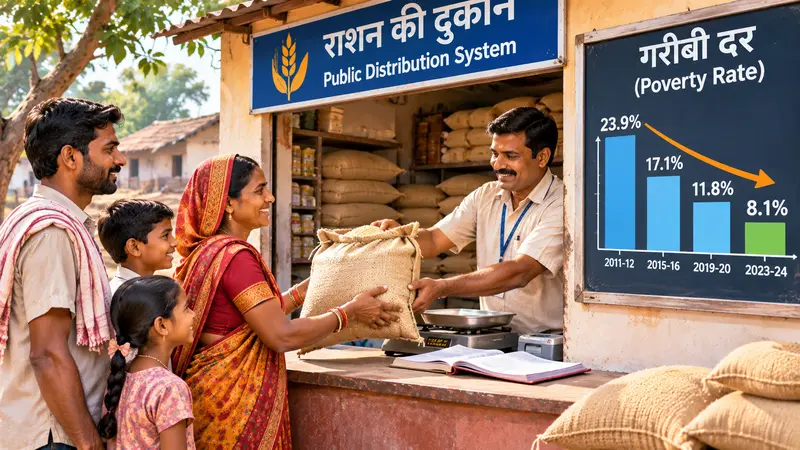
The World Bank's latest poverty and equity brief on India has produced a headline the government is proud of: extreme poverty, measured at $3 a day in 2021 prices, fell from 27.1% in 2011 to 2.6% in 2023. The Prime Minister called it "a historic fall in poverty" and "a generational rise in opportunity". In the retelling, the number has turned into a claim that about 50 crore Indians have been lifted out of extreme poverty. That is not what the brief says, and the gap between the two is a good place to start.
The figure of 496 million people refers to a higher bar. The brief uses three international lines in 2021 prices: $3 a day for extreme poverty, $4.20 for the lower-middle-income group, which is where India sits, and $8.30 for upper-middle-income countries. At the $4.20 line, the share of Indians below it fell from 57.7% in 2011 to 16.1% in 2023, and that fall is where the nearly 500 million people who moved above the line come from. At the $3 line, the fall in the share is dramatic, but the number of people concerned is far smaller. The two statements are both supported by the report, but they cannot be merged into a single claim about "extreme poverty".
What the brief actually shows
At the $3 line, poverty was 27.1% in 2011, 5.3% in 2022-23 and 2.6% in 2023. At $4.20, it was 57.7% in 2011 and 16.1% in 2023, which means about 233 million people remain below that line, and the bank projects the share to fall to 14.2% in 2026 and 12.1% by 2028. At $8.30, about 80% of Indians are still below the line. Rural poverty at $4.20 is 19.3% and urban poverty is 8.6%. About 57% of the remaining poor live in a contiguous belt of states from Uttar Pradesh to West Bengal.
The bank credits consumption growth, a rise in employment, especially among women entering paid work, and a wider set of social transfers, including free food grains that reach about 80 crore people. Employment rose by about 13.4 crore between 2017 and 2023, but the brief also says the jobs were mostly in low-productivity informal or agricultural work and that real earnings were broadly unchanged. Youth unemployment rose from 14.6% to 15.9% between the first quarters of this and last financial year, and the rise was most visible among young rural women. The same brief records that the top 10% of wage earners earned about 13 times the median earnings of the bottom 10%.
The inequality measure is more contested. The brief puts India's consumption Gini at 28.8 in 2011-12, 25.5 in 2022-23 and 23.0 in 2023, which would make India one of the most equal countries in the world. The brief itself cautions that consumption surveys under-capture wealthy households, and the 2026 World Inequality Report, which uses income data, finds that the top 10% take about 58% of national income while the bottom half gets about 15%.
Why economists question the numbers
The sharpest criticism is about the data. The 2022-23 Household Consumption Expenditure Survey is the first full consumption survey after 2011-12, and scholars who have examined it say it is not strictly comparable with the earlier rounds. The sampling design changed, the way items are grouped changed, and for the first time households were visited three times, a month apart. The bank's own methodology note concedes that the two surveys may produce substantially different consumption estimates and says comparability has to be managed. Critics point out that the bank dropped an earlier Indian survey round from its series over comparability worries, then made an exception for this one.
A second point is how consumption is counted. The bank adjusted the expenditure measure in four areas, including the value of free or subsidised items such as free food grains, and, for 2022-23, free school uniforms and footwear. Past practice in India's own surveys excluded free transfers. Counting them raises measured consumption among poor households and lowers measured poverty and inequality. Critics note that this adjustment was applied to India and not to other countries, and that unadjusted, the 2022-23 consumption Gini would be 29.5, not 25.5.
Third, India has no officially accepted poverty line for these years. The Tendulkar Committee line dates to 2009 and the Rangarajan Committee's line was never accepted by the government. Economist Mehrotra argues that the government stopped producing its own estimates in 2014 and now leans on the bank's. Changing the international line also matters: the move to 2021 prices lifted the lowest line by about 40%, from $2.15 to $3, and the bank's April 2025 estimate at the old line put extreme poverty at 2.3% in 2022-23, down from 16.2% in 2011-12.
Defenders respond that the method is vetted with each country, including India, before publication, and that other approaches agree broadly on the direction. An analysis by a United Nations research institute finds a wide range of results from the same 2022-23 data depending on the method, but notes that the old national line updated for inflation gives about 5.3% poverty, in line with the bank's extreme-poverty figure for that year.
What a careful reading looks like
The honest conclusion has three parts. Poverty in India has fallen over the last decade or so by almost any method, helped by free grain, direct transfers, toilets, piped water and electricity, which have reached households that once had none. The size of the fall depends on the line and the survey, and the best number for extreme poverty is probably a range and not a single digit. And a country with about 233 million people below the lower-middle-income line, a persistent belt of deprivation across the north and east, graduate unemployment close to 40% among the young according to one university study, and public health spending of just over 1% of GDP has not run out of poverty to fight. The data argument will not be settled by a better headline. It will be settled by a fresh national poverty line, a comparable survey series and publication of the underlying household data, which several economists have been asking for.
Sources
R
5 min
What did you think?