/
Omar Abdullah to expand J&K cabinet on Tuesday: three vacancies, oath at Lok Bhavan, Srinagar, at 10.30 am
Chief Minister Omar Abdullah will expand and reshuffle his council of ministers on Tuesday at 10.30 am at Lok Bhavan in Srinagar, where Lieutenant Governor Manoj Sinha will give the oath. Three of the nine posts are vacant. The Congress is expected to stay outside the cabinet.
A
4 min
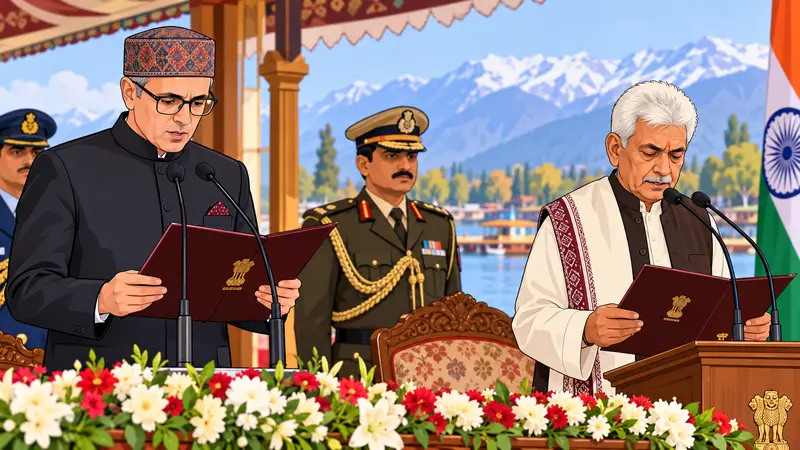
Jammu and Kashmir Chief Minister Omar Abdullah will expand and reshuffle his council of ministers on Tuesday, 27 October, with the oath to be administered at 10.30 am at Lok Bhavan in Srinagar. Lieutenant Governor Manoj Sinha will give the oath of office and secrecy to the new ministers. Three posts are vacant, and the names have not been made public.
The numbers behind the expansion
The Union Territory's Assembly has 90 seats, and the size of the council of ministers is capped at 10 per cent of the Assembly's strength. That limit allows a maximum of nine members, including the Chief Minister. The government now has six ministers, counting Abdullah, which leaves three berths open.
When the National Conference government took office after the elections of October and November 2024, only six ministers were sworn in, which left room for a later expansion. Abdullah, who met Sinha over the weekend, has said that the names are final and that the list is ready. The reports say that the final list had not been formally submitted to the Lieutenant Governor at the time of their meeting.
Who may be in and out
No names have been confirmed. There is talk that a couple of the present ministers may be dropped and that several new faces will be brought in to take the council to full strength. One report says three ministers may go and six new members come in, though that would exceed the cap of nine unless existing ministers are moved out. That claim comes from a single report and has not been confirmed elsewhere, and the arithmetic does not fit the limit on the size of the council.
The five ministers who took the oath in 2024 alongside Abdullah were Surinder Choudhary, who is the Deputy Chief Minister, Sakina Itoo, Javed Rana, Javaid Dar and Satish Sharma. Which of them, if any, are replaced will be known only on Tuesday.
The Congress, the National Conference's partner in the alliance, is expected to continue to support the government from outside and not take a place in the council of ministers. That arrangement has been in place since the government was formed, and it has sometimes caused friction, as the Congress has been critical of the government on some issues while staying out of its administration.
For the National Conference, the expansion is a way to widen representation. A cabinet at full strength allows it to give a place to different regions, communities and districts, in particular the Jammu division and the Pir Panjal and Chenab valley areas, where it needs support. It is also a message about the priorities for the rest of the term, since the portfolios of new ministers will show where the government wants to put its effort.
Abdullah has said in recent days that the names are final and that those who want a place do not need to approach him any more, which was taken as a sign that he has stopped taking lobbying and that the list will be a surprise to many. He had hinted at a reshuffle as well as an expansion, so some ministers may find their portfolios changed even if they keep their seats. The government has also been under pressure from within the National Conference and from allies to give a larger share to regions that feel left out.
Jammu and Kashmir is a Union Territory with a legislature, and its elected government shares power with a Lieutenant Governor who controls key subjects such as police and public order. The Chief Minister's room to act is therefore limited, and the choice of ministers is one of the few areas in which he has a free hand. Ministers' performance will also be judged against the promise of the restoration of statehood, which the government has said it will keep pressing for.
The things to watch on Tuesday are the list itself, whether women and members of minority communities are included, and who gets the main portfolios. Abdullah has said that the list is ready and that those who want a place do not need to knock at his door any more, an indication that he has made up his mind and wants an end to lobbying.
A
4 min
What did you think?