/
Mahabharata, Rajatarangini and Arthashastra enter UNESCO's Asia-Pacific register: what the listing means
The Mahabharata, Kalhana's Rajatarangini and Kautilya's Arthashastra have joined UNESCO's Memory of the World Regional Register for Asia and the Pacific, taking India's count to six, IGNCA said. The decision came at the 11th session in Jakarta. The register honours documents, not ideas.
S
4 min
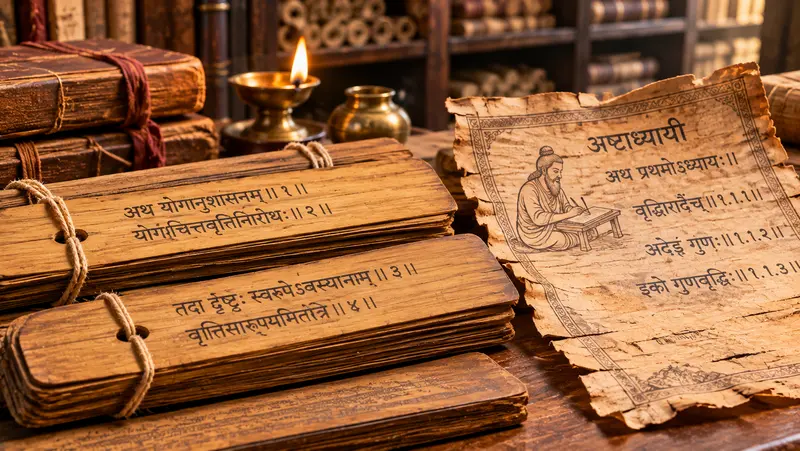
Three major works of India's literary and intellectual tradition, Kalhana's Rajatarangini, the Mahabharata and Kautilya's Arthashastra, have been included in UNESCO's Memory of the World Regional Register for Asia and the Pacific. The decision was taken at the 11th session in Jakarta, Indonesia, and was reported on 6 November 2026, citing Dr Sachchidanand Joshi, Member Secretary of the Indira Gandhi National Centre for the Arts, which prepared the nomination dossiers for all three. India's total in the regional register has risen to six.
The three works cover three different sides of Indian thought: history, ethics and epic narrative, and statecraft. Their listing is a genuine honour. It is also often misunderstood, so it helps to be exact about what has happened.
What the register is
UNESCO's Memory of the World programme, begun in the 1990s, aims to protect and give access to documentary heritage, meaning manuscripts, archives, books, recordings and similar material. It is separate from the World Heritage List, which covers monuments and natural sites, and from the list of Intangible Cultural Heritage, which covers living traditions.
The programme works at two levels. There is an international register and there are regional registers, of which the Asia-Pacific one is run by the Memory of the World Committee for Asia and the Pacific, known as MOWCAP. Nominations must meet at least one of its criteria, such as historical significance, artistic or stylistic importance, or social, community or spiritual relevance. Inscriptions are normally made every two years, and the 2026 cycle included a window from 15 February to 15 April for objections. The committee's general meeting was scheduled for 2 to 6 November in Jakarta, hosted by Indonesia's national archives.
Listing does not bring money or legal protection in itself. Its value lies in recognition, in encouraging preservation and in raising the chance that collections are digitised and shared.
An important point follows. The register usually inscribes specific documents or collections, not an idea or a story in the abstract. When India's entries were listed in 2024, they were described as particular items, including a manuscript of the Ramacharitamanasa and a 15th-century Panchatantra manuscript. UNESCO's own list for 2026 had not been published at the time of writing, so it is not yet clear exactly which manuscripts or collections of these three works are covered. That detail will matter to scholars.
The three works
The Rajatarangini, or "River of Kings", was written in Sanskrit verse by Kalhana in 12th-century Kashmir. It is a chronicle of the rulers of Kashmir and is often valued as one of the earliest works in the Indian tradition with a clear historical purpose. For students of the region, it remains a primary text.
The Mahabharata is among the longest poems ever composed. The epic explores duty, dharma and human values through the conflict between two branches of one family, and it contains the Bhagavad Gita. Its text has come down in many regional versions, and the work of preparing a critical edition took decades of scholarship.

The Arthashastra, attributed to Kautilya, is a treatise on governance, economics, diplomacy and statecraft. Its discussion of taxation, espionage and foreign policy still appears in university courses and in India's strategic debates.
Why it matters
The three join a short Indian list on the regional register. In May 2024, at the 10th meeting in Ulaanbaatar, three Indian items were inscribed: the Ramacharitamanasa, the Sahridayaloka-Lochana and a Panchatantra manuscript. In 2025 the Bhagavad Gita and Bharata's Natyashastra entered the international register.
For India, this reflects a sustained effort by IGNCA to bring classical knowledge into international heritage lists. The IGNCA statement describes the recognition as a matter of pride for India's civilisational continuity and its knowledge traditions. There is a practical side as well. Many Indian manuscripts remain in fragile condition in temples, private collections and small libraries, and international attention can help the case for funding, cataloguing and digitisation.
There is also room for a sober reading. Critics of heritage listings argue that they can turn living, argued-over texts into national trophies, and that a certificate does little for a palm-leaf manuscript slowly decaying in an unheated room. However, supporters reply that recognition is often the first step towards the money and attention that preservation needs. The test of this listing will be whether the documents become easier to study, not whether the announcement trends.
UNESCO and MOWCAP are expected to publish the full list of 2026 inscriptions, which will show what has been added from across the region and exactly which Indian documents are covered. IGNCA has not yet published the dossiers.
For readers, the more interesting follow-up is access. If the inscribed manuscripts are digitised and placed online, a student anywhere could read a work that was once available only to a small circle of scholars. That is what the Memory of the World programme says it exists to do.
Sources
About the Author
S
Subhash Gupta
Desk Editor
Subhash Gupta is a writer at Wirony, contributing articles that are reviewed and verified by the editorial team before publication. The publication prioritises accuracy, editorial…
S
4 min
What did you think?