/
Delhi's air hits 350, worst in 287 days: 10 stations severe, GRAP Stage II on, Diwali and farm fires ahead
Delhi's AQI reached 350 on 3 November, the highest since 20 January. Ten of 57 stations were in the severe band, led by Jahangirpuri at 462. Stubble smoke's share of PM2.5 is forecast to rise from 15% to 22% by 5 November. GRAP Stage II is in force; Diwali is on 8 November.
P
5 min
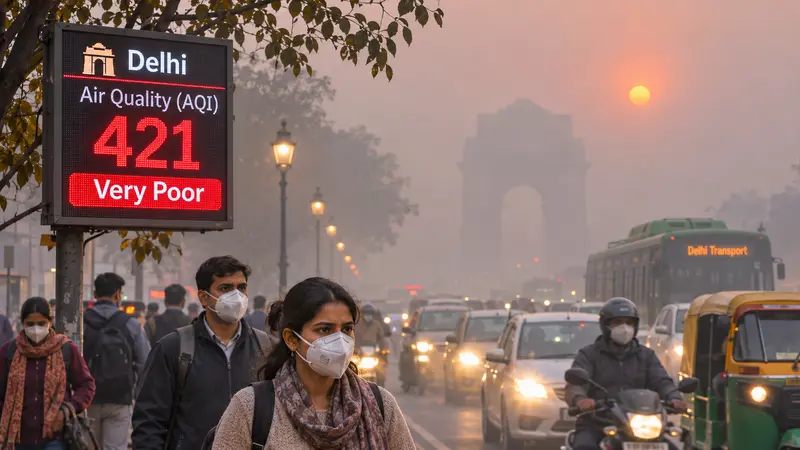
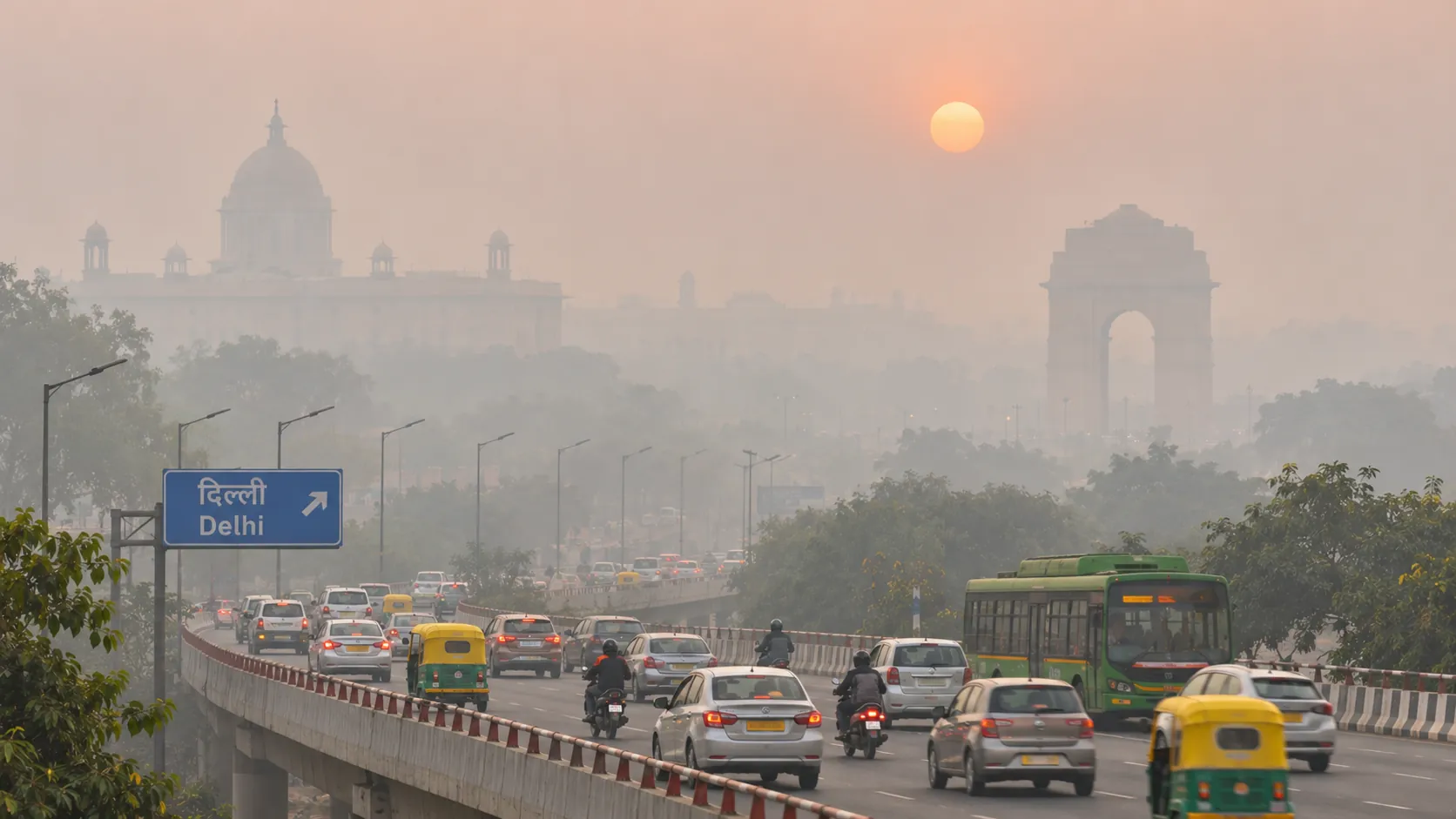
Delhi's air quality index reached 350 on Tuesday 3 November, the second day in a row in the very poor band and the worst reading in 287 days. The last time the city was worse was on 20 January, when the index stood at 378. The reading, taken at 4 pm, is up from 324 on Monday, 261 on Sunday and 117 on Saturday 31 October, which is a threefold rise in four days. Thick smog cut visibility through the day, and the forecast for the next several days offers little relief.
Of the 57 monitoring stations reporting, 10 were in the severe band, 35 in very poor and 12 in poor. The highest reading was at Jahangirpuri, which touched 462. Punjabi Bagh recorded 445, Rohini 442, DTU 438, Mundka 429, Alipur 428, Vivek Vihar 424, Narela 420, Bawana 415, IIT Delhi 411 and North Campus 401. On the Central Pollution Control Board's scale, 0 to 50 is good, 51 to 100 satisfactory, 101 to 200 moderate, 201 to 300 poor, 301 to 400 very poor and 401 to 500 severe. The main pollutant is PM2.5, the fine particles that settle deep in the lungs and carry the greatest risk for children, older adults and people with asthma or heart disease.
Where the smoke comes from
The official decision support system, which estimates what share of Delhi's PM2.5 comes from different sources, shows the change clearly. Stubble burning contributed 8.58% on 2 November and 15.3% on 3 November, and the forecast is 20.1% on 4 November and 22.2% on 5 November. Transport is estimated at 15.8%, residential sources at 3.9%, industry at 3% and construction at 2.2%. Those local sectors together account for about 40%. Neighbouring districts of the National Capital Region add roughly a fifth, with Jhajjar at 8.8%, Gurugram 4.1%, Sonipat 2.6%, Rohtak 2.5% and Mewat 2%.
Satellites detected 219 farm fires across six northern and central states on 2 November, including 98 in Punjab, 67 in Rajasthan and 48 in Madhya Pradesh, with none in Delhi itself. Since 15 September, 3,535 fires have been detected, with Punjab accounting for 1,612. The weather is working against dispersal. Safdarjung recorded a maximum of 29.1 degrees Celsius, about 1.4 degrees below the seasonal average, and a minimum of 16.4 degrees, 1.1 degrees above normal. A cool day and a mild night, with light winds, let pollutants accumulate near the ground instead of lifting away. The forecast for Wednesday is a mainly clear sky with a maximum of 28 degrees and a minimum of 15.
The reports do not attribute the spike to a single cause, and that is the honest reading. The jump from a moderate 117 to a very poor 350 in four days is what happens when a seasonal burst of smoke from fields arrives at the same time as stagnant air and a city's everyday emissions, and each factor makes the others worse.
What GRAP Stage II does, and what comes next
The Commission for Air Quality Management invoked Stage II of the Graded Response Action Plan across Delhi-NCR on 2 November, after the index reached 324, the first very poor day of the season. Stage I had been in force since 21 October. The stages are tied to the index: Stage I covers the poor band of 201 to 300, Stage II the very poor band of 301 to 400, Stage III the severe band of 401 to 450 and Stage IV anything above 450, and the measures of earlier stages continue when a higher one is invoked. Stage III has not been imposed.
Stage II relies on dust control, traffic management and public transport. It calls for mechanical or vacuum sweeping of identified roads, mainly at night and early morning, regular water sprinkling with dust suppressants at congestion points and heavy-traffic corridors, targeted action at hotspots and more inspections of construction and demolition sites. It raises parking charges to discourage private vehicles, asks states to run Metro, regional rail, CNG and electric buses more often, and staggers working hours for government and municipal offices in Delhi, Gurugram, Faridabad, Ghaziabad and Gautam Buddha Nagar. Residents' associations are to provide electric heaters to outdoor staff so that they do not burn biomass or waste for warmth. The Delhi Metro has added 20 extra weekday trips, or 40 in total, and non-BS-VI vehicles registered outside Delhi are being checked at the borders. A blanket construction ban is not part of Stage II.
The forecast from the early warning system of the Indian Institute of Tropical Meteorology points to very poor air from 4 to 6 November and then a fluctuation between very poor and severe over the following six days. That window includes Diwali on 8 November, when firecracker emissions could add to pollution that has already built up. If the index crosses 400 and stays there, Stage III would follow, with tighter limits on construction and polluting vehicles.
What it means for residents
The first point is that the next ten days are likely to be worse than the last four. Anyone with a respiratory or heart condition, young children and older relatives should limit time outdoors in the early morning and after sunset, when pollution is usually highest. A properly fitted N95 or equivalent mask helps outdoors, though cloth masks do little against fine particles. Keep windows closed in the worst hours and use a purifier in the room where the most vulnerable person sleeps. Schools and employers can reduce exposure by moving outdoor activity indoors.
The second point is structural. Stubble smoke is the swing factor this week, but transport alone is a larger steady contributor than any other sector in the city, and the share of burning will fade by late November while the rest does not. Stage-based measures are triggered by the index, which means they begin after air has already turned bad. The city has a few days before Diwali to show whether enforcement on dust, traffic and waste burning can hold the index below the 400 mark, because once the smoke from fields, festival fireworks and still air combine, no single order will clear it.
P
5 min
What did you think?