/
Tamil Nadu liquor costs Rs 10 more a bottle from 1 November; digital payment mandatory above Rs 1,000
From 1 November every bottle of liquor sold by TASMAC in Tamil Nadu costs Rs 10 more, because the maximum retail price now includes an environment and social welfare cess. The separate buy-back charge is folded into the price, and purchases above Rs 1,000 at state-run outlets must be paid digitally.
S
3 min
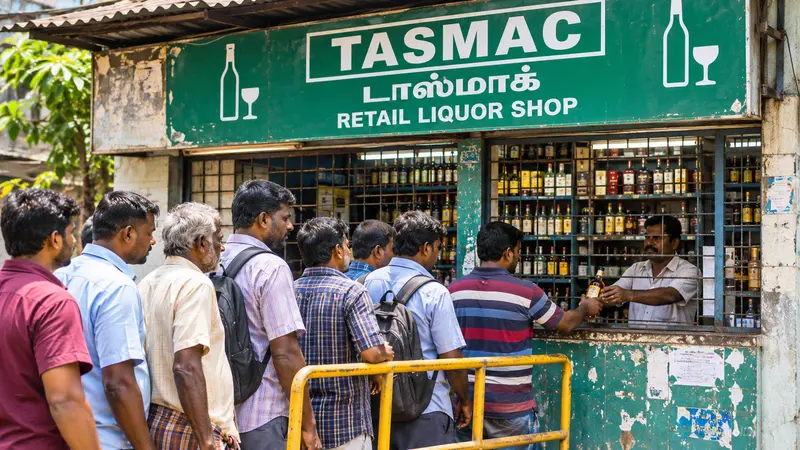
Liquor in Tamil Nadu will cost Rs 10 more a bottle from 1 November. The state's marketing corporation, TASMAC, is revising the maximum retail price to include an environment and social welfare cess, and the separate Rs 10 charge collected under the empty-bottle buy-back scheme is being scrapped and folded into the new price. From the same day, purchases above Rs 1,000 at state-run outlets must be paid digitally.
The price change
A TASMAC circular dated 29 October directs that the revised maximum retail price apply from 1 November. A bottle that now costs Rs 170 will cost Rs 180. The revision covers Indian-made foreign liquor, beer, wine, other state liquor and imported liquor, and the prices of liquor supplied to FL-2 and FL-3 licensed premises will also be revised. The reports describe it as a per-bottle increase and do not say whether it applies uniformly to all bottle sizes.
The increase is added as an environment cess. Prohibition and Excise Minister K Vignesh introduced a bill that allows a cess of up to Rs 20, and the Assembly passed it.
The buy-back scheme
Until now customers paid Rs 10 separately at the billing counter for the empty-bottle buy-back scheme. That separate charge is being scrapped, and the amount is folded into the revised price. Customers can still get Rs 10 back by returning eligible empty bottles. Staff may not collect any amount for the scheme beyond the revised price, and they may not charge more than the revised price by citing the bottle collection scheme.
The minister's justification, according to one report, was that consumers were being overcharged above the maximum retail price in the name of bottle collection. The scheme will start in three Chennai districts and five other districts where it had earlier faced opposition from retail workers.
Manufacturers and distributors must affix the revised price labels at production facilities, wholesale depots and retail outlets. Existing stock without the QR-code stickers for the buy-back scheme had to be identified and labelled by 31 October.
Retail shops will receive daily handling payments for receiving, storing and handing over empty bottles. One report says these range from Rs 750 to Rs 2,000 a day depending on location and average daily bottle sales, and another gives interim allowances of Rs 2,000 in the Chennai Corporation, Rs 1,800 in other corporations, Rs 1,600 in municipalities and town panchayats and Rs 1,500 in village panchayats. TASMAC operates 4,048 retail shops.
From 1 November, any payment above Rs 1,000 at state-run outlets must be made digitally, by UPI, debit card or credit card. A report says the threshold will fall to Rs 500 from January 2027. The stated aims are greater transparency, less risk in handling cash and better oversight.
The reports describe the change differently. One describes a new Rs 10 environment cess added to existing prices, and another says the separate Rs 10 buy-back charge that customers paid at the counter is being folded into the maximum retail price, so that customers no longer pay it separately. Both agree that a Rs 170 bottle will be marked at Rs 180 and that returning an eligible empty bottle brings back Rs 10.
The reports found do not give revenue estimates or projections for the cess, and they carry no reactions beyond the minister's justification. They do not say how many bottles are returned under the existing scheme, or whether the cess will rise toward the Rs 20 that the law allows.
S
3 min
What did you think?