/
E20 row: Centre rejects Karnataka's 26–31% ethanol claim, citing 893 samples. Why the two tests do not match
The Petroleum Ministry on 7 November rejected Karnataka's claim that some pumps sold petrol with 26–31% ethanol. It says 893 samples, 56 from Karnataka, met the 19–21% range, and questions the state's sampling and test method. Oil companies want joint testing. The dispute is unresolved.
R
5 min
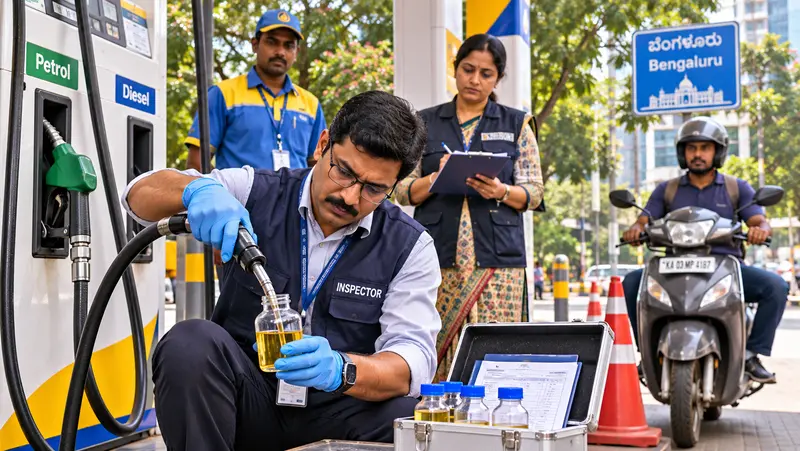
The Ministry of Petroleum and Natural Gas on 7 November 2026 rejected a claim by the Karnataka government that petrol sold at certain retail outlets in the state contains between 26% and 31% ethanol, well above the 20% blend sold nationally. The ministry said that E20 supplied by the three public sector oil marketing companies meets the Bureau of Indian Standards specification, IS 17021, and that 893 samples taken across 27 States and Union Territories were found compliant, including all 56 from Karnataka.
The dispute touches every driver in the country, and it has grown into a test of whose numbers can be trusted. So far only one side's full account has been published in the official record available. Karnataka's own press release, from its Department of Food, Civil Supplies, Consumer Affairs and Legal Metrology, was not available at the time of writing, and its claims are set out here as the Centre describes them.
What each side says
Karnataka's reported position is that petrol at some outlets had 26% to 31% ethanol. It also estimated an annual consumer loss from lower mileage of about Rs 62,000 crore and vehicle repair costs of about Rs 39,000 crore, a total of about Rs 1.01 lakh crore.
The Centre and the three oil companies, Indian Oil, Bharat Petroleum and Hindustan Petroleum, make four arguments.
The sampling was wrong. The Motor Spirit and High Speed Diesel Control Order and the Marketing Discipline Guidelines 2024 require six one-litre samples to be drawn: two for the dealer, two retained and two sent to a specified laboratory, with labels jointly signed. The companies say a September exercise followed the route through their laboratories, but that samples in the October exercise were taken without their representatives, and that they have not received retention samples, outlet details or laboratory reports.
The laboratory and method are not shown. The findings, they say, rest on certificates from a third-party laboratory, not one specified under the Control Order. IS 17021 prescribes certain methods. If gas chromatography is used, the sample must first be diluted 1:1 and the result corrected against a reference material. The certificates simply say "Ethanol % by Gas Chromatography".
The density does not fit. The certificates show densities of 0.742 to 0.749 g/cc for samples said to have 26–31% ethanol. Tested E20 samples recorded 0.752–0.760 g/cc. Since ethanol is denser than petrol, more ethanol should ordinarily raise the density, not lower it. This is the most striking technical point, and if the figures are right, it needs an explanation.
Their own tests are clean. Under a Quality Coordination Cell exercise with the Centre for High Technology, 893 samples from IOCL (330), BPCL (280) and HPCL (283) were all within the 19–21% range. The 56 Karnataka samples recorded 19% to 20%, with an average of 19.30%.
The companies also argue that they have no commercial reason to over-blend, because each extra litre of ethanol adds to procurement cost. Blending is done through calibrated systems at refineries and depots, not by hand.
Why it matters
Ethanol blending is one of the government's largest energy policies. Over the 2025-26 supply year, which ended on 31 October 2026, the oil companies blended 1,134 crore litres against petrol sales of about 5,673 crore litres, which works out to almost exactly 20%. Since 2014-15, the ministry says, the programme has saved more than Rs 1.97 lakh crore in foreign exchange, replaced about 316 lakh tonnes of crude, cut about 952 lakh tonnes of carbon dioxide and paid more than Rs 1.66 lakh crore to farmers.
Those national figures do not settle what is in a particular tank, however. An average near 20% says nothing about one pump, and the Centre's 893 samples came from its own system. A state testing independently is entitled to do so, and consumers have long complained about mileage. Independent verification is therefore the only way this ends.
On mileage, the government's position has been stated before. Its August 2025 response said that vehicles calibrated for E20 may lose about 1–2% in mileage, and some others about 3–6%, depending on the vehicle. The ministry argues that Karnataka's Rs 62,000 crore figure rests on a blanket assumption of a 10% loss across all vehicles and is not scientifically established, and that the Rs 39,000 crore repair estimate needs evidence. It notes that more than 30 crore two-wheelers and 4 crore four-wheelers have run on E20 for over three years with no widespread failures reported.
Critics will reply that older vehicles are the real concern, that an absence of reported breakdowns is not the same as an absence of wear, and that drivers had no choice of fuel. A small percentage of mileage lost, spread over tens of crores of vehicles, is also real money for households even if the state's figure is too high.
What happens next
The oil companies have asked Karnataka for complete sampling documents, outlet-wise reports and details of its method, and they want access to counterpart samples for independent testing at an authorised laboratory, with both sides present. They say any deviation established through the prescribed procedure will be dealt with under the guidelines.
That offer is the way forward. A joint test using the referee method would answer the question quickly. If Karnataka agrees, the result will be hard for either side to dispute. If it does not, or if the companies drag their feet, the row will turn political.
Drivers in Karnataka can keep their fuel bills and note any sudden drop in performance. Those with a specific complaint can raise it with the oil company or the state's legal metrology department, and can ask a pump for a filter paper test or a density check, which outlets are generally expected to provide. Until a joint result is published, neither claim should be treated as proved.
Sources
About the Author
R
Reyaansh Agarawal
Staff Writer
Reyaansh Agarawal contributes to Wirony, covering stories that are carefully reviewed and approved by the editorial team before publication. Wirony is committed to maintaining tran…
R
5 min
What did you think?