/
Coal and mineral exchanges 90% ready, says Reddy, as Centre eases rule behind unsold critical mineral blocks
At the Goa mining ministers' meet on 5 November, G. Kishan Reddy said coal and mineral exchanges are nearly ready. The Centre offered 20 critical mineral blocks and 11 exploration blocks, and cut the bidders needed in a second round from three to two. Only 64 of 100 earlier blocks have sold.
A
5 min
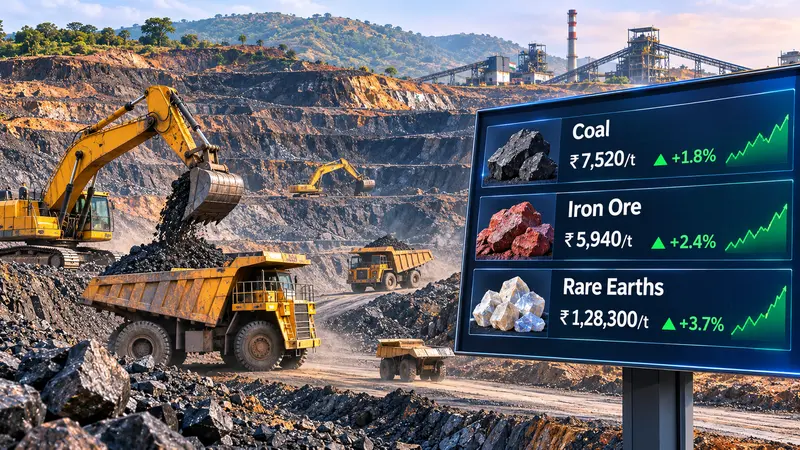
Union Coal and Mines Minister G. Kishan Reddy has said the Centre will soon launch coal and mineral exchanges, with nearly 90% of the preparatory work complete. He was speaking at the 4th Conference of Mining Ministers in Goa on 5 November 2026. On the same day the Ministry of Mines put 20 critical and strategic mineral blocks and 11 exploration blocks up for auction, and it explained a rule change meant to deal with one of its most stubborn problems: blocks that fail to sell.
Taken together, the announcements are about two weak points in India's mineral supply. One is how minerals are sold once they are mined. The other is getting them out of the ground at all.
What the exchanges would do
Reddy said the exchanges would give companies, enterprises and traders a common platform to buy and sell coal and minerals produced across states. They would cover iron ore, limestone, bauxite, critical minerals and coal. The ministry had already opened an online portal for applications to register coal exchanges earlier this year.
Today a buyer who needs coal or ore deals largely with individual producers and state-level arrangements. An exchange would put buyers and sellers on one screen. In principle that should make prices easier to see, widen the market for smaller miners and give users such as cement or sponge iron plants another route to supply. The minister's own claim was limited: market access will improve.
The important details are not yet public. The government has not given a launch date, the rules for trading, the list of operators or how an exchange would sit alongside existing coal supply agreements. Critics of such platforms point out that a market is only as deep as the volume actually offered on it, and that in coal a very large share of output is still tied up in long-term supply to power plants. How much will be traded freely is the question that will decide whether the exchanges matter.
The minister also gave figures on who earns what. Up to 96% of the mining sector's income goes to state governments, he said, while the Centre's share is limited to 50% of the GST collected on minerals. States' revenue from non-coal mining has risen from about Rs 13,000 crore in 2014-15 to over Rs 70,000 crore, and around Rs 1.36 lakh crore has accumulated under the District Mineral Foundation, the fund meant for mining-affected areas. That last number deserves more attention than it gets: it is money collected for some of India's poorest districts, and the conference release does not say how much has been spent.
The block auctions, and the rule that changed
The ninth tranche offers 20 blocks across eight states.
| State | Blocks | Main minerals |
|---|---|---|
| Chhattisgarh | 5 | Phosphorite-limestone, vanadium, gallium, titanium, rare earths, bauxite |
| Rajasthan | 3 | Potash and halite, tungsten |
| Telangana | 3 | Titanium, vanadium, scandium, gallium |
| West Bengal | 3 | Graphite, rare earths, rare metal |
| Madhya Pradesh | 2 | Vanadium, gallium, titanium, bauxite |
| Maharashtra | 2 | Rare earths, rare metal, vanadium, gallium |
| Andhra Pradesh | 1 | Graphite |
| Bihar | 1 | Glauconite |
The third exploration licence tranche adds 11 blocks in six states, led by rare earths in Rajasthan and Telangana, along with copper in Madhya Pradesh and vanadium in Maharashtra and Gujarat. Exploration licences, created under Section 10BA of the mining law, let private firms search for 29 critical and deep-seated minerals before any mine exists.
The most useful number in the release is the record so far. In eight earlier tranches, 100 unique blocks were offered and 64 were sold. On exploration, 11 blocks have been sold across two tranches.
So more than a third of blocks found no buyer. The ministry names one reason. Under the old rule, a second round needed three technically qualified bidders. The Mineral (Auction) Third Amendment Rules, notified on 16 October 2026, cut that to two for Part D minerals. The ministry says this addresses a key reason blocks have gone unsold. Letters of Intent will now also be issued automatically through the Unified Mining Portal.
The trade-off is clear. Fewer bidders should mean more completed auctions, but also less competition for each block, and the winning bid is the percentage of revenue offered to the state. A sale at a thin premium is still a sale, and for minerals India imports heavily, the government appears to have decided that getting blocks moving matters more than squeezing out the last rupee.
Why it matters
Critical minerals are the raw material of electric vehicles, batteries, electronics, fertilisers and defence equipment, and the ministry frames this as a question of security. Rare earths and tungsten have become strategic worries worldwide as supply has concentrated in a few countries. India's domestic coal output has now passed one billion tonnes for a second year, according to the Coal Secretary, but in critical minerals it remains early in the journey.
An auction is only the first step, however. Reddy urged states to bring auctioned mines into operation faster, because a block sold on paper produces nothing until clearances, land and exploration are done. That process usually takes years.
Dates matter for bidders. Tender documents went on sale on 5 November, the last date to buy them is 1 January 2027 and bids are due by 5 pm on 7 January 2027. The ministry also launched ANVESH and EKAM, two Indian Bureau of Mines portals, with ANVESH giving access to data on production, despatch, prices and trade.
The results in January will show whether the lower bar works. If more of these 31 blocks sell than in earlier rounds, the ministry's diagnosis was right. If they do not, the problem lies deeper, in geology, data or the economics of the blocks themselves.
This article is for information and is not investment advice.
Sources
- Ministry of Mines launches the Ninth Tranche of Critical Mineral Block Auction and the Third Tranche of Exploration Licence Auction (PIB)2026-11-05
- Day 1 of 4th Conference of Mining Ministers (PIB)2026-11-05
- Govt calls for accelerated coal sector reforms to strengthen India's energy security (All India Radio)2026-11-06
About the Author
A
Amita Sahani
Staff Writer
Amita Sahani writes for Wirony. Every story under this byline is reviewed and approved by an editor before it is published, and corrections are made openly.
A
5 min
What did you think?