/
Semicon 2.0 portal opens for fabs, equipment and packaging as 12 component projects get Rs 7,503 crore nod
Ashwini Vaishnaw launched the Semicon 2.0 application portal on 6 November for Pillars 2, 3 and 4: machines and materials, fabs, and packaging. He also announced 12 ECMS approvals worth Rs 7,503 crore. Five of 12 Semicon 1.0 projects are in commercial production. The goal now is equipment makers.
P
5 min
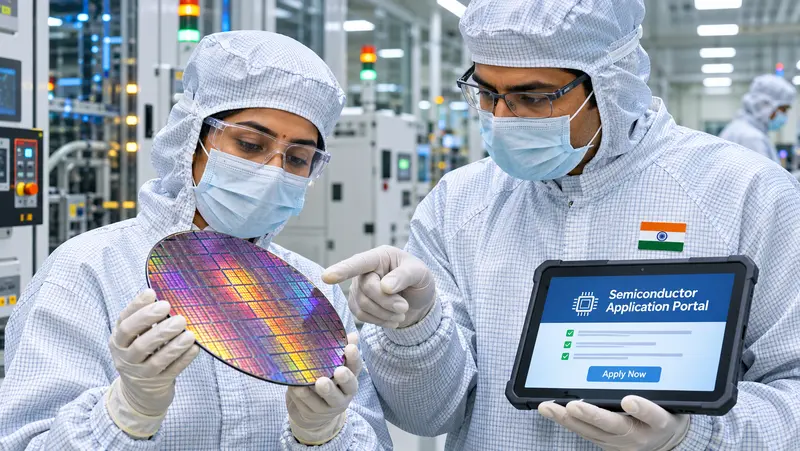
Union Electronics and IT Minister Ashwini Vaishnaw on 6 November 2026 launched the Semicon 2.0 web application portal, opening applications under three of the programme's six pillars. The Ministry of Electronics and IT said companies can now apply under Pillar 2 on machines and materials, Pillar 3 on setting up more fabs and Pillar 4 on chip assembly, testing and packaging. At the same event he announced 12 more approvals under the Electronics Components Manufacturing Scheme, with a projected investment of Rs 7,503 crore.
The portal is a procedural step, but it marks the point at which India's second chip programme stops being an announcement and starts taking applications.
What opened, and what has not
Semicon 2.0 was approved by the Union Cabinet with an outlay of Rs 1,27,500 crore, and it was notified on 31 August. It has six pillars: chip design, machines and materials, fabs, packaging, research and development, and talent. The India Semiconductor Mission is the nodal agency, handling applications, appraisal and oversight, with project support of up to six years and fiscal support on a pari-passu basis.
Pillars 1, 5 and 6, covering design, research and talent, are not part of this week's launch.
Mr Vaishnaw set out what the government now wants. Semicon India 2.0, he said, would focus on building an ecosystem in equipment, materials, chemicals and gases, with a target of attracting at least three major equipment manufacturers and five chemicals and gases companies to India. He called for rigorous selection of projects, and said that quality, technological depth, research and global competitiveness must guide the choices.
That emphasis is the most interesting part of the announcement. The first phase was about getting fabs and packaging plants on the map. The second recognises that a chip plant depends on an enormous supply chain of specialised tools and ultra-pure materials, nearly all of it made abroad. Without those, an Indian fab will remain dependent on imports for almost everything that goes into it.
Semicon 1.0 provides the baseline. Twelve projects were approved across six states, with cumulative investment of over Rs 1.64 lakh crore, and five had started commercial production by October 2026. Some 105 startups have been given access to design tools, and about 70,000 students at 332 institutions have been trained under the Chips to Startup programme.
The 12 new component approvals
The Electronics Components Manufacturing Scheme runs alongside the chip programme and aims to build the parts that go into devices.
| ECMS approvals | This round | Total so far |
|---|---|---|
| Applications | 12 | 118 |
| Projected investment | Rs 7,503 crore | Rs 77,051 crore |
| Projected production | Rs 39,045 crore | Rs 5,73,146 crore |
| Direct jobs | 7,127 | 81,755 |
The new approvals span seven states: Gujarat, Karnataka, Madhya Pradesh, Maharashtra, Punjab, Tamil Nadu and Uttar Pradesh. They cover multi-layer printed circuit boards, relays, heat sinks and specialty ceramics, as well as supply chain items such as copper foil, anode and cathode materials, polypropylene film and camera rims, and capital goods such as precision moulds and automation equipment. This round has the first approvals under the scheme for copper foil, cathode active material and specialty ceramics. In total the scheme now covers 34 products across 16 states, and Mr Vaishnaw said nearly 50% of the units approved belong to the MSME sector.

He said India's electronics journey had moved beyond assembly towards a domestic value chain that includes modules, components, materials and advanced technologies, with growing capabilities in battery cells, copper foils and high-end circuit boards.
Why it matters
India imports nearly all its chips and most electronic components, so these programmes bear on trade, jobs and security. In a period of strained supply chains and geopolitical tension over technology, a domestic base has obvious value. The projected production figure of over Rs 5.7 lakh crore, if achieved, would be a significant addition to electronics output.
Those are projections, however, and readers should keep that in mind. Investment figures on approval are what applicants say they will spend, and jobs are what they expect to create. The stronger test is how much is built and running. Five of 12 chip projects in commercial production is real progress, and it is also a reminder that seven are not there yet.
There is a wider debate as well. Critics of large chip subsidies argue that India is entering a capital-heavy and fast-moving industry where the leaders spend far more each year, and that public money might go further in design and talent, where India already has a strong position. However, the government's view is that design without manufacturing leaves the country exposed, and that the two must be developed together. The opening of equipment and materials to applications before design shows where it thinks the gap is widest.
Winning global equipment makers will be particularly hard. Such companies are few, are heavily concentrated in a handful of countries and go where the fabs are. India has to persuade them that its demand is large and durable enough, and the target of three such firms is modest for that reason.
The first thing to look for is who applies, especially whether a major international equipment or materials company files. The second is how quickly the mission appraises applications, since Mr Vaishnaw has spoken of the speed at which Semicon 1.0 projects moved. The third is the launch of the remaining pillars on design, research and talent. The government has also set a goal of training one lakh more semiconductor engineers. The scheme page says that the application window is open for three years from the issue of guidelines, so the first approvals, not the opening of the portal, will be the real measure.
This article is for information and is not investment advice.
Sources
About the Author
P
Prateek Rawat
Staff Writer
Prateek Rawat is a contributor to Wirony. All articles published under this byline undergo editorial review and approval before publication, with any necessary corrections handled…
P
5 min
What did you think?