/
Ultra Gas plans 15 new LNG stations this year, targets 100-plus outlets by FY29
Ultra Gas said it will add 15 LNG retail stations by the end of the current financial year, taking its network to 25 by March. The firm plans ₹900 crore investment for 100-plus outlets by FY29, pitching 25%-30% fuel savings for trucking.
R
4 min
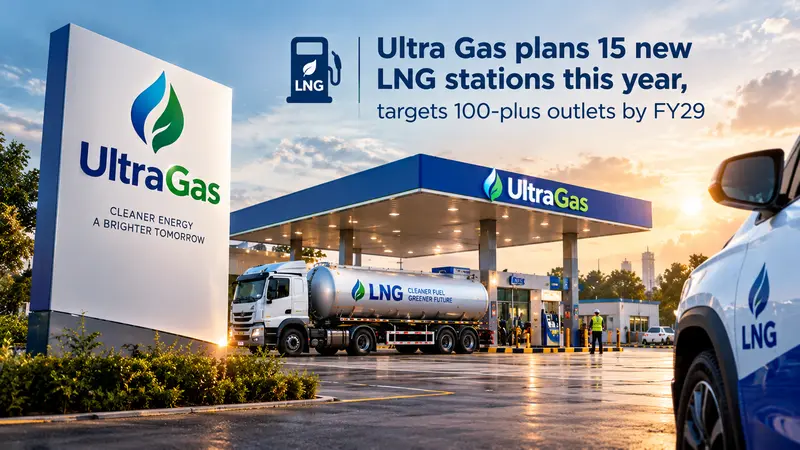
Ultra Gas, the Essar-backed retailer of liquefied natural gas for vehicles, said it plans to add 15 LNG retail stations by the end of the current financial year, expanding its footprint as India’s freight market tests cleaner fuels against the hard math of running costs.
Maqsood Shaikh, the company’s chief executive officer and managing director, said the additions would take Ultra Gas’s network to 25 stations by March. The company’s longer-term target is more than 100 outlets by the end of FY29, a build-out it said would require an investment of ₹900 crore.
The expansion pitch is straightforward: make LNG easy to find on long highway runs, and truckers will be more willing to switch. With 25 stations operating by March, Shaikh said the company expects “98% assurance” that a driver using the network will find a station every 200 to 250 km.
That density matters because LNG trucks, while gaining attention as a lower-emissions alternative to diesel in certain duty cycles, are still a niche on Indian roads. Operators worry about range, refuelling time, and the risk of being stranded if a planned stop is out of service or too far away.
A bet on LNG trucking
Ultra Gas is framing its build-out as a way to unlock demand for LNG-fuelled heavy vehicles. Shaikh said the expanded network could generate demand for around 6,000 LNG trucks.
The company’s investment plan runs through FY29, a period in which India’s logistics industry is also grappling with tighter delivery expectations, toll and route optimisation, and pressure from customers to report emissions more transparently. LNG’s advocates argue it can cut local pollutants and, depending on use and supply chain, reduce greenhouse-gas intensity compared with older diesel fleets.
For fleet owners, though, the deciding factor often lands on the monthly fuel bill. Ultra Gas is selling LNG’s economics as much as its environmental profile, with Shaikh saying LNG-powered freight transport could deliver fuel-cost savings of 25% to 30%.
Those savings are not guaranteed for every route or operator. They can depend on the vehicle’s utilisation, the relative price of LNG and diesel, and access to service support. Still, the company’s message is that refuelling availability is the first hurdle, and that it expects policy support and long-term supply arrangements to help the market develop.
What’s driving the rollout
India’s gas story is often told in two different registers. On one track is industrial and power-sector demand for natural gas, which rises and falls with price and availability. On another is the push to use gas in transport, where LNG is being positioned as a step toward lower-emission freight while electric and hydrogen options mature.
More from GeneralExplore General


Ultra Gas’s plan sits squarely in that second lane. The company is not talking about household piped gas or city gas distribution in this announcement. Instead, it is trying to solve a problem that has limited LNG trucking adoption: a thin refuelling map that makes route planning difficult for long-haul operators.
The company’s claim of near-continuous coverage across its own network, with stations spaced 200 to 250 km apart, is meant to address that anxiety. If it holds in practice, it would allow dispatchers to plan runs with predictable stops, rather than treating LNG as feasible only on a handful of corridors.
Another factor is the way fleet purchasing works. Large operators often need confidence not just that fuel is available today, but that it will still be available across the vehicle’s life. A publicly stated plan to grow from 25 stations by March to more than 100 by FY29 is designed to signal that the network is not a short-term experiment.
At the same time, the build-out is capital intensive. Ultra Gas has put a number on its ambition: ₹900 crore for 100 LNG stations by FY29. Delivering that at pace will require site acquisition, equipment procurement, safety systems, and dependable LNG supply logistics.
What comes next
The next checkpoint for Ultra Gas is March, when it expects to reach 25 LNG retail stations. After that, the company’s stated goal is to keep adding outlets through FY29 until it crosses 100.
For the broader market, the coming months will test whether the two parts of the LNG trucking proposition can move together: a refuelling network that reduces operational risk, and enough of a cost edge to justify switching vehicles and training drivers and mechanics.
If the network expands as planned, fleet operators will still weigh LNG against other routes to lower emissions, including newer diesel technology, route and load optimisation, and, on some corridors, electrification. Ultra Gas is betting that for long-haul freight, the fastest near-term change will come from a fuel that can be pumped quickly, stored on-board, and supported by a highway network built for trucks.
Sources
R
4 min
What did you think?