/
CPAO revises SOP for NPS-to-OPS migration in death, disability cases of Central staff
CPAO has issued a revised SOP dated 19 Oct 2026 for migrating eligible death or disability NPS pension cases to OPS, replacing the 2025 process. The move directs accounting offices and authorised banks to implement the updated procedure promptly.
R
3 min
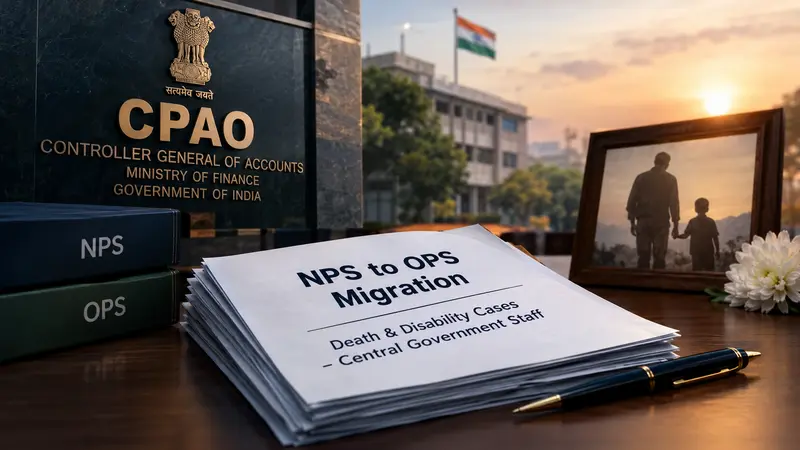
A revised set of pension procedures issued this week has changed how some Central government families in India can move a deceased or disabled employee’s pension case from the National Pension System (NPS) to the Old Pension Scheme (OPS), a switch that can alter the long-term shape of benefits.
The Central Pension Accounting Office (CPAO) issued the updated standard operating procedure (SOP) on 19 October 2026, directing accounting authorities and authorised banks to put the new process into effect without delay. The order says the change was cleared by the Controller General of Accounts (CGA) after “challenges encountered” in earlier migrations.
The decision matters most to a narrow but sensitive set of cases: so-called “legacy” NPS-AR pension matters tied to death or disability, where families are seeking migration to the defined-benefit OPS under government service rules.
What the CPAO changed
CPAO handles authorisation, accounting and payment for Central Government (Civil) pensioners. In its order, it said the revised SOP is meant to make the migration of eligible NPS pension cases to OPS easier and faster for the offices that process them and the banks that pay them.
The new SOP replaces an earlier procedure issued on 17 September 2025. In practice, that means any ministry or department dealing with an eligible death or disability case, and the bank handling the pension payment, must follow the updated steps rather than the older checklist.
The order is procedural, but the stakes are financial. NPS is a defined-contribution, market-linked retirement plan. OPS is a defined-benefit pension under government service rules. For families dealing with a death or disability, the difference between a market-linked corpus and a rule-based pension can shape monthly income certainty, survivor benefits and the way paperwork moves through offices.
Because CPAO’s direction specifically mentions “legacy NPS-AR” cases, it is not a blanket invitation for all employees to opt out of NPS. It is a mechanism for dealing with a category of cases that, the government acknowledges, had run into problems under the previous process.
The immediate impact is on families of Central government employees whose pension cases fall into the eligible category described in the CPAO order: death or disability matters where migration from NPS to OPS is permitted under rules, and where the case is being processed through the pension authorisation and banking chain.
For those families, the “big decision” is whether to pursue the migration route under the revised procedure and, if so, how quickly they can assemble documents and coordinate with the office processing the claim.
The updated SOP also places responsibility on multiple links in the chain. The CPAO has told the “concerned accounting authorities” and the “authorised banks” to implement it promptly, signalling that the bottlenecks were not limited to one office.
While the order does not publish a timeline for disposal of cases, its language points to an attempt to cut repeat queries and back-and-forth that can slow payments.
Wider pay-and-pension backdrop
The SOP revision lands at a time when Central government staff and pensioners are also watching for another decision that affects monthly payouts.
As of 22 October, the Centre had not confirmed the pending Dearness Allowance (DA) revision due from July 2026. Employees have been expecting a 3% increase, which would raise DA from 60% to 63% of basic pay, along with arrears if the revision is cleared retrospectively. With no official announcement yet, uncertainty has dragged into late October.
The Union Cabinet did not hold its expected weekly meeting on 21 October, pushing back expectations of a decision during the festive period.
Taken together, the delayed DA call and the new pension migration SOP underline how much of a government employee’s retirement and family security can turn on administrative orders and Cabinet decisions as much as on service tenure.
For affected families, the immediate next step is procedural: approach the department handling the pension case and the authorised bank, and ask that the claim be processed under the revised SOP that came into force with the 19 October order.
R
3 min
What did you think?