/
Udta Teer review: First-day reactions praise Ayushmann Khurrana, but critics split on tone
Udta Teer opened in theatres on October 23, drawing quick first-show reactions online. Many praised Ayushmann Khurrana’s comic timing and the film’s satirical spy premise, while others found the tone uneven as it turns more serious.
R
4 min
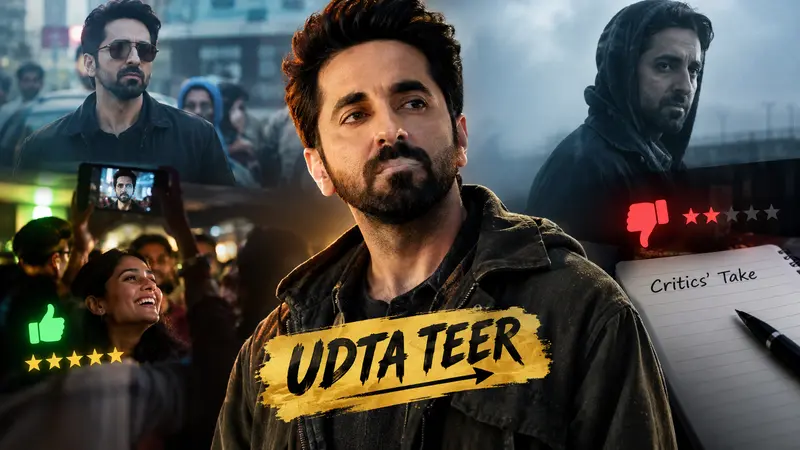
Early audience reactions to Udta Teer began flooding social media within minutes of the first shows ending on October 23, with many calling Ayushmann Khurrana’s new spy-comedy a breezy entertainer even as others flagged an uneven second half.
The film, directed by Aakash A. Kaushik and released in cinemas on October 23, pairs Khurrana with Sara Ali Khan and leans into satire at a time when big, grim espionage dramas have dominated the genre. The initial chatter online largely praised the central gag and Khurrana’s comic timing, while suggesting the movie’s tone shifts as the plot moves from farce into higher-stakes action.
At the centre of Udta Teer is Bilal, a Pakistani operative embedded in India’s Counter Terrorism Squad under the identity Vikrant. An accident leaves him with amnesia, and the spy wakes up fully convinced he is the ultra-patriotic Indian officer his cover story claims he is. That identity crisis, played straight by the character and exploited by nearly everyone around him, becomes the engine for the film’s comedy.
Kaushik’s setup has been described as a reversal of the usual “super-agent saves the nation” template, with the protagonist’s mission collapsing not because he is caught, but because he forgets what he is doing there in the first place. The resulting confusion ricochets through handlers, family and local assets, as Bilal-turned-Vikrant begins defending the very country he was sent to infiltrate.
A spy plot built on amnesia
Udta Teer runs 137 minutes, and its early stretch is designed like a comedy of errors that keeps tightening the screws. Bilal’s misplaced zeal turns routine intelligence work into a series of escalating misunderstandings, and the film uses that to poke at chest-thumping rhetoric without turning the India-Pakistan backdrop into sermon or scolding.
Several early reviews have singled out the simplicity of the hook as the film’s biggest strength. The premise is easy to grasp, and it gives the actors room to play in scenes that depend on timing rather than exposition. That said, the same reviews also point to a familiar problem for high-concept comedies: once the joke has landed, the film has to find fresh ways to keep it moving.
That’s where the reactions begin to split. While the first half is widely seen as confident and consistently funny, the later portions have been described as less sure-footed when the story leans harder into suspense. Some critics have argued that the film starts to chase conventional spy-movie beats, blunting the bite of its satire just when the stakes rise.
Still, even the mixed takes tend to agree on one point: the movie is trying to do something different inside a well-worn format. By making the “enemy agent” the most fervent flag-waver in the room, Udta Teer frames patriotism as performance, habit and accident, not just ideology.
Performances and the early verdict
Khurrana is the film’s anchor, and first-day reactions have repeatedly credited him for holding the tonal balancing act together. His Bilal plays like a man improvising his own identity in real time, which is the key to making the premise work beyond a single punchline.

The supporting cast is also a major part of the film’s appeal. Rahul Bose and the late Mukul Dev, in particular, have drawn praise for landing some of the biggest laughs, with their characters positioned to both exploit and fear the chaos Bilal creates. The ensemble includes Suhail Nayyar, Ram Kapoor and Gulshan Grover, adding familiar faces to a story that depends on misunderstandings and shifting loyalties.
Sara Ali Khan’s role has been described as more limited than Khurrana’s, giving her less space to shape the film’s direction. Even so, she is part of the larger swirl of characters trying to manage the fallout from Bilal’s amnesia, and her presence adds to the frantic energy of the group dynamics.
Critics have also diverged sharply on the overall execution. Some early ratings reported on release day ranged from 3.5/5 at one outlet to 2/5 at another, reflecting the same divide visible in first-show reactions: viewers who prefer the movie’s comic intent and those who feel the screenplay loses control when it shifts gears.
For now, Udta Teer’s opening day story is less about a single consensus than about a clear split. The film’s fans are embracing it as a light, satirical break from heavy spy fare, while sceptics are questioning whether it can sustain its clever setup all the way to the finish.
The next signal will come as the weekend audience broadens beyond first-show crowds and online regulars. If word-of-mouth stays strong on the humour and performances, Udta Teer could find a steady run; if the mixed notes on the second half dominate, the conversation may harden into a more polarised verdict.
R
4 min
What did you think?