/
India–New Zealand trade deal takes effect: every Indian export now enters duty-free, dairy stays shut
The free trade agreement came into force at one minute past midnight on Tuesday. New Zealand has dropped duties on all Indian goods; India opens 70 percent of its tariff lines but keeps dairy, sugar and edible oils protected, with 6,000 visas a year and a $20 billion investment pledge alongside.
P
5 min
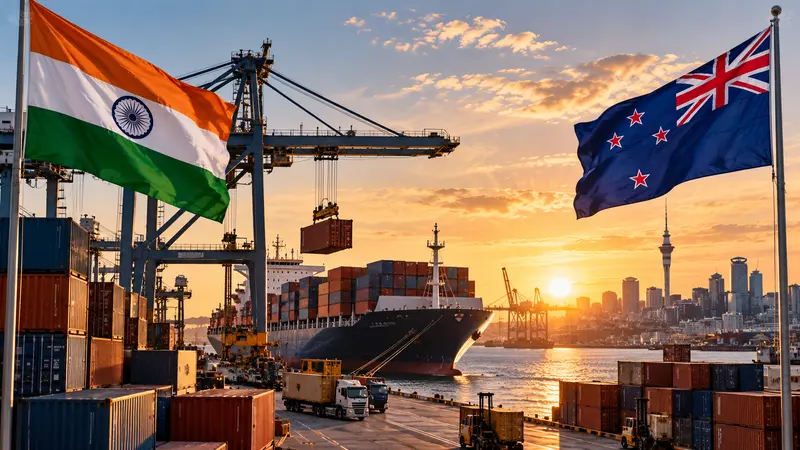
India's free trade agreement with New Zealand came into force at one minute past midnight on Tuesday, and from that moment every Indian export entering New Zealand pays no customs duty at all.
The date was chosen for its symbolism: Vijayadashami, the festival of victory. Commerce and Industry Minister Piyush Goyal signed the deal with his New Zealand counterpart Todd McClay in New Delhi on 27 April, New Zealand's Parliament passed the enabling law in September, and the two ministers fixed 20 October together. Goyal said the entry into force "will overcome all hurdles" and would open doors for Indian workers, travellers, professionals and students as much as for exporters.
What each side gives
New Zealand's side is simple. Duties go to zero on 100 percent of the lines that cover Indian goods, removing peak tariffs of up to 10 percent. The sectors that gain most are the ones that employ most: textiles and apparel, leather and footwear, gems and jewellery, engineering goods and processed food. Indian pharmaceutical and medical device companies get a faster route in, because New Zealand accepts inspection approvals already granted by the regulators in the United States, Europe, Britain and Canada.
India's side is deliberately narrower. The agreement covers 70 percent of India's tariff lines; the other 30 percent is excluded outright. Dairy, meat other than sheep, sugar, edible oils and a list of core agricultural commodities stay protected, the same red lines India has drawn in every recent negotiation. New Zealand's apples, kiwifruit and manuka honey come in under quotas, minimum import prices and seasonal windows rather than open access. Some of India's cuts take effect at once; others are phased over as long as ten years. Inputs Indian manufacturers want, among them wooden logs, coking coal and metal scrap, enter duty-free from the start.
Dairy was the sticking point for a decade. New Zealand is the world's largest dairy exporter and its negotiators wanted a way into the largest milk market on earth; India's farm lobby, with some 80 million households depending on milk, would not have it, and successive talks stalled on that single line. The deal that finally emerged gives New Zealand duty-free entry only for dairy ingredients that are processed in India and exported again. If India ever offers real dairy access to a comparable country, it has agreed to consult New Zealand first. The two governments will review the whole agreement a year from now.
People, not just goods
The part of the deal most likely to be felt in Indian households is about movement. A new Temporary Employment Entry pathway allows 5,000 skilled Indians to work in New Zealand at any one time on visas of up to three years, with 600 places set aside for chefs, yoga instructors, practitioners of traditional Indian medicine and music teachers. A side letter adds up to 1,000 working holiday visas a year for Indians aged 18 to 30 who hold a degree and functional English: twelve months in the country, up to six months with any single employer, up to four months of study. New Zealand has two years to set that scheme up.
Students gain too. Indian students are guaranteed 20 hours of work a week while they study, graduates in science and technology fields may stay and work for up to three years, and doctoral scholars for up to four. Services commitments run across about 118 sectors, from information technology and construction to tourism and professional services.
The visa numbers are modest against India's outflow of workers and students, but they are written into a treaty rather than left to annual immigration policy, which is the point. New Zealand's immigration settings have tightened and loosened several times in the past five years; a quota in an agreement is harder to cut.

Trade will move faster at the border as well. Cargo is to be cleared within 48 hours, express and perishable consignments within 24, and eligible exporters may certify the origin of their own goods digitally.
The money and the target
Two-way trade in goods and services stands at about $2.4 billion a year, small for two economies of this size. The stated aim is to double it to NZ$7 billion, roughly Rs 35,000 crore, by 2030. New Zealand has also committed to help bring $20 billion of investment into India over 15 years across agriculture, manufacturing, infrastructure and start-ups, a pledge Goyal said "holds immense potential to strengthen manufacturing, infrastructure, services & innovation".
On the farm side the deal trades expertise rather than tariffs. An agriculture productivity partnership will bring New Zealand's precision farming methods to Indian orchards, post-harvest handling, food safety and beekeeping, with centres of excellence for apples, kiwifruit and honey.
Commerce Secretary Rajesh Agrawal set the tone for how the government wants it read. "These ties are not only about market access and having more exports to each other," he said; the agreement was meant as a long-term partnership and a way to diversify India's export markets and supply chains. McClay, for his part, called the entry into force the start of a longer process whose success would depend on how well businesses use it.
That is the open question. Zero duty is an invitation, not an order, and New Zealand is a market of five million people at the far end of a long shipping lane. The deal's value for India lies as much in the visas, the student rights and the investment pledge as in the tariff schedule. Its first real test comes with the review in October next year, when both sides will see whether exporters and employers answered the invitation. Cricket, at least, is ahead of trade: India's men begin a five-match T20 series in Christchurch on Thursday.
P
5 min
What did you think?