/
Shenzhen Declaration: Trump, Putin and Xi back peace and nuclear restraint, skip Ukraine
Trump, Putin and Xi met in Shenzhen on 19 November for the first confirmed three-way meeting and issued the Shenzhen Declaration on peace, UN reform, energy supply and nuclear risks. It names no settlement for Ukraine or Iran. The US intelligence chief defended Trump calling Putin a friend.
P
4 min
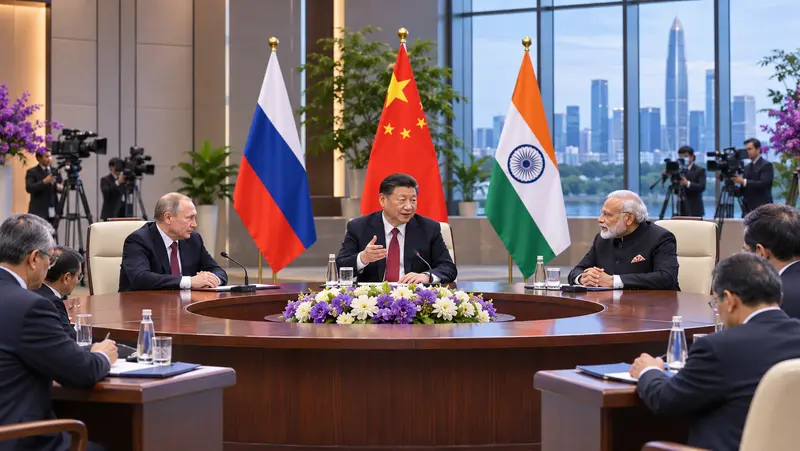
US President Donald Trump, Russian President Vladimir Putin and Chinese President Xi Jinping met in Shenzhen, China, on Thursday, 19 November 2026, in what is described as the first confirmed three-way meeting of the leaders of the world's three largest nuclear powers. They issued a joint statement, called the Shenzhen Declaration, that speaks of peace, reform of the United Nations, stable energy supplies and the reduction of nuclear risks. Four days later it is still drawing comment, mostly because of what it leaves out: it offers no settlement of the war in Ukraine or the war in Iran.
The leaders met in a roundtable on the sidelines of the APEC conference in Shenzhen. Accounts of the length of the talks differ, with some putting it at about 90 minutes and others at about 80. Trump had flown to Shenzhen after attending a Quad meeting in Manila. Only the three leaders are named as taking part in the roundtable, and the makeup of the delegations has not been described.
Trump posted pictures of the meeting with the caption "My Friend". Asked on greeting Putin who he was, he joked, "Who is he?" and then said, "He's my friend." Asked at a briefing on Friday whether Russia is a friend to America, Trump said, "I can't speak to America," and added that Putin had been "very nice" to him during what he called the Russia hoax.
What the declaration says
The declaration, titled in some accounts the Declaration toward Peace, sets out a shared vision. It commits the three states to work for peace, to reform the United Nations, to stabilise global energy supplies by raising the production and supply of refined petroleum products, and to reduce nuclear risks. Critics note that it carries no firm commitments. One analysis says it contains nothing specific on nuclear disarmament, limits on the deployment of weapons, verification or a timetable for talks.
| Item | What the reports say |
|---|---|
| Date and place | 19 November 2026, Shenzhen |
| Format | Roundtable on the sidelines of APEC |
| Declaration | Peace, UN reform, energy supply, reducing nuclear risks |
| Nuclear risks | Statement of intent; no firm commitments reported |
| Ukraine and Iran | Not settled in the declaration |
Xi said, according to China's foreign ministry, that "peace among major countries brings stability to the world, while their contention would only lead to chaos in the world." Putin, in comments reported after the meeting, rejected comparisons with the 1945 Yalta conference, saying that there was no division of the world into spheres of influence at Yalta. The comparison was made by critics who feared that the three powers might settle matters over the heads of smaller countries.
German Chancellor Friedrich Merz replied to that comparison: "At Yalta, Europe was divided up. And we won't allow anything like that to happen again." Ukraine's foreign minister, Andrii Sybiha, wrote on X that "Shenzhen is not the Yalta of Putin's dreams." Some European and Asian capitals were also said to be concerned about deals being made without their involvement. One commentary said the summit gave Putin a platform while placing no practical obligation on him over Ukraine.
The US intelligence chief
Director of National Intelligence Jay Clayton defended Trump's remarks on Sunday in television interviews. He called the meeting historic and the remarks entirely appropriate. "Is Vladimir Putin America's friend? He is not America's friend in Ukraine. Not at all. Not at all," he said. He added that "it should be assuring that you have the three world nuclear powers getting together and saying: We're not going to go in that direction." On another programme he said that whatever language the president wants to use, "I trust him completely."
The war in Ukraine and the war in Iran are not mentioned in the declaration, according to the accounts read. The United Nations reform it calls for has no timetable, and the question of a permanent seat on the Security Council for countries such as India is not resolved in it. The declaration's text on the White House website is the primary document, and the full wording was not available when this report was written, so the points above rest on the reports of its content.
What the declaration does not do
The declaration is a political statement and not a treaty. It creates no legal obligations, sets up no body to check whether the three states keep their word, and names no date by which anything must happen. Whether the three act on it will show in how they handle the next round of talks on Ukraine and on the Iranian war, and in whether the nuclear language leads to any contact between their military staffs.
A meeting of this kind is rare. The United States, Russia and China hold most of the world's nuclear weapons. A statement from the three that they intend to reduce nuclear risks has symbolic value, but without verification or a timetable its practical value is limited. How far the three act on it will show in the coming months.
The White House, the Kremlin and China's foreign ministry are the official sources for the declaration and the leaders' statements.
About the Author
P
Prateek Rawat
Staff Writer
Prateek Rawat is a contributor to Wirony. All articles published under this byline undergo editorial review and approval before publication, with any necessary corrections handled…
P
4 min
What did you think?