/
Centre proposes instant licence suspension for substandard drugs, dropping the show-cause step: what changes
The Health Ministry has proposed amending the Drugs Rules, 1945, so a manufacturing licence can be suspended at once when a drug fails specified critical quality tests. Today a show-cause notice comes first. The public has 30 days to object. CDSCO flagged 330 samples as substandard in September.
A
5 min
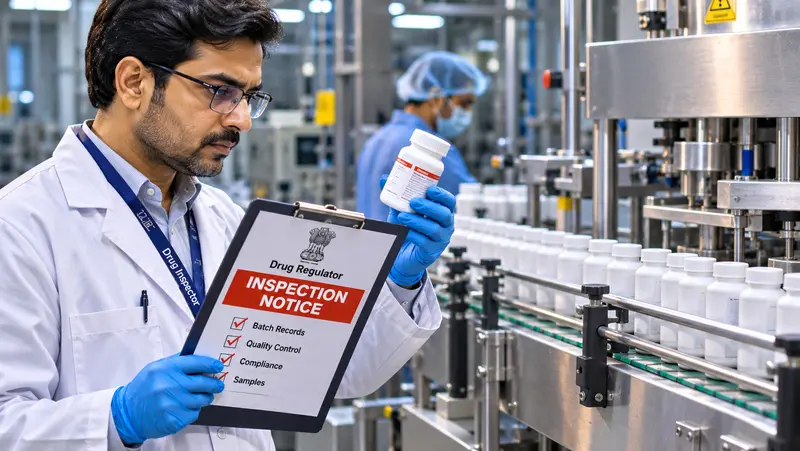
The Union Ministry of Health and Family Welfare has proposed changing the Drugs Rules, 1945, so that a medicine maker's manufacturing licence can be suspended immediately when a drug is declared Not of Standard Quality on specified critical quality parameters. Under the rules as they stand, a licensing authority must first issue a show-cause notice. The proposal, made public on 5 November, gives the public 30 days to send objections and suggestions.
It is a small change in wording and a large change in sequence. Regulators would act first and hear the company afterwards, for the failures that matter most.
What the draft proposes
The suspension would stay in force until the manufacturer has completed a root cause analysis and corrective and preventive action to the satisfaction of the licensing authority. It could be lifted only after those measures have been verified. Objections can be sent to the Under Secretary (Drugs) in the ministry or by email to drugsdiv-mohfw@gov.in within the 30-day window.
A second draft, notified on 28 October, deals with sterile medicines. It would align microbial monitoring in Grade A clean areas with the World Health Organization's guidelines on good manufacturing practice for sterile products, and would treat any microbial growth detected in those areas as a trigger for investigation. Taken together, the two drafts tighten both ends of the problem: what a factory must watch for, and what happens when a product fails.
Why it matters
The scale of routine failure explains the push. The Central Drugs Standard Control Organisation said 330 samples were found Not of Standard Quality in September 2026 alone, 42 by central laboratories and 288 by state laboratories. A sample is flagged when it fails one or more specified parameters, and CDSCO stresses that the finding applies only to the batch tested and does not raise concerns about other products on the market.
The ministry says the change would allow quicker action, stop continued manufacture and distribution of a failed product, and improve accountability and patient safety. The gap it is trying to close is time. Between a laboratory report and a show-cause reply, a batch can keep moving through distributors and pharmacies.
The cough syrup episode of 2025 is the background every regulator has in mind. After the deaths of children in Chhindwara in Madhya Pradesh, allegedly linked to contaminated syrup, a central team found diethylene glycol above permissible limits in a sample of Coldrif, made in Kancheepuram in Tamil Nadu, and the company's licence was cancelled. The government has since tightened oversight in several steps. A Parliament reply published in March 2026 records risk-based inspections of more than 960 premises since December 2022, which led to more than 860 actions by state licensing authorities, including show-cause notices, stop-production orders, suspensions and cancellations. More than 1,100 cough syrup manufacturers and 380 blood centres were audited. Revised Schedule M, the good manufacturing standard, took effect for companies with turnover above Rs 250 crore from 29 June 2024 and for smaller companies from 1 January 2026.
The draft therefore fits a pattern: standards were raised first, inspections followed, and the penalty for a serious failure is now being made faster.

The questions the draft must answer
Three points will decide whether the rule works as intended. The first is the meaning of "critical quality parameters". The proposal applies only to failures on specified parameters, and the list is the core of the rule. A failed assay for a toxic contaminant is very different from a labelling or minor dissolution variation. The public summary of the draft does not set out the list, so manufacturers, doctors and patient groups should read the draft notification itself during the comment period.
The second is the scope of the suspension. The ministry's language refers to manufacturing licences. A 2014-era report of the Drugs Consultative Committee recommended that, where one product fails but a firm's manufacturing practice is otherwise sound, only that product's licence should be suspended. A rule that stops a whole plant over one product would have a much bigger effect on supply, including of essential medicines, than a rule that stops one line.
The third is who decides and how quickly. Manufacturing licences are largely issued and enforced by state licensing authorities, and capacity varies between states. A power to suspend at once is only as good as the laboratory result behind it and the speed with which a verified correction can reverse it. Critics of a suspend-first approach will argue that a single failed sample can be wrong and that a small manufacturer could lose weeks of production before a retest. Supporters will answer that the cost of waiting is measured in patients, and that the draft reserves the power for critical failures. Both arguments belong in the 30-day consultation.
The practical steps do not change with the draft. CDSCO publishes a monthly drug alert list of samples declared Not of Standard Quality, with the product name, manufacturer and batch number, on its website, and state drug controllers publish their own alerts. Pharmacists can check stock against those lists. Patients who hold a medicine named in an alert should compare the batch number on the strip or bottle and speak to their doctor or pharmacist before stopping a prescribed course, because the alert applies to the batch and not to the drug in general.
What happens next is procedural. After the comment period, the ministry will consider the objections and can then publish the final rule in the Gazette, with or without changes. Until then, the show-cause step remains the law. This article is for information and is not medical advice.
Sources
- Govt proposes immediate suspension of manufacturing licence of substandard drugs (All India Radio)2026-11-05
- CDSCO flags 330 drug samples as Not of Standard Quality in September 2026 (All India Radio)2026-10-23
- Variations in generic medicines: regulatory measures, Ministry of Chemicals and Fertilizers (PIB)2026-03-20
About the Author
A
Amita Sahani
Staff Writer
Amita Sahani writes for Wirony. Every story under this byline is reviewed and approved by an editor before it is published, and corrections are made openly.
A
5 min
What did you think?