/
India's factory survey: corporate manufacturing GVA up 9.28%, but 16% of plants produce 77% of output
MoSPI's Annual Survey of Industries 2024-25 shows corporate manufacturing GVA rose 9.28% and employment 7.57%, while GVA per worker rose only 2.25%. Plants with Rs 10 crore or more in machinery are 15.84% of factories but 76.82% of output. Five states hold over 54% of manufacturing GVA.
P
5 min
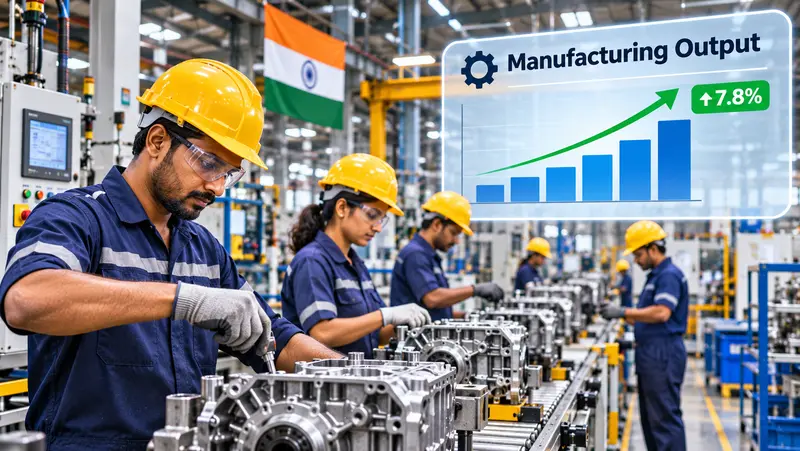
The Ministry of Statistics and Programme Implementation has published the detailed results of the Annual Survey of Industries for 2024-25, the most complete official picture of India's registered factories. The release of 4 November 2026 says the manufacturing corporate sector, which accounts for more than 89% of total gross value added, recorded GVA growth of 9.28% over the previous year. The number of factories in operation in that sector rose 3.45%, and persons engaged rose 7.57%. The survey covers April 2024 to March 2025, with fieldwork from October 2025 to June 2026. A factsheet came out on 30 September, and Volume I, the Summary Results and unit-level data are now available.
The numbers describe an expansion, but the more telling findings are about who produces what, where, and how productively.
Growth in jobs, slower growth in productivity
Set the headline figures side by side and a pattern appears.
| Measure, 2024-25 over previous year | Change |
|---|---|
| GVA, manufacturing corporate sector | +9.28% |
| Persons engaged, corporate sector | +7.57% |
| Factories in operation, corporate sector | +3.45% |
| Gross value of plant and machinery, registered sector | +7.25% |
| Net value added per factory in operation | +6.59% |
| GVA per person engaged | +2.25% |
Employment rose almost as fast as output. That is welcome in a country looking for factory jobs. The other side is that GVA per person grew only 2.25%, so most of the expansion came from adding people and plants and not from each worker producing much more. Since the figures do not state whether they are in constant prices, they should be read as a description of the survey's own measures and not as real productivity growth.
A small group of large plants does most of the work
The size tables are the most striking part of the release. Factories with plant and machinery of up to Rs 5 crore make up 78.69% of all operating factories. They hold 10.55% of fixed capital and employ 34.32% of the workforce, but produce 19.24% of output and 17.61% of net value added. Factories with Rs 10 crore or more in plant and machinery are 15.84% of the total, yet hold 87.42% of fixed capital, employ 59.66% of workers and produce 76.82% of output and 78.07% of net value added.
| Plant and machinery | Share of factories | Share of workers | Share of emoluments | Share of output |
|---|---|---|---|---|
| Up to Rs 25 lakh | 59.56% | 24.06% | 13.93% | 12.56% |
| Rs 25 lakh to Rs 5 crore | 19.13% | 10.26% | 8.67% | 6.68% |
| Rs 5 crore to Rs 10 crore | 5.48% | 6.01% | 5.60% | 3.94% |
| Rs 10 crore and above | 15.84% | 59.66% | 71.80% | 76.82% |
The smallest group shows the problem most clearly. Factories with up to Rs 25 lakh in machinery employ almost a quarter of workers and pay them under 14% of emoluments. Large plants employ about six in ten workers and pay more than seven in ten rupees of wages and benefits. Pay follows capital.
Classified by output, the concentration is sharper. Factories with output above Rs 500 crore are just 3.57% of the total but account for 62.07% of output, 60.96% of net value added and 30.72% of workers.
Maharashtra, Gujarat, Tamil Nadu, Karnataka and Uttar Pradesh together hold more than 54% of manufacturing GVA. Five industries, food products, textiles, basic metals, motor vehicles and wearing apparel, provide more than 41% of manufacturing employment.

Those two facts matter for policy. The employment-heavy industries are not all the highest-value ones, so a state chasing jobs and a state chasing value added may need different strategies. And more than half of the value added in the registered factory sector comes from five states, which shows how far the rest of the country has to go in building an industrial base.
Why it matters, and how to read it
The survey covers factories registered under the Factories Act, along with certain other registered establishments and electricity undertakings, and it uses an establishment approach under the Collection of Statistics Act. It leaves out the informal workshops that employ a very large number of Indians, which are the subject of a separate survey. So a rise in factory jobs does not by itself tell us what is happening to manufacturing work as a whole. Some of it may reflect firms moving into the formal sector.
The data are also old by the time they appear: 2024-25 results are arriving in late 2026. They describe the economy before the oil shock of this year. Their value lies in depth and not speed. The survey feeds national accounts at the national and state levels, and the unit-level data let researchers test claims about productivity, wages and firm size.
For policy makers, the release points to three questions. Can capital reach smaller factories, which employ a third of workers but hold a tenth of capital? Can productivity per worker grow faster than 2.25%? And can industry spread beyond five states? The Cabinet's new VISTAR scheme for statistics, approved on 4 November, promises more granular state and district estimates, which should make those questions easier to answer. The full tables are on the ministry's website.
This article is for information and is not investment advice.
Sources
About the Author
P
Prateek Rawat
Staff Writer
Prateek Rawat is a contributor to Wirony. All articles published under this byline undergo editorial review and approval before publication, with any necessary corrections handled…
P
5 min
What did you think?