/
Pope Leo XIV demands justice in Peru for 57 slain Amazon defenders
Pope Leo XIV demanded justice on Sunday 15 November for environmental defenders killed protecting the Amazon, speaking in Pucallpa, Peru. He cited 57 murders estimated by environmental groups for 2010 to 2024 and backed Indigenous land protection.
S
5 min
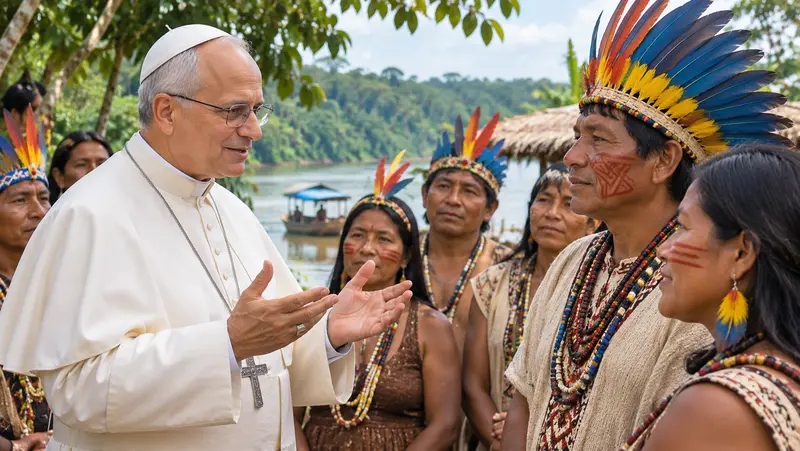
Pope Leo XIV demanded justice on Sunday 15 November for environmental defenders killed while protecting the Amazon, telling Indigenous representatives and missionaries in the Peruvian city of Pucallpa that their blood "cries out to God". He also threw his backing behind Indigenous efforts to stop their lands from being ravaged by logging and illegal mining.
The visit took place on the penultimate day of his South American tour. Leo travelled into the Peruvian Amazon and met the gathering along the Ucayali River, in the north-eastern city of Pucallpa. Many in the crowd wore traditional feathered headwear and the face markings of the region.
"The cry of the Earth and the cry of the poor are inseparable," the Pope told them. The line echoes a central teaching of his predecessor, Pope Francis, which ties care for the most vulnerable to care for God's creation.
Leo said he had come to Pucallpa to support the communities in their search for justice and peace. He then referred to the killings of those who have defended the forest: environmental groups estimate that 57 environmental defenders were murdered in the Peruvian Amazon between 2010 and 2024.
"The blood of these brothers cries out to God and demands justice," Leo said. The crowd applauded.
The killings and the damage Leo described
The Pope returned to the dead several times in his address. "Many Indigenous leaders have been murdered for defending their territories," he said in Pucallpa, a city in the Amazonian rainforest. The figure of 57 is an estimate from environmental groups, and Leo cited it as the measure of what the communities have lost.
He did not stop at the killings. Speaking to an audience he knew to be living with the consequences, the 71-year-old pontiff set out the damage in plain terms. "You know well the damage caused by indiscriminate deforestation and the pollution of rivers and other waters through illegal mining and oil spills," he said.
Then he rejected the idea that such harm is a run of bad luck. "These are not isolated accidents, but the consequences of the irresponsible exploitation of natural resources, which undermines the very existence of communities," Leo said.
The pressures he named are well established in the region. Communities in Peru face mounting strain from illegal logging, gold mining and coca production. Illegal gold mining has become an increasingly lucrative business in the Amazon, devastating forests and polluting rivers, while illegal mining and coca growing have also driven deforestation.
Leo urged Catholics to oppose the deforestation and pollution that follow gold and oil production. He voiced support for Indigenous efforts to protect their territories from illegal mining, logging and what he called the "insatiable thirst for domination".
The speech drew on his own years of experience as a bishop in Peru, as well as on the constant preaching of Francis about the environment and the plight of Indigenous groups. It was among his most forceful addresses of the tour.
The meeting on the river was followed by a Mass in Pucallpa, where the Pope pressed the same themes. In both settings he called for a different model of economic development, one that respects the Earth and the Indigenous peoples who care for it. He set that against what he described as the "irresponsible exploitation" carried out by outside actors.
At the Mass, his criticism turned to the pace of the response. "Very little has been done – and very slowly at that – while the means to exploit and pollute creation have accelerated," he said.
He did not leave the congregation with a warning alone. Leo told worshippers not to bury the Lord's gifts, saying that God gives believers the strength to repair and heal the suffering that exploitation of creation has caused. The appeal was addressed to Catholics, and to the missionaries and Indigenous representatives who had gathered with him earlier along the Ucayali.
The choice of Pucallpa gave the message a specific setting. The city sits on the river where the communities he addressed live and work, and where, in his words, they are searching for justice and peace. By speaking there rather than in Lima or another large city, Leo placed the argument in the territory that is under pressure.
Where the visit fits in a 12-day tour
The Amazon stop was part of a 12-day tour of South America. Earlier legs took Leo to Argentina and Uruguay, where he held Masses, including one in Uruguay in which he urged the crowd to be "bridge builders". In Peru he also met survivors of clergy abuse, amid calls for justice for them as well.
Only days before the Amazon visit, in Argentina, he called on the country to safeguard democracy. The Pucallpa address belongs to a run of speeches in which he has tied faith to public questions. In May, during a visit to an area of Italy, he criticised companies that chase "giddy" profits at the cost of environmental pollution.
Across these appearances the pattern is consistent: Leo speaks about harm done to people and to the natural world in the same breath, as he did on the Ucayali with his line that the cry of the Earth and the cry of the poor cannot be separated.
For the Indigenous communities of the Peruvian Amazon, the Pope's visit offered public recognition of the deaths that environmental groups have counted and of the pressures they face from loggers, miners and coca growers. The demand for justice he voiced on Sunday is directed at the killings between 2010 and 2024; the address as described did not set out any legal step or fund to follow it.
Sunday was the second-to-last day of the tour. Its final day falls today, Monday 16 November.
About the Author
S
Subhash Gupta
Desk Editor
Subhash Gupta is a writer at Wirony, contributing articles that are reviewed and verified by the editorial team before publication. The publication prioritises accuracy, editorial…
S
5 min
What did you think?