/
Supreme Court stays Madras High Court order to return antiquities dealer Subhash Kapoor to Germany
A Supreme Court bench of Justices B.V. Nagarathna and R. Mahadevan has stayed the Madras High Court's 8 September order directing the Centre to take custody of art trafficker Subash Chandra Kapoor and facilitate his return to Germany. The High Court relied on the speciality rule.
P
4 min
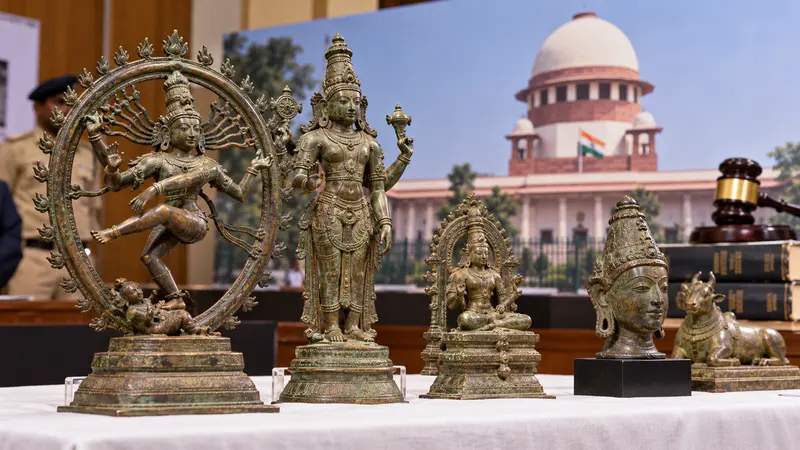
The Supreme Court has stayed an order of the Madras High Court that had directed the Union government to take custody of the antiquities dealer Subash Chandra Kapoor and facilitate his return to Germany. A bench of Justices B.V. Nagarathna and R. Mahadevan passed the interim stay on Tuesday, 27 October, while hearing a special leave petition against the judgment of the Madurai bench of the High Court. The reports do not give the court's reasoning or a date for the next hearing.
The High Court order
On 8 September, the Madras High Court allowed a habeas corpus petition on behalf of Kapoor. It held that his detention could not continue without Germany's consent, and it directed the Union government to take custody of him within two weeks and to proceed in accordance with law to facilitate his return to Germany.
The High Court's reasoning rested on the rule of speciality. That rule, which is a part of extradition law and of the India-Germany extradition treaty, says that a person who is handed over by one country to another for a particular offence may be tried only for that offence, unless the country that handed him over agrees to more. The Ministry of External Affairs had told the High Court that Germany did not consent to the proposed extension of the prosecution to other cases.
The background
Kapoor was extradited from Germany to India on 13 July 2012 in connection with an idol theft case that was registered at the Udayarpalayam police station in Tamil Nadu. He has completed the sentence in that case, but he has remained in custody in other idol theft cases that are pending against him. His detention in those cases was the matter on which the High Court ruled.
Kapoor is widely described as an international dealer in stolen antiquities. Investigations in several countries have linked him to the sale of ancient sculptures taken from temples in India, and the Tamil Nadu cases are about bronze and stone idols that disappeared from temples in the state. The reports available do not list the pending cases or the charges in each.
Who went to the Supreme Court
The special leave petition was filed by S. Vijay Narayanan, a temple devotee, who appears as the next friend of the desecrated deities. In Indian law, an idol has the status of a legal person and can be represented by a person who is responsible for it. By filing on behalf of the deities, the petitioner argues that the interest in trying the cases is that of the temples whose idols were taken.
The Supreme Court's stay applies, according to the reports, to the High Court's direction. Some outlets describe it as halting the Centre's steps to take custody and return him, and others say it stops the High Court's order entirely. The final scope will be clear from the order.
The case raises a point that is of interest outside the idol thefts. When a person is extradited, how far can he be prosecuted for offences other than the one for which he was handed over? The rule protects the person and the surrendering country, and it is meant to keep extradition from being used as a way of trying someone for other things. Against that, the argument for the prosecution is that crimes committed in India should be tried in India, and that a person should not escape trial for them because of the route by which he arrived.

The treaty allows for consent of the surrendering country to be sought for further prosecution, and the Ministry of External Affairs has said that Germany has not given it. The Supreme Court will have to decide whether the High Court was right to treat that as a bar to continued detention, and what it means for the cases that remain.
For the temples, the stay means that the cases can continue while the Supreme Court considers the appeal. Many of the stolen idols have yet to be recovered, and trials are one of the ways in which evidence about the networks of dealers and buyers comes out. For Kapoor, the stay removes, for now, the order that would have sent him back to Germany.
The next step is the hearing of the petition, and the court may ask the Centre and the State of Tamil Nadu to file their positions. The questions will be about the treaty, the status of the pending cases and the length of time Kapoor has been in custody.
P
4 min
What did you think?